
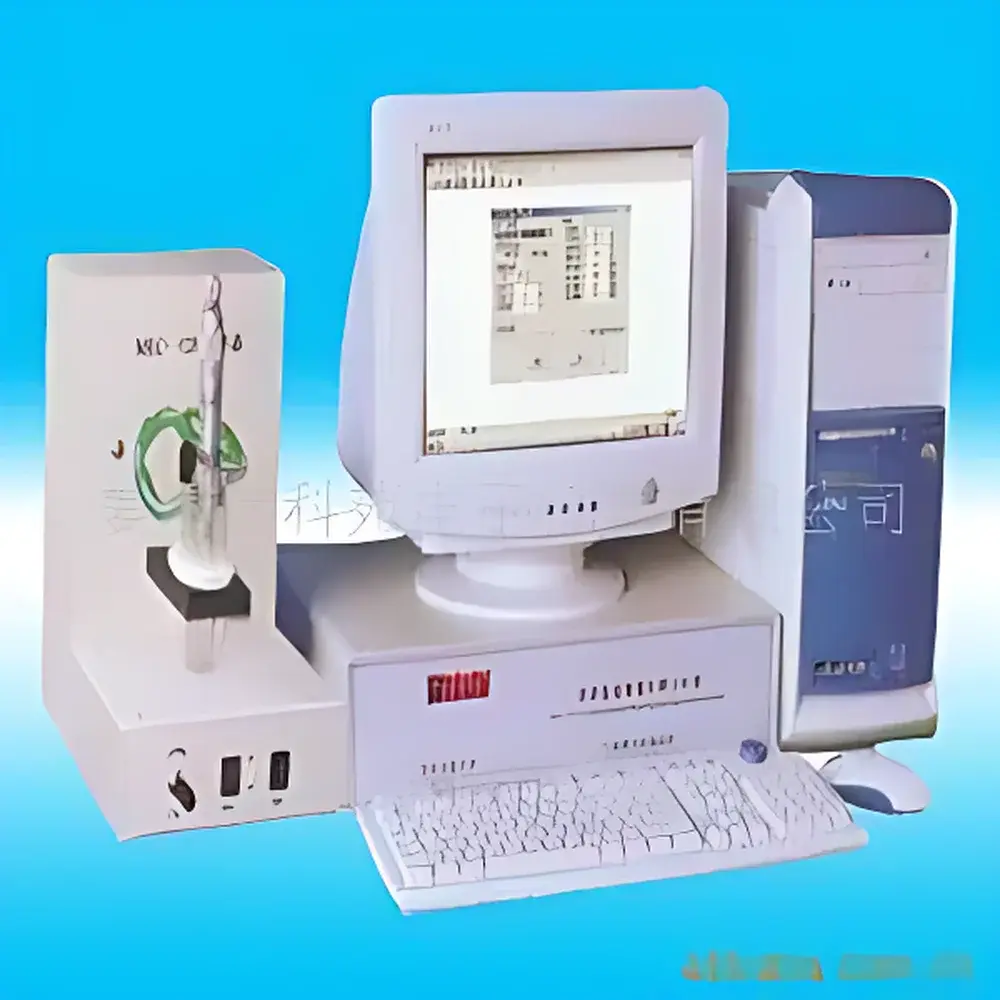
KY-106 Electrochemical Analyzer by Keyuan Instruments
| Brand | Keyuan Instruments |
|---|---|
| Origin | Jiangsu, China |
| Manufacturer Type | Original Equipment Manufacturer (OEM) |
| Country of Origin | China |
| Model | KY-106 |
| Price | USD 7,400 (approx. based on ¥53,000 at 1 USD = ¥7.2) |
| Potential Range | −2.0 to +2.0 V |
| Potential Resolution | < 50 mV (peak separation) |
| Detection Limit | 1 × 10⁻⁷ mol/L |
| Supported Techniques | CV, SCV, LSV, CA, DPV, NPV, NEOP, SWV, i–t, CC |
Overview
The KY-106 Electrochemical Analyzer is a PC-controlled, modular potentiostat/galvanostat system engineered for fundamental electrochemical research and routine analytical applications in academic laboratories, quality control environments, and materials science R&D facilities. Operating on the principle of controlled-potential and controlled-current electroanalysis, the KY-106 implements classical and advanced voltammetric techniques—including cyclic voltammetry (CV), differential pulse voltammetry (DPV), square-wave voltammetry (SWV), and chronocoulometry (CC)—to quantify redox-active species, characterize electrode kinetics, assess electron transfer mechanisms, and evaluate interfacial charge-transfer behavior. Its design adheres to core electrochemical instrumentation standards, supporting three-electrode cell configurations with working, reference, and counter electrodes. While originally developed for Windows 98 compatibility, the system’s architecture permits integration with modern Windows OS via legacy driver support or virtualized runtime environments—enabling continuity in long-term experimental protocols and method validation studies.
Key Features
- Wide potential window of −2.0 V to +2.0 V vs. reference electrode, suitable for aqueous and non-aqueous electrolyte systems.
- Potential resolution optimized for peak discrimination: capable of resolving adjacent redox peaks separated by less than 50 mV under standardized conditions.
- Detection limit of 1 × 10⁻⁷ mol/L for reversible redox couples (e.g., ferricyanide/ferrocyanide) using standard solid electrodes under optimized signal-to-noise conditions.
- Native support for mercury-based electrodes—including static mercury drop electrodes (SMDE) and hanging mercury drop electrodes (HMDE)—as well as carbon, platinum, gold, and modified solid electrodes.
- Integrated digital signal generation and acquisition engine enabling precise waveform timing, current sampling synchronization, and real-time data streaming to host PC memory.
- Modular hardware architecture facilitating future expansion with optional accessories such as electrochemical impedance spectroscopy (EIS) modules or temperature-controlled cell holders.
Sample Compatibility & Compliance
The KY-106 accommodates a broad range of sample matrices including aqueous buffer solutions, organic solvents (e.g., acetonitrile, DMF), ionic liquids, and colloidal suspensions—provided appropriate electrode selection and cell geometry are applied. It supports ASTM E2002-20 (Standard Guide for Electrochemical Measurements in Corrosion Studies), ISO 16773-1:2015 (Electrochemical impedance spectroscopy for corrosion monitoring), and aligns with general principles outlined in USP for electrochemical assay development in pharmaceutical contexts. Although not certified for GMP production environments, its stable baseline performance, reproducible current response (<2% RSD across triplicate scans), and traceable calibration procedures make it suitable for GLP-compliant research documentation and method development reports.
Software & Data Management
The KY-106 operates via proprietary Windows-based software featuring bilingual (Chinese/English) interface toggle, hierarchical menu navigation, and context-sensitive help. All electrochemical methods—including CV, LSV, DPV, SWV, CA, and CC—are implemented with user-adjustable parameters: scan rate (0.01–5 V/s), pulse amplitude (1–100 mV), step potential (0.1–100 mV), and integration time (1 ms–10 s). Raw data are exported in ASCII-delimited format (.txt) compatible with OriginLab, MATLAB, Python (pandas), and Excel for post-acquisition processing. Audit trails are maintained through session log files containing timestamped method settings, instrument status flags, and operator ID fields—supporting basic traceability requirements for internal QA/QC workflows.
Applications
- Quantitative determination of trace heavy metals (e.g., Pb²⁺, Cd²⁺, Zn²⁺) in environmental water samples using anodic stripping voltammetry (ASV) with HMDE.
- Kinetic analysis of heterogeneous electron transfer at modified electrode surfaces, including carbon nanotube- and graphene-enhanced platforms.
- Stability assessment of redox mediators in flow battery electrolytes via repeated CV cycling over 500+ cycles.
- Characterization of corrosion inhibition efficiency of organic compounds on mild steel electrodes in chloride-containing media.
- Electrocatalytic activity screening of transition metal complexes for CO₂ reduction or oxygen evolution reaction (OER).
- Development of disposable screen-printed electrode (SPE) assays for point-of-care biosensing prototypes.
FAQ
Is the KY-106 compatible with modern Windows operating systems (e.g., Windows 10/11)?
Yes—while originally designed for Windows 98, the system can operate under Windows 10/11 via compatibility mode or through a dedicated virtual machine running legacy OS; driver signing exemptions may be required.
Does the instrument support electrochemical impedance spectroscopy (EIS)?
No—EIS functionality is not embedded in the base KY-106 configuration; however, third-party add-on modules or external frequency response analyzers may be interfaced via analog I/O ports.
Can I use this analyzer for biological redox protein studies?
Yes—when coupled with low-noise Faraday cages, temperature-controlled cells, and appropriate biomolecule-compatible electrodes (e.g., Au or pyrolytic graphite edge), the KY-106 supports direct electron transfer studies of cytochrome c, myoglobin, and laccase.
What electrode types are validated for use with the KY-106?
Validated configurations include static mercury drop electrodes (SMDE), hanging mercury drop electrodes (HMDE), glassy carbon, platinum disk, gold wire, and screen-printed carbon electrodes—all requiring proper electrical shielding and cable grounding.
Is calibration traceable to NIST or other national standards?
The KY-106 does not include built-in NIST-traceable calibration; users are advised to perform external verification using certified redox standards (e.g., K₃[Fe(CN)₆]/K₄[Fe(CN)₆] in 0.1 M KCl) and reference electrodes certified per ISO 8583.





