
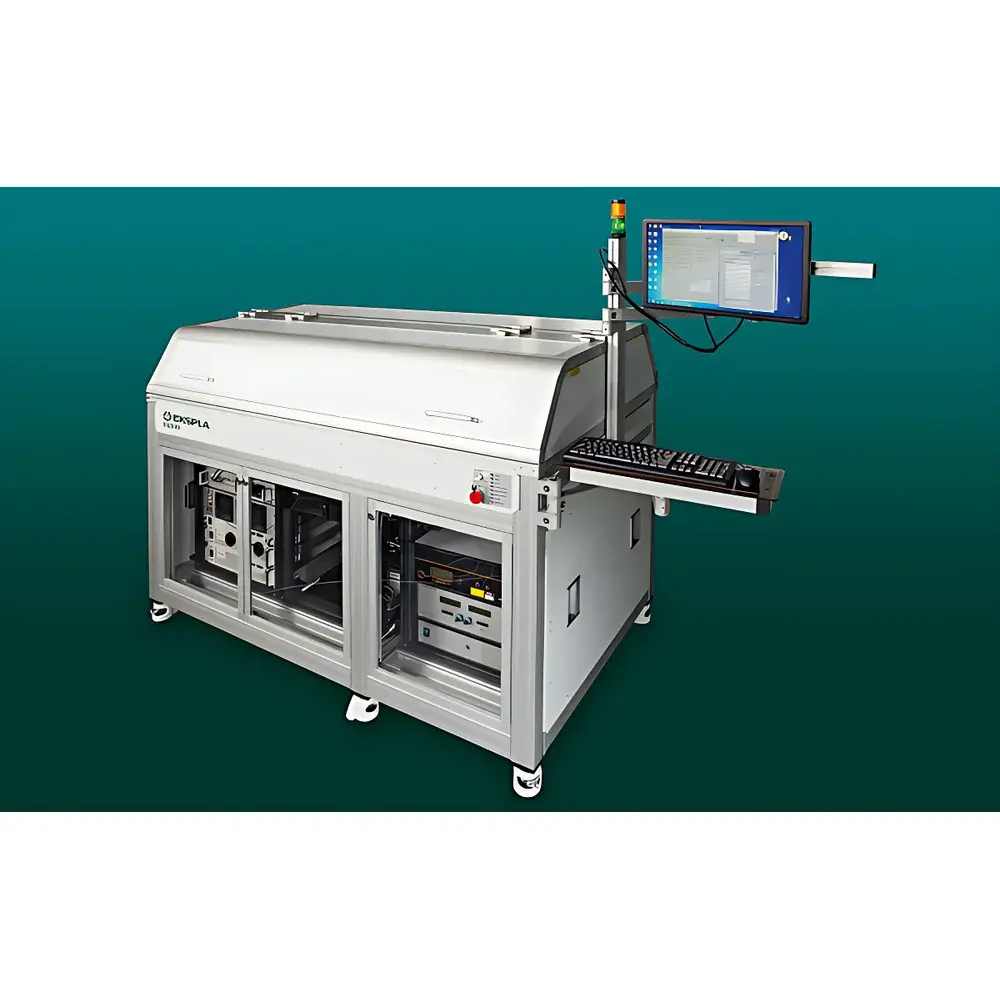
NL941 Time-Programmable DPSS Nanosecond Laser System
| Brand | Ekspla |
|---|---|
| Model | NL941 |
| Wavelength | 1064 nm |
| Max Pulse Energy | 2 J |
| Pulse Width | 5 ns (FWHM) |
| Repetition Rate | Up to 20 kHz (burst mode) |
| Beam Profile | Top-Hat (Flat-Top) Spatial Distribution |
| Pumping | Diode-Pumped Solid-State (DPSS) |
| Control Interface | Arbitrary Waveform Generator (AWG)-Driven Electro-Optic Modulator (EOM) for Temporal Pulse Shaping |
| Footprint | ≤ 1 m × 2 m |
| Compliance | CE, RoHS, IEC 60825-1:2014 Class 4 Laser Product |
Overview
The NL941 is a high-energy, diode-pumped solid-state (DPSS) nanosecond laser system engineered for precision temporal pulse control in demanding scientific and industrial applications. Operating at the fundamental wavelength of 1064 nm, it delivers up to 2 J per pulse with a nominal pulse duration of 5 ns (FWHM), optimized for high peak power and excellent temporal stability. Unlike conventional Q-switched lasers with fixed temporal envelopes, the NL941 integrates an arbitrary waveform generator (AWG)-driven electro-optic modulator (EOM) directly into the cavity or beam path—enabling real-time, user-defined time-domain pulse shaping. This capability supports complex pulse sequences such as burst-mode operation (e.g., 30 pulses at 1 kHz or 4 pulses at 20 kHz within a 20 s window), tailored leading/trailing edge profiles, and amplitude-modulated pulse trains. Its top-hat spatial beam distribution ensures uniform energy deposition across target areas—critical for applications requiring consistent fluence thresholds, including laser-induced damage threshold (LIDT) testing, plasma generation, and pump-probe spectroscopy.
Key Features
- Diode-pumped solid-state architecture delivering high optical-to-optical efficiency and long-term operational stability
- Programmable temporal pulse shaping via AWG-synchronized electro-optic modulation—enabling sub-nanosecond timing resolution and arbitrary intensity vs. time profiles
- Burst-mode flexibility: configurable pulse count (1–30), intra-burst repetition rate (1–20 kHz), and inter-burst delay (ms to seconds)
- Top-hat (flat-top) spatial beam profile with M² < 1.3, minimizing hot spots and maximizing irradiance uniformity
- Compact mechanical footprint (≤ 1 m × 2 m), designed for integration into optical tables, vacuum chambers, or OEM laser processing stations
- Integrated thermal management and vibration-damped laser head housing for low pointing instability (< 5 µrad/°C) and shot-to-shot energy stability (≤ ±1.5% RMS over 1 h)
Sample Compatibility & Compliance
The NL941 is compatible with standard optical mounts (e.g., kinematic mirror mounts, translation stages) and interfaces seamlessly with ultrafast diagnostics (streak cameras, photodiodes with GHz bandwidth, autocorrelators). It meets international laser safety standards per IEC 60825-1:2014 (Class 4), includes interlocked shutter control, key-switched enable circuitry, and embedded emission indicators. All firmware and hardware design adhere to CE marking requirements and RoHS Directive 2011/65/EU. While not inherently GLP/GMP-certified, its deterministic pulse timing, audit-trail-capable internal logging (via RS232/Ethernet), and repeatable energy calibration support integration into ISO/IEC 17025-accredited laboratories and FDA-regulated R&D workflows where traceable laser parameter documentation is required.
Software & Data Management
Control is executed through Ekspla’s proprietary LaserStudio software suite (Windows-based), supporting full remote configuration of burst parameters, pulse shape templates, energy monitoring, and real-time oscilloscope-style waveform visualization. The system exports timestamped pulse energy logs (CSV), AWG waveform definitions (.awg binary), and diagnostic telemetry (cavity temperature, diode current, Q-switch status) via TCP/IP or USB 2.0. An optional SDK (C/C++, Python bindings) enables integration with LabVIEW, MATLAB, or custom automation platforms—facilitating synchronization with motion controllers, spectrometers, or data acquisition systems under IEEE 1588 PTP or NTP time stamping. All parameter changes are logged with user ID, timestamp, and pre/post values—supporting 21 CFR Part 11-compliant electronic record retention when deployed on validated IT infrastructure.
Applications
- Laser-induced breakdown spectroscopy (LIBS) requiring controlled pulse trains for plasma reheating and signal enhancement
- Pump-probe experiments in ultrafast physics, where precisely delayed, shaped pump pulses excite coherent phonons or spin states
- Calibration of high-speed photodetectors and streak cameras using programmable rise/fall times and multi-pulse sequences
- LIDT testing of optical coatings and substrates under non-uniform temporal loading conditions
- OEM integration into laser cleaning, surface texturing, and thin-film ablation systems requiring spatiotemporal fluence control
- Development of adaptive laser ignition sources for combustion research and detonation physics
FAQ
What pulse shapes can be generated with the NL941?
User-defined waveforms—including square, ramp, Gaussian, double-pulse, and custom shapes—are synthesized via the AWG-driven EOM, limited only by the 5 ns base pulse width and EOM bandwidth (~100 MHz small-signal modulation depth).
Is external triggering supported?
Yes—TTL-compatible external trigger input (positive/negative edge selectable) enables synchronization with third-party equipment with jitter < 2 ns RMS.
Can the NL941 operate continuously at 20 kHz?
No—20 kHz operation is restricted to short bursts (e.g., 4 pulses) due to thermal load constraints; sustained repetition rates are rated up to 1 kHz for full-energy output.
Does the system include beam delivery optics?
The NL941 laser head outputs collimated 1064 nm radiation; beam expansion, harmonic generation, or focusing optics are available as optional accessories or custom OEM modules.
How is pulse energy calibrated and maintained?
An integrated pyroelectric sensor with NIST-traceable calibration certificate is factory-installed; users may perform in situ energy verification and apply correction factors via LaserStudio’s calibration utility.



