
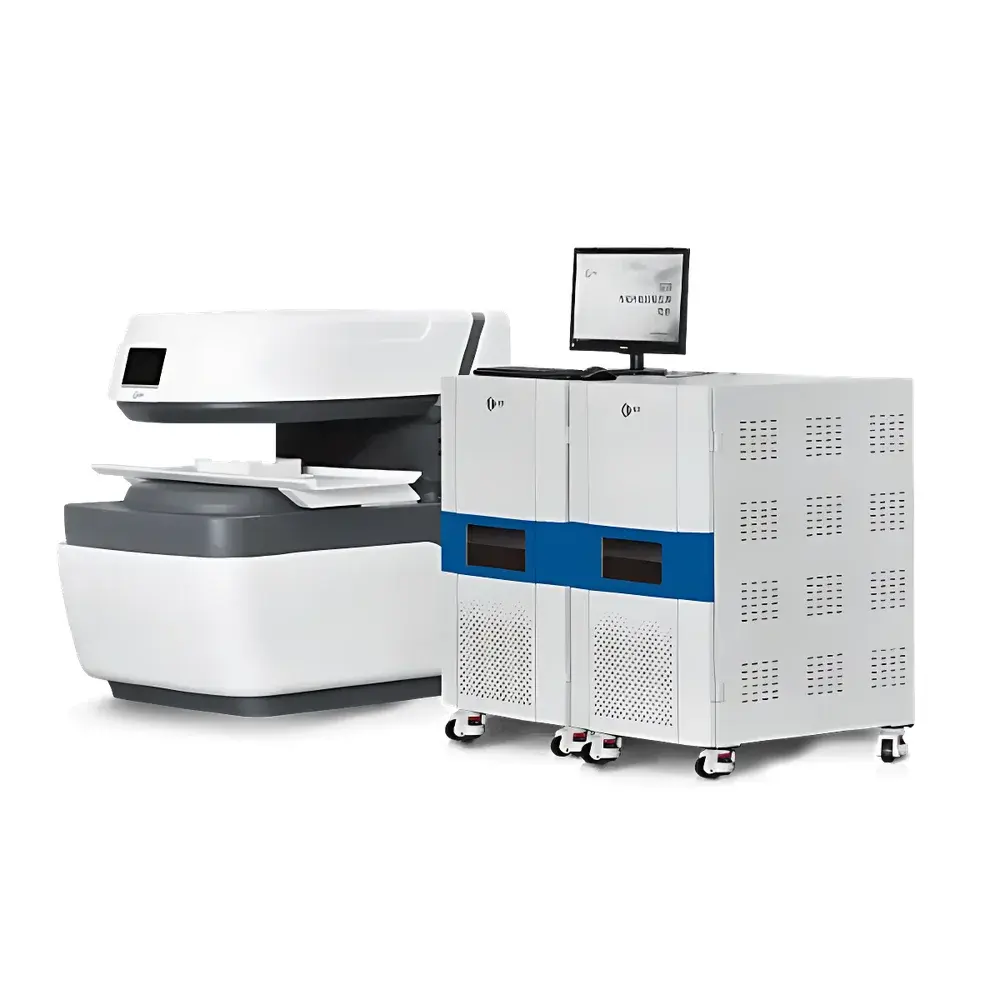
NIUMAG MacroMR12-150H-4 Large-Bore Low-Field Nuclear Magnetic Resonance Imaging System
| Brand | NIUMAG |
|---|---|
| Origin | Jiangsu, China |
| Manufacturer Type | Authorized Distributor |
| Origin Category | Domestic |
| Model | MacroMR12-150H-4 |
| Instrument Type | Low-Field NMR Analyzer |
| Sample Type | Solid-Liquid Combined |
| Magnetic Field Strength | 0.3 T ± 0.03 T |
| Magnet Homogeneity | ≤50 ppm |
| Magnet Configuration | C-Type Open Design |
| Sample Access | Horizontal and Vertical |
| Maximum Sample Diameter | 4 inches (101.6 mm) |
Overview
The NIUMAG MacroMR12-150H-4 is a large-bore, low-field nuclear magnetic resonance (NMR) imaging system engineered for non-invasive, quantitative characterization of geological and construction materials under near-native conditions. Operating at a static magnetic field of 0.3 T, it leverages the intrinsic sensitivity of 1H nuclei to detect and differentiate fluid phases—including free water, bound water, oil, and gas—within porous media without sample destruction. Its fundamental measurement principle relies on spin-echo-based relaxation time analysis (T1, T2) and spatially resolved NMR imaging (MRI), enabling simultaneous acquisition of relaxation spectra and 2D/3D proton density–weighted, T1-weighted, or T2-weighted images. The C-type open magnet architecture accommodates full-diameter rock cores up to 4 inches (101.6 mm), eliminating size-related sampling bias and supporting in-situ, multi-parameter experiments under controlled temperature, pressure, and fluid flow environments.
Key Features
- C-type open magnet design with dual-axis (horizontal and vertical) sample access, optimized for rapid loading/unloading of oversized geological specimens including intact core plugs, engineered soil columns, and cementitious monoliths.
- High-stability, temperature-regulated RF probe with integrated gradient coils, delivering consistent signal-to-noise ratio (SNR) and spatial resolution across extended acquisition windows required for T2 decay curve fitting and diffusion-weighted imaging.
- Modular hardware interface supporting optional environmental chambers, triaxial stress cells, pore-pressure controllers, and fluid injection manifolds—enabling true multi-physics coupling (thermo-hydro-mechanical-chemical, THMC).
- Pre-calibrated pulse sequences for standardized NMR measurements, including inversion-recovery (T1), Carr–Purcell–Meiboom–Gill (CPMG, T2), stimulated echo (D-T2), and single-point imaging (SPI) protocols compliant with ASTM D7264 and ISO 10427 guidelines for porous media analysis.
- Robust mechanical housing and active shimming system ensure long-term field stability (<±0.03 T drift over 72 h), critical for longitudinal studies involving creep, hydration, or phase transition monitoring.
Sample Compatibility & Compliance
The MacroMR12-150H-4 accepts heterogeneous, irregular, and high-permittivity samples commonly encountered in geoscience and civil engineering laboratories—including sandstone, shale, coal, concrete, asphalt, frozen soils, and polymer-modified composites. Its large bore eliminates the need for core sectioning, preserving structural integrity and interfacial continuity essential for accurate saturation profiling and damage evolution tracking. All data acquisition and processing workflows adhere to GLP-compliant documentation standards, with audit-trail-enabled software supporting 21 CFR Part 11 requirements for electronic records and signatures. Calibration certificates traceable to NIST standards are provided for magnetic field strength, temperature control, and RF power output.
Software & Data Management
The system runs on NIUMAG’s proprietary NMI-Studio v5.x platform, a Windows-based application featuring intuitive workflow-driven experiment setup, real-time spectral preview, automated baseline correction, and inverse Laplace transform (ILT) processing for T2 distribution deconvolution. Raw FID and k-space datasets are stored in vendor-neutral HDF5 format, ensuring compatibility with third-party analysis tools such as MATLAB, Python (NumPy/SciPy), and Bruker TopSpin. Integrated database management supports metadata tagging (sample ID, environmental conditions, operator, timestamp), version-controlled processing scripts, and batch export to LIMS-compatible CSV or XML schemas. Remote monitoring and scheduled acquisitions are enabled via secure TLS-encrypted API endpoints.
Applications
- Reservoir Characterization: Porosity quantification, pore-size distribution mapping, movable/immobile fluid saturation, relative permeability estimation, wettability assessment via spontaneous imbibition T2 contrast.
- Enhanced Oil Recovery (EOR) Monitoring: Real-time visualization of polymer flood front propagation, surfactant-induced wettability alteration, and CO2 miscible displacement dynamics under elevated P/T.
- Unconventional Resource Evaluation: Isothermal adsorption/desorption kinetics of CH4 and CO2 in shale matrix, hydrate nucleation/growth inhibition studies, supercritical CO2 fracturing efficiency validation.
- Geomechanical Damage Analysis: Non-destructive tracking of microcrack initiation and coalescence during triaxial compression, thermal cycling, freeze-thaw cycling, or chemical corrosion exposure.
- Cementitious Materials Science: Hydration degree mapping, capillary water migration kinetics, carbonation front progression, and chloride ingress profiling via longitudinal relaxometry.
- Soil Physics & Cryosphere Studies: Unfrozen water content quantification in permafrost, soil moisture redistribution under evapotranspiration gradients, and microwave-assisted thawing mechanism validation.
FAQ
What sample sizes can the MacroMR12-150H-4 accommodate?
It supports cylindrical samples up to 4 inches (101.6 mm) in diameter and 150 mm in length, with standard holders for 1″, 1.5″, 2″, 2.5″, and 4″ core diameters.
Is the system capable of quantitative T2 distribution analysis?
Yes—equipped with CPMG-based acquisition and built-in regularization algorithms for robust, noise-resistant T2 spectrum inversion using non-negative least squares (NNLS) and maximum entropy methods.
Can temperature and pressure be controlled during NMR measurement?
Yes—when paired with optional environmental modules, the system supports temperature ranges from –40 °C to +120 °C and confining pressures up to 70 MPa, with real-time sensor feedback synchronized to NMR acquisition triggers.
Does the software support compliance with regulatory data integrity standards?
Yes—NMI-Studio implements full 21 CFR Part 11 functionality, including user role management, electronic signatures, immutable audit trails, and encrypted raw data archiving.
How is calibration maintained across extended operational periods?
The system includes automated daily field homogeneity checks, RF power calibration routines, and reference phantom-based SNR validation; all logs are archived and exportable for internal QA audits.





