
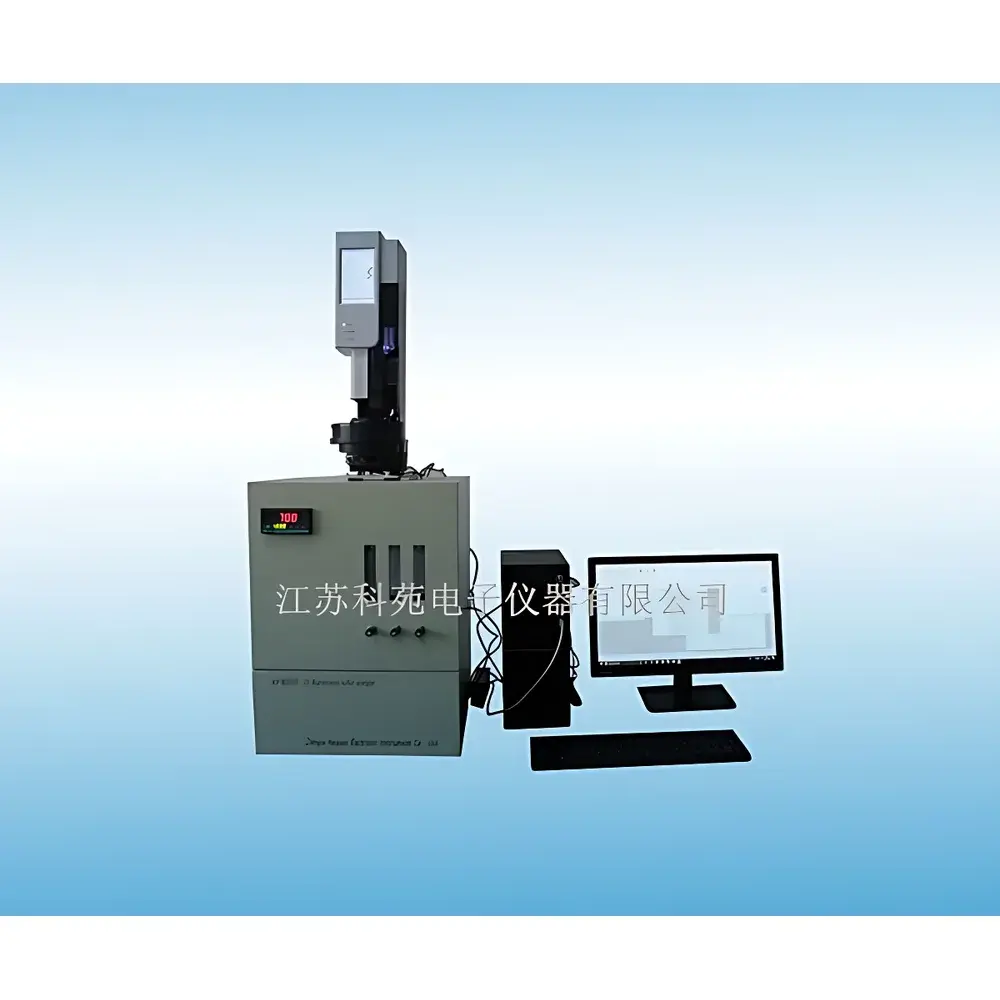
KY-3000S UV-Fluorescence Sulfur Analyzer by Keyuan Instruments
| Brand | Keyuan Instruments |
|---|---|
| Origin | Jiangsu, China |
| Manufacturer Type | Direct Manufacturer |
| Country of Origin | China |
| Model | KY-3000S A |
| Detection Principle | UV Fluorescence (ASTM D5453, ISO 20846, UOP 971) |
| Sample Forms | Liquid, Solid, Gas (with optional dedicated injectors) |
| Sulfur Measurement Range | 0.2 mg/L to 100% w/w |
| LOD | 0.2 mg/L (as S) |
| Furnace Temperature Range | Ambient to 1100 °C |
| Temperature Control Accuracy | ±0.5% of setpoint or ±3 °C (whichever is greater) |
| Carrier Gas | High-purity Argon (≥99.98%) and Oxygen (≥99.98%) |
| Power Consumption | 2 kW |
| Dimensions (L×W×H) | 680 × 480 × ~520 mm |
| Data Acquisition | 24-bit ADC, USB 2.0 interface, minimum detectable signal < 1 µV |
| PMT Voltage | Adjustable, software-controlled |
| Calibration Options | Single-point or multi-point calibration using certified SRMs |
| Software Compatibility | Windows 10/11, 64-bit |
Overview
The KY-3000S UV-Fluorescence Sulfur Analyzer is a laboratory-grade elemental sulfur analyzer engineered for high-precision quantification of total sulfur in hydrocarbon matrices and related industrial materials. It operates on the well-established ultraviolet fluorescence detection principle: samples are combusted in a high-temperature quartz furnace under controlled oxygen-rich conditions, converting all sulfur species (e.g., thiophenes, sulfides, mercaptans, sulfate salts) into excited-state SO2 molecules. Upon relaxation, SO2 emits characteristic UV photons at ~320 nm, which are detected by a low-noise photomultiplier tube (PMT). Signal intensity is linearly proportional to sulfur mass flow rate, enabling trace-to-percent-level quantification without compound-specific response factors. This method is fully compliant with major international standards including ASTM D5453 (petroleum products), ISO 20846 (gasoline), UOP 971 (middle distillates), and GB/T 11140 (Chinese national standard). The instrument is widely deployed in coal preparation labs, refinery QC/QA departments, petrochemical R&D centers, and third-party testing laboratories requiring regulatory-grade sulfur data.
Key Features
- High-stability quartz combustion furnace with programmable temperature control from ambient to 1100 °C, ensuring complete oxidation of refractory sulfur compounds in coal-derived liquids, heavy fuel oils, and solid coke samples.
- Optimized gas flow management system with dual high-purity gas lines (Ar + O2) and real-time pressure monitoring to maintain stoichiometric combustion and minimize quenching effects on fluorescence yield.
- Low-noise, thermoelectrically cooled photomultiplier tube with digitally adjustable high-voltage supply (0–1000 V), enabling dynamic optimization of signal-to-noise ratio across wide concentration ranges.
- 24-bit analog-to-digital conversion and USB 2.0 interface ensure high-resolution spectral capture and deterministic data transfer—critical for GLP-compliant reporting and long-term method validation.
- Modular injector design supports interchangeable sampling modules: liquid autosampler (10 µL–100 µL), solid sample boat loader (for pulverized coal or catalysts), and gas loop injection (for LPG, natural gas, or refinery off-gas).
- Firmware and software architecture support full audit trail logging, user access levels, electronic signatures, and 21 CFR Part 11 compliance packages for regulated environments.
Sample Compatibility & Compliance
The KY-3000S accommodates diverse sample types relevant to coal utilization and downstream refining processes. Liquid samples include coal tar, phenol oil, wash oil, and desulfurized diesel; solids include pulverized bituminous coal, activated carbon, and spent hydrotreating catalysts; gases include synthesis gas (syngas) and coal gasification effluents. All analyses adhere to strict quality assurance protocols aligned with ISO/IEC 17025 requirements. Method validation documentation—including precision (RSD ≤ 2.5% at 10 mg/L S), linearity (r² ≥ 0.9998 over 0.2–500 mg/L), and recovery (98–102% using NIST SRM 2724b)—is provided with each system. The analyzer meets CE marking requirements and conforms to IEC 61000-6-3 (EMC) and IEC 61010-1 (safety) standards.
Software & Data Management
The proprietary Keyuan Analytical Suite v4.x provides intuitive workflow-driven operation—from method setup and calibration curve generation to real-time chromatogram visualization and automated report export (PDF, CSV, XML). Calibration supports both single-point bracketing and multi-point weighted linear regression using certified reference materials traceable to NIST or LGC. All raw detector signals, furnace thermocouple logs, gas pressure traces, and user actions are timestamped and stored in an encrypted SQLite database. Optional 21 CFR Part 11 configuration enables role-based permissions, electronic signature capture, and immutable audit trails—fully auditable during FDA, CNAS, or internal GMP audits. Data can be exported directly to LIMS via ASTM E1384-compliant interfaces or scheduled FTP/SFTP transfers.
Applications
- Quantitative sulfur speciation screening in coal liquefaction products and direct coal-derived liquids per ASTM D7169.
- Monitoring sulfur removal efficiency in coal-fired power plant flue gas desulfurization (FGD) slurries and gypsum by-products.
- QC testing of low-sulfur marine fuels (IMO 2020 compliant) and pipeline specification verification for coal-to-liquids (CTL) transportation.
- Research on sulfur retention mechanisms in fluidized bed coal combustion and sorbent performance evaluation (e.g., limestone, dolomite).
- Trace sulfur analysis in coal-based carbon materials used in battery anodes or supercapacitors, where residual sulfur degrades electrochemical stability.
FAQ
What sulfur species does the KY-3000S detect?
It measures total sulfur—regardless of chemical form—including organic sulfides, thiophenes, sulfoxides, sulfones, elemental sulfur, sulfates, and inorganic sulfides. No species-specific calibration is required.
Can the instrument analyze powdered coal directly?
Yes, using the optional solid sample introduction module with ceramic boats and programmable ash correction routines to compensate for matrix-induced combustion interference.
Is routine maintenance complex?
Routine tasks include quartz reactor cleaning every 200–300 injections, PMT window inspection, and gas filter replacement every 6 months—documented in the included GLP-maintained service logbook.
How is system performance verified between calibrations?
Daily system suitability testing is performed using a mid-range check standard; drift tolerance is set to ±3% relative to initial calibration—exceeding this triggers automatic recalibration prompts.
Does the software support multi-user network deployment?
Yes, the client-server edition supports concurrent access from up to 16 workstations with centralized database hosting and role-based method libraries.





