
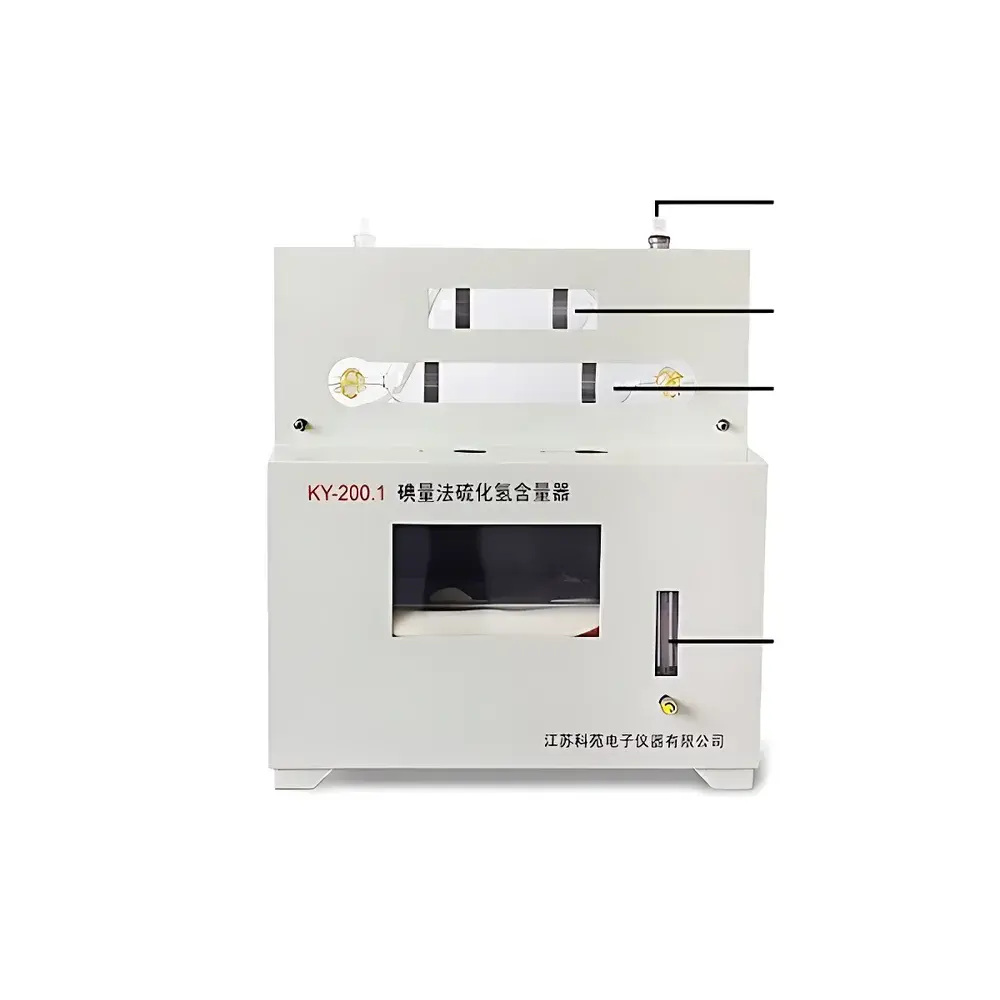
KY-200.1 Iodometric Hydrogen Sulfide Analyzer
| Brand | Keyuan Instruments |
|---|---|
| Origin | Jiangsu, China |
| Manufacturer Type | Direct Manufacturer |
| Origin Category | Domestic (China) |
| Model | KY-200.1 |
| Pricing | Available Upon Request |
Overview
The KY-200.1 Iodometric Hydrogen Sulfide Analyzer is a dedicated benchtop analytical system engineered for the precise, trace-to-high-concentration quantification of hydrogen sulfide (H₂S) in natural gas streams. It implements the classical iodometric titration method—standardized under ASTM D4084, ISO 8573-5, and GB/T 13610—based on stoichiometric redox chemistry. In this method, gaseous H₂S is first captured quantitatively via absorption into an excess of zinc acetate solution, forming insoluble zinc sulfide (ZnS) precipitate. Subsequently, the ZnS is oxidized by a known excess of standardized iodine (I₂) solution. The unreacted iodine is then back-titrated with sodium thiosulfate (Na₂S₂O₃) using starch indicator, enabling calculation of H₂S concentration from the iodine consumption. This gravimetrically anchored wet chemical approach delivers high reproducibility (<2% RSD at ≥10 ppmv), robustness against matrix interferences (e.g., CO₂, hydrocarbons), and full compliance with field-deployable sampling protocols requiring on-site absorption.
Key Features
- Field-compatible absorption train design: Integrated gas sampling valve, impinger manifold, and calibrated gas syringe enable quantitative H₂S capture directly at the point of extraction—minimizing analyte loss or oxidation prior to analysis.
- Dual-range volumetric precision: Supports sample volumes from 5 mL to 15,000 mL (adjustable per expected H₂S concentration), ensuring optimal stoichiometric excess across the full 0–99.9% v/v measurement range.
- Standardized reagent handling: Pre-calibrated iodine and sodium thiosulfate titrants supplied with certified molarity (±0.1% uncertainty); all glassware conforms to ISO 648 and ISO 1042 for Class A volumetric accuracy.
- Modular titration station: Includes magnetic stirrer, burette clamp, white ceramic titration tile, and digital burette reader (0.01 mL resolution) to reduce endpoint misjudgment and support GLP-compliant manual titration records.
- Trace contamination control: All wetted components are borosilicate glass or PTFE-lined; zinc acetate solution is prepared under nitrogen-purged conditions to prevent aerial oxidation of Zn²⁺ and ensure complete H₂S precipitation.
Sample Compatibility & Compliance
The KY-200.1 is validated for natural gas matrices meeting ISO 8573-1 purity classes 2–4, including sour gas containing up to 10,000 ppmv total sulfur compounds. It excludes interference from mercaptans, COS, and elemental sulfur under standard operating conditions due to selective ZnS formation kinetics and pH-controlled absorption (pH 4.5–5.5). The methodology satisfies mandatory reporting requirements under China’s GB 17820-2018 (Natural Gas Quality Standard) and supports audit-ready documentation per ISO/IEC 17025:2017 clause 7.8 (Reporting of Results). Full traceability is maintained through batch-certified reagents, NIST-traceable volumetric glassware calibration certificates, and operator-signed analysis worksheets.
Software & Data Management
While the KY-200.1 operates as a manual wet-chemistry platform, it integrates seamlessly with laboratory information management systems (LIMS) via optional digital data capture modules. An accompanying Excel-based Calculation Template (v2.1) automates stoichiometric conversion from titrant volume to H₂S concentration in % v/v, mg/m³ (at 20 °C, 101.325 kPa), and ppmv—applying temperature/pressure correction per ISO 6976. All calculation logic is transparent, auditable, and fully editable. For regulated environments, the template supports 21 CFR Part 11-compliant electronic signatures when deployed on validated Windows OS platforms with controlled access and change logs.
Applications
- Upstream gas processing: Quantitative H₂S verification pre-amine treatment and post-scavenger injection.
- Transmission pipeline monitoring: Batch-wise quality assurance per contractual H₂S limits (e.g., ≤4 ppmv for Class A gas).
- Biogas upgrading facilities: Monitoring H₂S removal efficiency across iron sponge or activated carbon beds.
- Calibration reference generation: Preparation of certified H₂S reference gases via gravimetric dilution for FTIR or electrochemical sensor validation.
- Educational laboratories: Teaching fundamental redox stoichiometry, gas absorption kinetics, and ISO-compliant analytical protocol execution.
FAQ
Is the KY-200.1 suitable for continuous online monitoring?
No—it is designed exclusively for discrete, grab-sample analysis requiring manual operator intervention at each stage.
Can it measure H₂S in liquefied petroleum gas (LPG) or propane?
Not without modification: The absorption system is optimized for gaseous-phase sampling at ambient pressure; vapor-phase LPG analysis requires specialized pressure-rated impingers and phase-separation traps.
What is the minimum detectable concentration?
At 15,000 mL sample volume and 0.01 M Na₂S₂O₃ titrant, the practical LOD is 0.0003% v/v (≈4.3 mg/m³) with ±5% expanded uncertainty (k=2).
Are replacement reagents and certified standards available?
Yes—Keyuan Instruments supplies zinc acetate dihydrate (≥99.9%), potassium iodide (ACS grade), and sodium thiosulfate pentahydrate (certified primary standard), all with CoA and lot-specific molarity statements.
Does the system meet explosion-proof requirements for field use?
The analyzer itself contains no electrical components; however, field deployment requires coordination with zone-rated sampling pumps and static-dissipative tubing per IEC 60079-10-1 for hazardous area classification.
Related Products





