
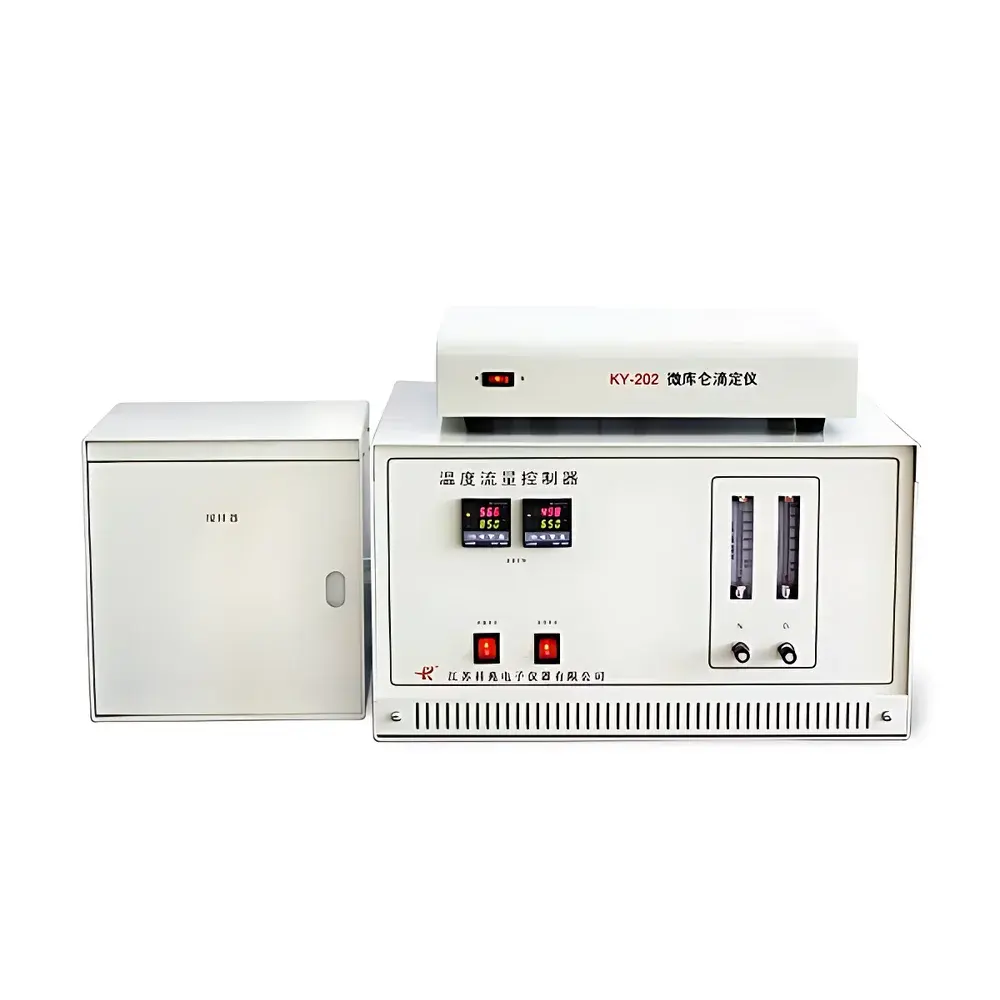
Kyoyuan KY-200 Microcoulometric Sulfur and Chlorine Analyzer
| Brand | Kyoyuan Instruments |
|---|---|
| Origin | Jiangsu, China |
| Manufacturer Type | Manufacturer |
| Regional Classification | Domestic (China) |
| Model | KY-200 |
| Pricing | Upon Request |
| Principle | Microcoulometric Titration (ASTM D5808 / SH/T 0253 / GB/T 11061.4) |
| Sample Forms | Liquid, Solid, Gas (with optional injectors) |
| Detection Range | S: 0.1–10,000 mg/L |
| Cl | 0.1–10,000 mg/L |
| LOD | 0.1 mg/L (S and Cl) |
| Repeatability | CV ≤3% for [S] >10 mg/L |
| Temperature Control | Ambient to 1100 °C, ±1 °C |
| Carrier Gases | Industrial-grade N₂ and O₂ |
| Cooling | Fan-cooled pyrolysis furnace (auto-start/stop) |
| Compliance | ASTM D5808, SH/T 0253, GB/T 11061.4, SH/T 0222, GB/T 3208, GB/T 18612 |
Overview
The Kyoyuan KY-200 Microcoulometric Sulfur and Chlorine Analyzer is a fully automated elemental analyzer engineered for trace-level quantification of total sulfur and total chlorine in hydrocarbon-based matrices using the principle of controlled-potential microcoulometric titration. In operation, samples—liquid, solid, or gaseous—are introduced into a high-temperature quartz combustion tube (up to 1100 °C) under a precisely regulated flow of nitrogen and oxygen. Organic and inorganic sulfur species are quantitatively converted to SO₂; chlorine-containing compounds are converted to HCl. The gaseous effluent is swept into a dual-mode titration cell where electrochemical generation of titrant occurs: iodine (I₂) for sulfur determination, and silver ions (Ag⁺) for chlorine analysis. The charge consumed during electrolysis is measured in real time by the integrated microprocessor, and analyte concentration is calculated directly via Faraday’s law of electrolysis. This method delivers stoichiometric accuracy without reliance on calibration curves, ensuring inherent traceability and long-term measurement stability.
Key Features
- True dual-analyte capability: simultaneous or independent sulfur and chlorine quantification in a single instrument platform.
- Digital microcoulometric control architecture with embedded PID temperature regulation (±1 °C) across the full 25–1100 °C range.
- Automated sample introduction via programmable liquid autosampler; optional solid and gas sampling modules available for heterogeneous sample workflows.
- Fan-cooled pyrolysis system with intelligent thermal management—fans activate only when required, minimizing energy use and extending component life.
- Modular titration cell design featuring corrosion-resistant electrodes and optimized electrolyte circulation for low carryover and high reproducibility.
- Comprehensive onboard diagnostics including real-time voltage/current monitoring, cell impedance tracking, and automatic baseline stabilization.
Sample Compatibility & Compliance
The KY-200 supports analysis of diverse sample types—including gasoline, diesel, jet fuel, naphtha, lubricants, LPG, natural gas condensates, crude oil, and petrochemical intermediates—as well as environmental extracts and polymer additives. Its performance aligns with internationally recognized standard methods: ASTM D5808 (organic chloride in aromatics), SH/T 0253 (total sulfur in light petroleum products), GB/T 11061.4 (total sulfur in natural gas), SH/T 0222 (LPG sulfur), GB/T 3208 (sulfur in benzene), and GB/T 18612 (organic chlorine in crude oil). The system meets GLP data integrity requirements through timestamped audit trails, user-access controls, and non-erasable raw signal storage—facilitating compliance with regulatory frameworks including ISO/IEC 17025 and FDA 21 CFR Part 11 when configured with validated software.
Software & Data Management
The KY-200 operates under Kyoyuan’s proprietary analytical software suite, providing full instrument control, real-time parameter visualization, and automated report generation. All acquisition parameters—including temperature ramp profiles, gas flow rates, electrolysis thresholds, and integration windows—are configurable and stored with each analysis. Raw current vs. time traces are archived alongside final concentration results, enabling retrospective reprocessing and uncertainty evaluation. Data export is supported in CSV, PDF, and XML formats compatible with LIMS integration. Software validation documentation (IQ/OQ protocols) and electronic signature functionality are available upon request to support regulated laboratory environments.
Applications
This analyzer serves critical quality control and research functions across upstream, midstream, and downstream sectors. Refineries deploy it for feedstock screening and product certification against sulfur limits (e.g., ultra-low-sulfur diesel <10 ppm). Petrochemical labs use it to monitor catalyst poisoning risks from chloride contamination in ethylene cracker feeds. Environmental testing laboratories apply it to quantify halogenated contaminants in soil leachates and wastewater per EPA Method 9056A adaptations. Academic and R&D institutions leverage its high sensitivity (0.1 mg/L LOD) and wide dynamic range (0.1–10,000 mg/L) for method development in speciation studies, oxidation kinetics, and catalyst deactivation modeling.
FAQ
What sample forms can be analyzed without modification?
Liquid samples (e.g., fuels, solvents) are supported out-of-the-box using the standard syringe-based liquid autosampler.
Is calibration required before each analysis?
No—microcoulometric analysis is absolute (Faraday-based); calibration is performed only during initial system qualification or after major maintenance using certified reference materials (e.g., dibutyl sulfide, chlorobenzene).
Can the same titration cell be used for both sulfur and chlorine measurements?
Yes—the dual-mode cell is field-reconfigurable via software-selectable electrolyte and electrode settings; no hardware swap is needed.
What maintenance intervals are recommended for routine operation?
Quartz combustion tube inspection every 500 injections; electrolyte replacement every 72 hours of cumulative run time; annual verification of temperature sensor accuracy and gas flow calibration.
Does the system support unattended overnight operation?
Yes—full sequence programming, auto-shutdown after completion, and alarm-triggered pause/resume ensure robust 24/7 batch processing capability.
Related Products




