
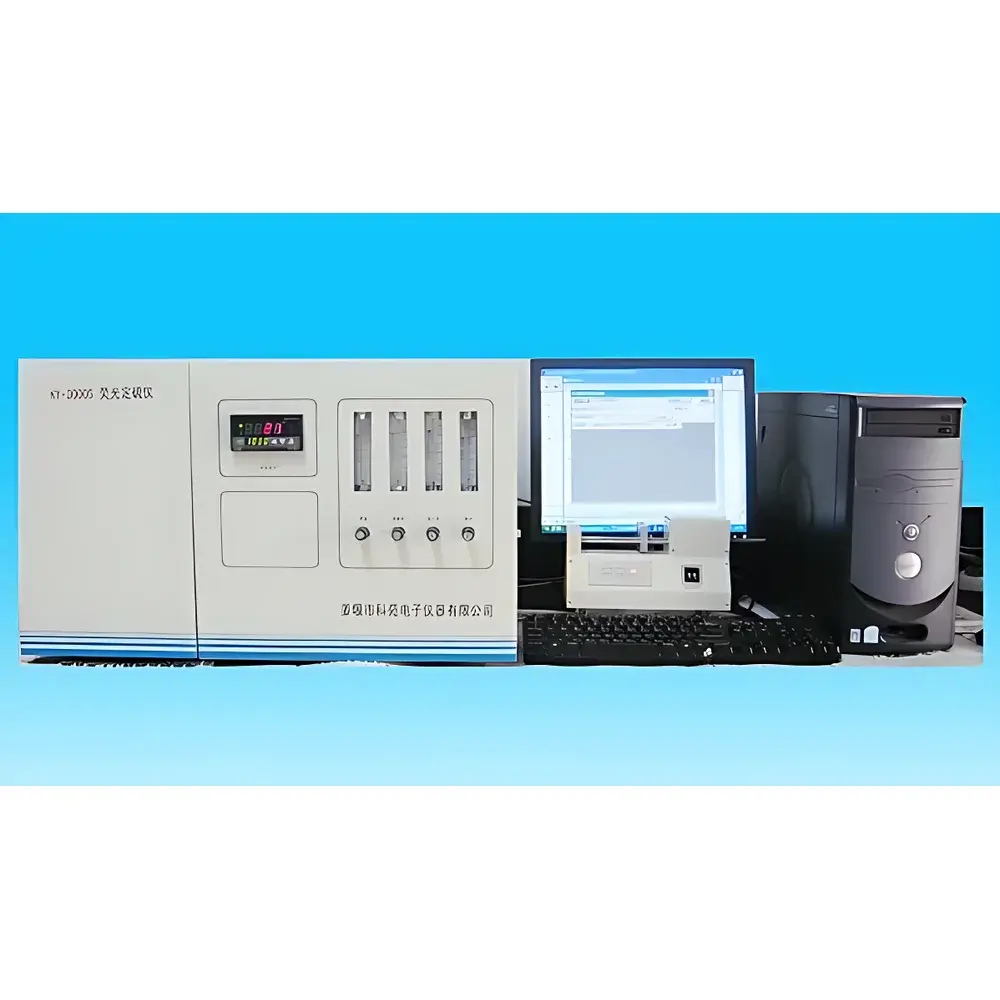
Kyuyuan KY-3000S UV Fluorescence Total Sulfur Analyzer
| Origin | Jiangsu, China |
|---|---|
| Manufacturer Type | Authorized Distributor |
| Model | KY-3000S |
| Price Range | USD 7,000–14,000 (FOB China) |
| Analyte | Total Sulfur |
| Detection Principle | UV Fluorescence (ASTM D5453 / SH/T 0689 / GB/T 34100-2017) |
| Sample Forms | Liquid, Solid, Gas (with optional injectors) |
| Detection Range | 0.2 mg/L to 5000 ppm (up to % level) |
| LOD | 0.2 mg/L (as S) |
| Repeatability | ≤±0.1 mg/L (0.2–1.0 mg/L) |
| Furnace Temp Control | RT–1300 °C, ±3 °C |
| Gas Requirements | ≥99.98% O₂ and ≥99.98% Ar |
| Data Acquisition | 24-bit USB interface, signal resolution <1 µV |
| PMT HV Adjustment | Continuously variable |
| Calibration | Single- or multi-point standard curve |
| Software Compatibility | Windows 10/11, macOS (via Wine), Linux (via VM) |
Overview
The Kyuyuan KY-3000S UV Fluorescence Total Sulfur Analyzer is a benchtop elemental analyzer engineered for precise, trace-level quantification of total sulfur in petroleum-based matrices—including gasoline, diesel, jet fuel, crude oil, naphtha, LPG, refinery streams, and petrochemical feedstocks—as well as polymers and lubricants. It operates on the internationally standardized ultraviolet fluorescence detection principle: samples are combusted in a high-temperature quartz furnace under controlled oxygen/argon atmosphere, converting all sulfur species quantitatively to SO₂; the resulting SO₂ is carried into a reaction chamber where it is excited by 190–230 nm UV light, emitting characteristic fluorescence at ~320 nm. This emission is detected by a low-noise photomultiplier tube (PMT) with adjustable high-voltage bias, enabling dynamic optimization across wide concentration ranges. The instrument complies fully with ASTM D5453, SH/T 0689, and GB/T 34100–2017—methods mandated by regulatory bodies for compliance monitoring in refineries, quality control laboratories, and third-party testing facilities operating under ISO/IEC 17025 or API RP 990.
Key Features
- High-fidelity 24-bit analog-to-digital conversion via native USB 2.0 interface, supporting real-time signal acquisition with sub-microvolt resolution (<1 µV minimum detectable signal)
- Programmable high-temperature combustion furnace (RT to 1300 °C, ±3 °C stability), optimized for complete oxidation of refractory sulfur compounds including thiophenes and sulfides
- Adjustable PMT high-voltage supply allowing user-defined gain calibration for optimal signal-to-noise ratio across linear dynamic range (0.2 mg/L to % w/w)
- Modular sample introduction architecture: compatible with liquid autosamplers (1–100 µL), solid boat injectors (1–20 mg), and gas sampling loops (1–5 mL) — all meeting ASTM D5453 Annex A1–A3 requirements
- Robust quartz reaction chamber with integrated optical filters and temperature-stabilized detector housing to minimize thermal drift and ambient interference
- Fully compliant data handling architecture supporting audit trails, electronic signatures, and metadata tagging per FDA 21 CFR Part 11 readiness guidelines
Sample Compatibility & Compliance
The KY-3000S accommodates heterogeneous sample types without method revalidation: volatile liquids (e.g., gasoline), viscous fuels (e.g., bunker C), solid catalysts, and gaseous hydrocarbons (e.g., ethylene, propane). All combustion and detection protocols adhere strictly to the stoichiometric equivalence and calibration traceability requirements defined in ASTM D5453 Clause 8 (Calibration), Clause 10 (Precision), and Annex A4 (Interlaboratory Study Data). Instrument validation documentation includes system suitability tests (SST), blank response verification (<0.1 mg/L), and linearity assessment (R² ≥0.999 over five decades). Certified reference materials (CRMs) from NIST, AccuStandard, or Conostan are recommended for initial qualification and periodic recalibration. The analyzer supports GLP/GMP-aligned workflows through configurable user access levels, password-protected method editing, and immutable raw data archiving.
Software & Data Management
Kyuyuan’s proprietary SulfurView™ software (v4.2+) runs natively on Windows 10/11 (64-bit) and offers full cross-platform compatibility via virtualized environments on macOS and Linux. Core functionalities include automated peak integration using derivative-based baseline correction, adaptive integration windowing, and real-time spectral noise suppression. All analysis files (.svd) embed complete metadata: operator ID, instrument serial number, calibration date, gas pressure logs, furnace ramp profiles, and raw time-resolved fluorescence traces. Export options include CSV (for LIMS ingestion), PDF analytical reports with embedded chromatograms, and XML-formatted results compliant with ASTM E1382–22 (Standard Practice for Electronic Data Exchange in Chemical Analysis). Audit trail records capture every parameter change, result override, and report generation event with timestamp and user attribution.
Applications
- Refinery QC/QA: Monitoring sulfur content in hydrotreated naphtha, kerosene, and ULSD to verify desulfurization efficiency against EPA Tier 3 and Euro 6 specifications
- Fuel certification labs: Performing ASTM D5453-compliant testing for ASTM D975 (diesel), D4814 (gasoline), and D1655 (jet fuel) conformance reporting
- Petrochemical R&D: Quantifying sulfur poisoning effects on FCC catalysts and evaluating sulfur retention in amine scrubbers
- Contract testing services: Supporting ISO 17025 accreditation with documented uncertainty budgets per EURACHEM/CITAC Guide CG4
- Academic research: Studying sulfur speciation kinetics in model compounds under varying oxidative conditions
FAQ
What combustion gases are required, and what purity levels are mandatory?
High-purity oxygen (≥99.98%) and argon (≥99.98%) are essential to prevent quenching of SO₂ fluorescence and ensure stoichiometric oxidation. Lower purities introduce background noise and reduce sensitivity below 0.2 mg/L.
Can the instrument analyze solid samples such as catalysts or rubber compounds?
Yes—using the optional solid sample boat injector and optimized combustion protocol (1200 °C, extended hold time), certified recovery rates exceed 98.5% for organosulfur standards in alumina-supported catalysts and EPDM elastomers.
Is the software validated for regulated environments (e.g., pharmaceutical or fuel certification labs)?
SulfurView™ supports 21 CFR Part 11 readiness via role-based access control, electronic signature capture, and immutable audit trails—but formal validation must be performed by the end-user per their internal SOPs and regulatory scope.
How often does the PMT require recalibration or replacement?
Under normal operation (≤8 h/day), PMT gain stability exceeds 12 months; annual verification using a factory-calibrated sulfur standard is recommended. Typical PMT service life exceeds 5 years with proper voltage management.
Does the system support remote diagnostics or preventive maintenance alerts?
Yes—the embedded controller logs furnace thermocouple drift, gas flow deviations, and detector dark current trends. Alerts trigger via email or SNMP when parameters exceed user-defined thresholds, enabling predictive maintenance scheduling.



