
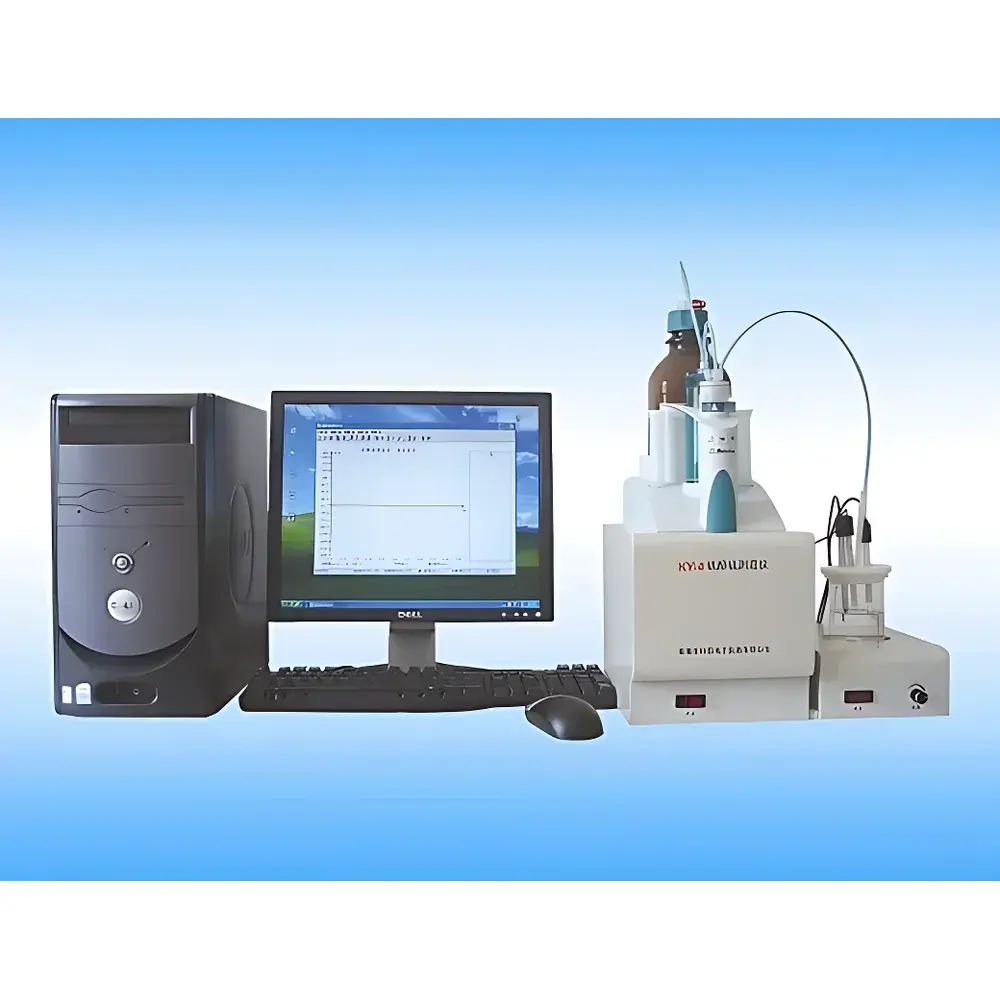
Kyuyuan KY-403B Automated Potentiometric Titrator
| Brand | Kyuyuan Instruments |
|---|---|
| Origin | Jiangsu, China |
| Manufacturer Type | Direct Manufacturer |
| Region Category | Domestic (China) |
| Model | KY-403B |
| Pricing | Available Upon Request |
| Sample Type | Liquid |
| Sulfur Alcohol (Mercaptan Sulfur) Measurement Range | 0.0001–0.01 % (m/m) |
| Titration Method | Potentiometric Titration |
| Burette Volume | 10 mL |
| Minimum Dispensing Volume | 0.01 mL |
| Potential Measurement Range | −1999.5 to +1999.5 mV |
| Burette Accuracy | ±0.1 % of Full Scale |
| Electronic Unit Basic Error | ±0.1 % of full scale reading + 0.5 mV |
| Relative Error | ≤5 % |
| Input Impedance | ≥1 × 10¹² Ω |
| Compliance Standard | JJG 814–2015 Verification Regulation for Automated Potentiometric Titrators |
Overview
The Kyuyuan KY-403B Automated Potentiometric Titrator is a dedicated analytical instrument engineered for precise, trace-level determination of mercaptan sulfur (R–SH) in petroleum products—including gasoline, naphtha, kerosene, and distillates—according to standardized potentiometric titration principles. It operates on the fundamental electrochemical principle of monitoring potential change across a redox-sensitive electrode pair (typically silver/silver sulfide indicator electrode and reference electrode) during controlled addition of standardized silver nitrate (AgNO₃) titrant. The inflection point of the resulting E–V curve (potential vs. titrant volume) is identified algorithmically as the equivalence point, enabling quantification of reactive thiol groups with high reproducibility. Designed for routine QC/QA workflows in refinery laboratories, independent testing labs, and R&D facilities, the KY-403B integrates hardware-level stability with software-driven endpoint refinement—ensuring compliance with methodological rigor required for ASTM D3229, IP 467, and ISO 8217 Annex D applications.
Key Features
- Imported precision burette assembly with integrated piston-driven dispensing mechanism, delivering consistent volumetric accuracy per ISO/IEC 17025 traceability requirements.
- Real-time digital smoothing of titration curves using adaptive Savitzky–Golay filtering, minimizing noise-induced endpoint ambiguity without data interpolation artifacts.
- Automatic endpoint correction via second-derivative (d²E/dV²) zero-crossing detection, dynamically compensating for slow electrode response or minor drift in reference potential.
- Dual high-impedance (>1 × 10¹² Ω) analog front-end with guarded input architecture, ensuring minimal loading error and stable baseline potential under low-conductivity hydrocarbon matrices.
- Fully automated liquid handling: auto-refill, fixed-volume pre-titration addition, and post-endpoint wash cycles—all programmable via intuitive Windows-based interface.
- Compliance-ready architecture supporting audit trails, user access levels, and electronic signature functionality aligned with FDA 21 CFR Part 11 expectations for regulated environments.
Sample Compatibility & Compliance
The KY-403B is validated for direct analysis of non-aqueous liquid samples with low dielectric constants and variable conductivity—particularly hydrocarbon-based fuels where conventional aqueous-phase titrations fail. Sample introduction requires no derivatization; analysis proceeds in ethanol–toluene solvent medium per ASTM D3229. Instrument performance verification follows JJG 814–2015, covering linearity, repeatability (RSD ≤ 2.5 % at 0.001 % m/m level), and endpoint resolution. Calibration verification includes certified reference materials (CRMs) traceable to NIM (National Institute of Metrology, China). System documentation supports GLP/GMP-aligned validation protocols including IQ/OQ/PQ documentation templates.
Software & Data Management
The bundled Kyuyuan TitrationSuite v3.2 provides full method development, execution, and reporting capabilities. Each titration run logs raw mV vs. volume data, smoothed derivative plots, calculated endpoints, and uncertainty estimates based on burette tolerance and electrode drift compensation. Data files are stored in encrypted .ktd format with embedded metadata (operator ID, timestamp, environmental temperature, reagent lot). Export options include CSV, PDF analytical reports (with customizable headers/footers), and XML for LIMS integration. All user actions—including parameter edits, result overrides, and calibration events—are recorded in an immutable audit trail with SHA-256 hashing.
Applications
- Quantification of total mercaptan sulfur in motor gasoline per ASTM D3229 and GB/T 1792–2015.
- Quality control of jet fuel and diesel feedstocks prior to sweetening unit processing.
- Research-grade investigation of sulfur speciation kinetics in model hydrocarbon systems.
- Verification of desulfurization catalyst efficiency in lab-scale hydrotreating simulations.
- Supporting ISO 8217 marine fuel compliance reporting for sulfur content limits.
FAQ
What electrode configuration is recommended for optimal mercaptan sulfur detection?
A silver/silver sulfide composite indicator electrode paired with a double-junction Ag/AgCl reference electrode (filled with saturated KNO₃ in non-aqueous compatible electrolyte) is specified for maximum selectivity and response time.
Can the KY-403B be used for other titration modes beyond mercaptan sulfur?
Yes—the platform supports acid–base, redox, complexometric, and precipitation titrations via method reconfiguration; however, factory calibration and validation data are specific to mercaptan sulfur per JJG 814–2015.
Is remote operation supported for networked laboratory environments?
Local area network (LAN) connectivity is available via Ethernet port; remote desktop access is permitted under IT-administered security policies, but cloud-based control is not implemented to preserve data integrity and regulatory compliance.
How often must the burette be recalibrated?
Burette volumetric accuracy shall be verified quarterly using certified Class A glassware and gravimetric procedure per JJG 814–2015 Section 6.3; full recalibration is required after mechanical maintenance or observed deviation >±0.05 % F.S.
Does the system meet international regulatory requirements for pharmaceutical or food testing?
While compliant with general metrological standards, the KY-403B is optimized for petrochemical matrices; its current validation scope does not extend to USP , EP 2.2.20, or AOAC methods—custom qualification may be performed by end-user laboratories.




