
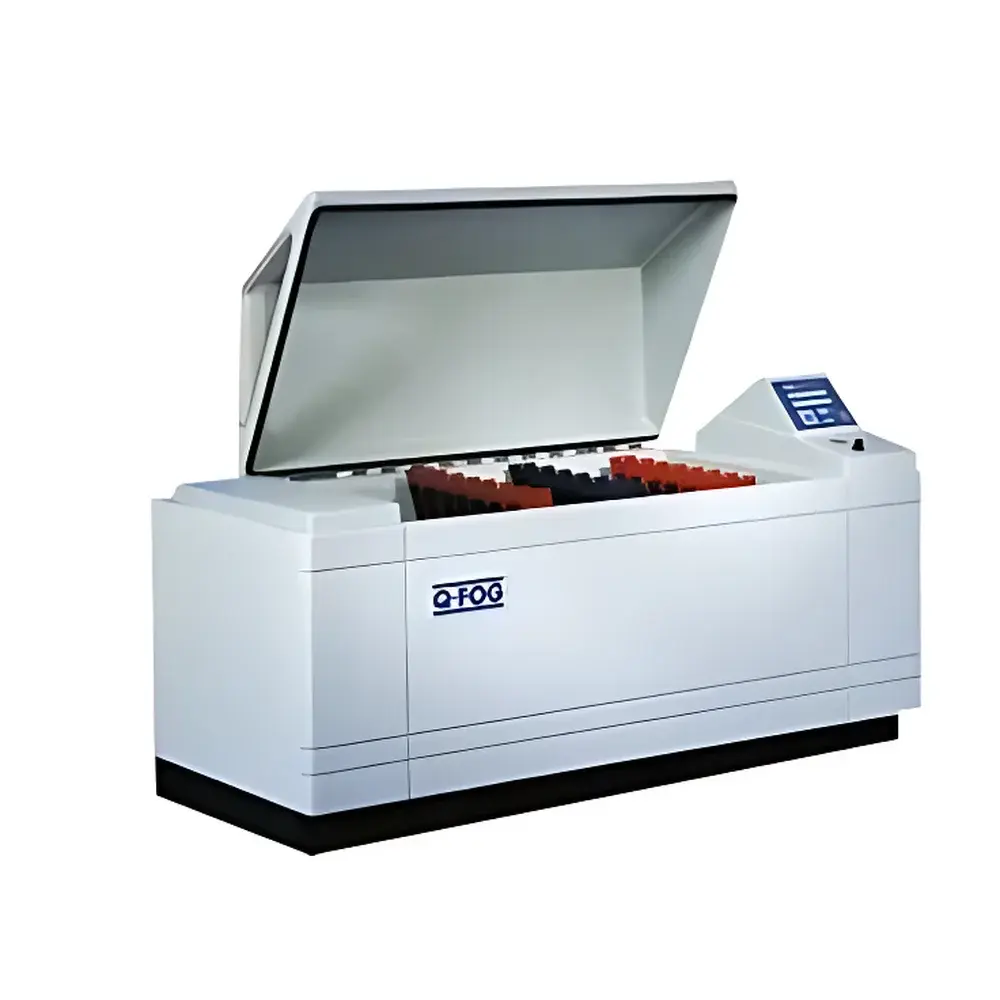
Q-LAB CCT600 Cyclic Corrosion Test Chamber
| Brand | Q-LAB |
|---|---|
| Origin | USA |
| Model | Q-LAB CCT600 |
| Chamber Capacity | 640 L |
| Sample Capacity | 160 panels (75 mm × 150 mm) |
| Operating Environments | Salt Fog / Dry / 100% RH Humidity / Ambient Hold |
| Temperature Range | Ambient to 50 °C (typical operational range for cyclic corrosion testing) |
| Salt Solution Delivery | Precision-controlled via variable-speed peristaltic pump and regulated air pressure |
| Internal Solution Reservoir | 120 L with level sensor and filtration |
| Compliance | Designed to support ASTM B117, ISO 9227, ASTM G85 Annexes (A1–A5), SAE J2334, GMW 14872, Ford CETP 00.00-L-467, VDA 621-415, and other internationally recognized cyclic corrosion standards |
Overview
The Q-LAB CCT600 Cyclic Corrosion Test Chamber is an engineered solution for laboratory-based simulation of real-world atmospheric corrosion mechanisms. Unlike conventional continuous-salt-spray systems (e.g., ASTM B117), the CCT600 implements programmable multi-phase environmental cycles—including salt fog, controlled drying, 100% relative humidity, and ambient hold—to replicate the wet-dry transitions, condensation events, and electrolyte concentration dynamics observed in outdoor exposure. This architecture enables high-fidelity correlation between accelerated lab results and field performance—particularly critical for automotive OEMs, Tier-1 suppliers, coating formulators, and metal finishing laboratories requiring predictive durability assessment under ISO 16148, SAE J2334, or proprietary OEM specifications. The chamber’s robust stainless-steel construction, integrated water purification interface, and thermally optimized airflow design ensure long-term stability across thousands of test hours while maintaining traceable repeatability per GLP and GMP-aligned quality systems.
Key Features
- 640-liter internal chamber volume with ergonomic access door and reinforced viewing window with integrated LED illumination for real-time visual monitoring without opening the chamber
- Four-phase environmental control: salt fog (ASTM B117-compliant), forced-air drying (with auxiliary heater for low-humidity conditions), 100% RH humidity (steam-assisted, not water-jacketed), and ambient hold—each independently controllable in sequence
- Precision salt solution delivery system: variable-speed peristaltic pump + calibrated air pressure regulator enable independent adjustment of deposition rate (typically 1.0–2.0 mL/80 cm²/h) and spray pattern geometry—eliminating the coupling artifact common in gravity-fed or fixed-orifice nozzles
- 120-liter internal reservoir with dual-stage filtration (particulate + activated carbon), automatic low-level alarm, and self-contained recirculation path minimizing operator intervention
- Q-FOG® microprocessor controller with intuitive touchscreen interface, built-in diagnostics, scheduled maintenance alerts, and fail-safe shutdown protocols compliant with IEC 61000-6-2/6-4 EMC requirements
- Rapid thermal response architecture: direct-heated chamber walls and high-CFM cooling/drying fan enable transition from 100% RH to <20% RH in under 30 minutes—significantly faster than water-jacketed alternatives
Sample Compatibility & Compliance
The CCT600 accommodates up to 160 standard test panels (75 mm × 150 mm) on adjustable-angle racks (15° tilt option available). Larger or three-dimensional components may be suspended using optional 20 mm diameter support rods (F-9014-K kit). All internal fixtures are non-reactive 316 stainless steel or PTFE-coated. The system supports full traceability for regulated environments: audit-ready test logs include timestamped environmental profiles, setpoint deviations, solution usage metrics, and calibration history. It meets functional requirements for ISO/IEC 17025-accredited labs and provides documented compatibility with FDA 21 CFR Part 11 data integrity principles when paired with Q-Lab’s optional Q-FOG Data Logger software (version 5.2+).
Software & Data Management
The embedded Q-FOG controller stores up to 100 user-defined test programs with nested sub-cycles, ramp rates, and conditional branching logic (e.g., “if RH > 95% for >120 min, initiate dry phase”). Exportable CSV logs include temperature, humidity, fog status, elapsed time, and system fault codes. Optional Ethernet connectivity enables remote monitoring via Q-Lab’s WebLink™ platform—supporting role-based access control, electronic signature workflows, and integration into LIMS or MES infrastructure. Firmware updates maintain alignment with evolving industry standards (e.g., latest revisions of GMW 14872 or VDA 621-415).
Applications
- Automotive component validation per GMW 14872 (cyclic corrosion), Ford CETP 00.00-L-467, and Chrysler MS-AK-902
- Coating adhesion and blistering assessment under SAE J2334 Prohesion-type cycling
- Zinc-plated fastener corrosion resistance per ISO 10289 and ASTM B633
- Electrochemical interface degradation studies in battery enclosures and EV powertrain housings
- Marine-grade alloy qualification per ASTM G85 Annex A5 (acidified salt fog)
- Pre-qualification screening for aerospace hardware per Boeing D6-17487 and Airbus AITM 1-0002
FAQ
What standards does the CCT600 support out-of-the-box?
The CCT600 natively executes ASTM B117, ISO 9227, ASTM G85 Annexes A1–A5, SAE J2334, and major OEM specifications including GMW 14872 and Ford CETP 00.00-L-467—without hardware modification.
Is purified water mandatory?
Yes. The system requires Type II deionized or distilled water (resistivity ≥1 MΩ·cm) to prevent nozzle clogging and ensure consistent fog chemistry—integrated conductivity monitoring alerts operators to out-of-spec supply conditions.
Can the CCT600 perform non-standard custom cycles?
Absolutely. Its controller supports user-defined multi-step sequences with variable dwell times, ramp rates, and conditional logic—validated for complex protocols such as VDA 621-415 Stage 3 or JASO M609 extended cycling.
How often does the internal reservoir require refilling?
With a full 120 L capacity and typical Prohesion cycling (4 h fog / 2 h dry), the reservoir sustains uninterrupted operation for ≥7 days—reducing routine maintenance frequency and improving lab throughput.
Does the system include calibration documentation?
Each unit ships with NIST-traceable temperature and humidity sensor calibration certificates (valid at time of shipment), plus a comprehensive IQ/OQ protocol template aligned with ISO 17025 and FDA 21 CFR Part 11 requirements.



