
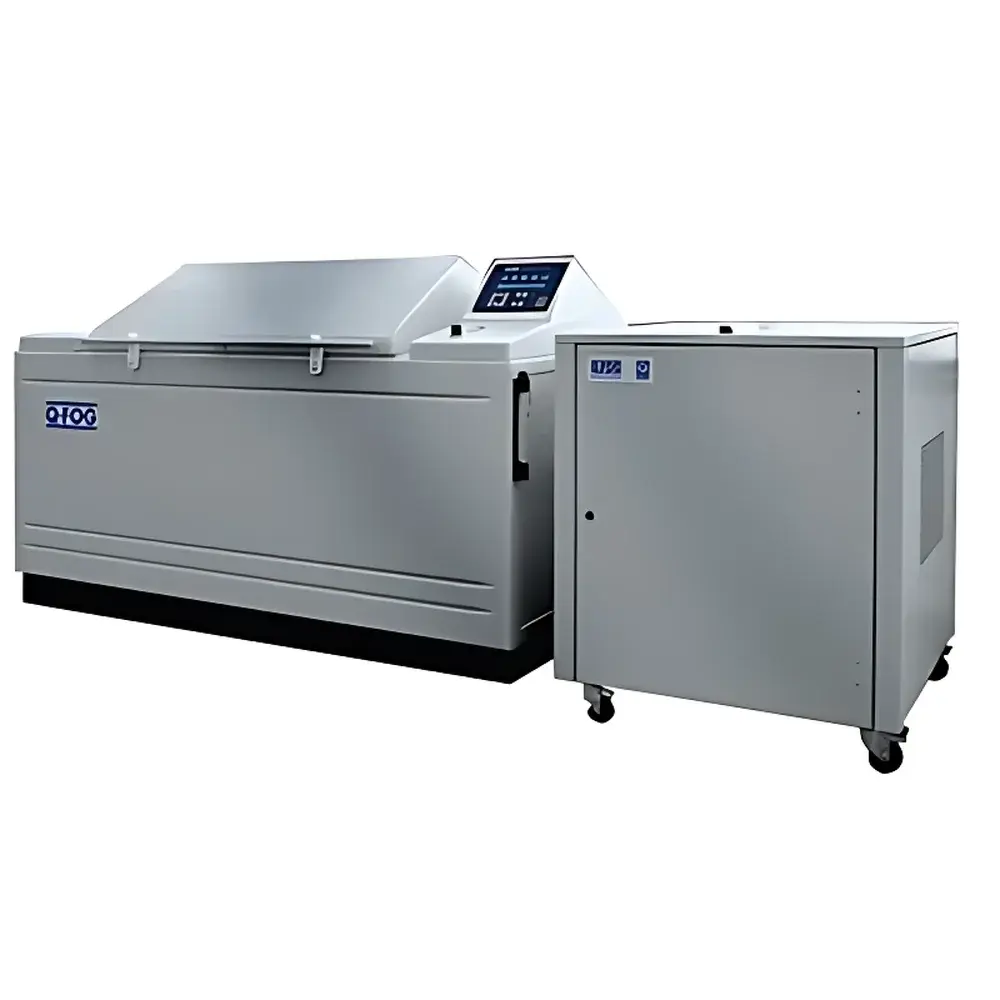
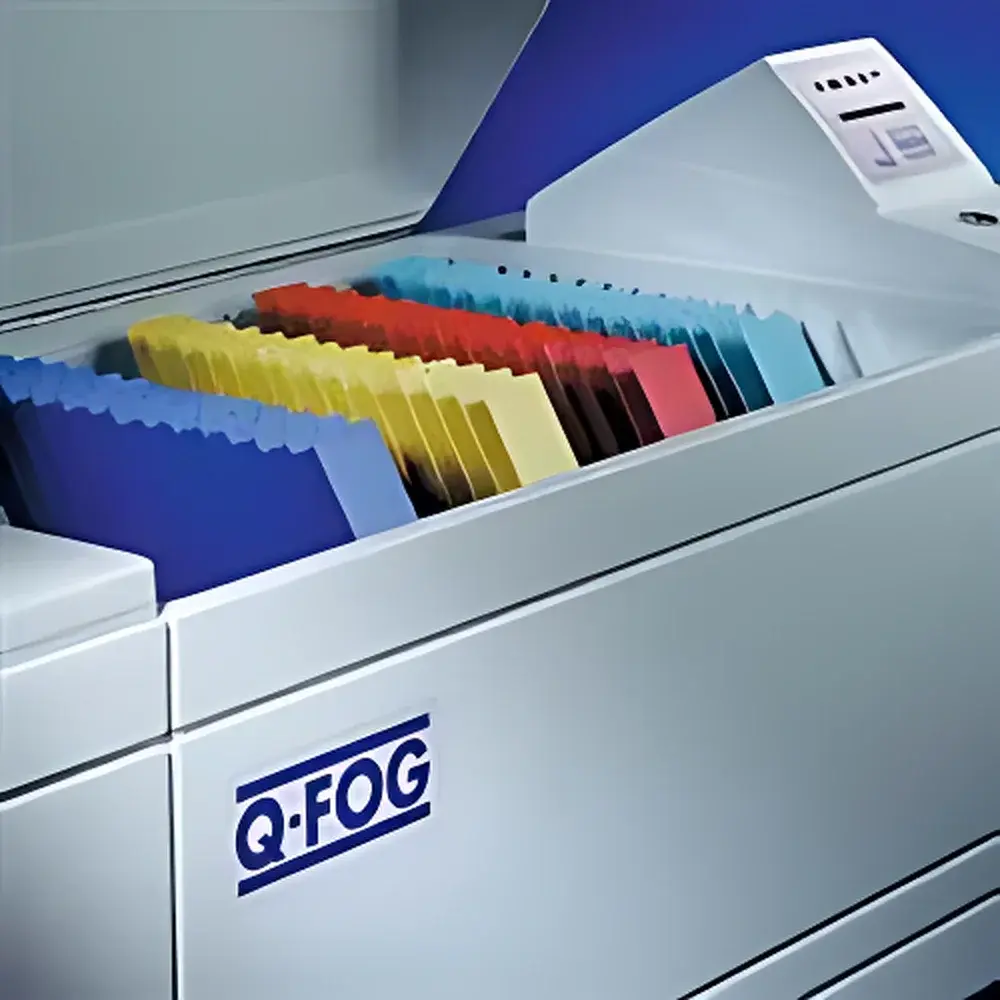
Q-Lab Q-FOG CCT-600 Cyclic Corrosion Test Chamber
| Brand | Q-Lab |
|---|---|
| Origin | USA |
| Model | Q-FOG CCT-600 |
| Chamber Types | Salt Spray, Dry-off, 100% RH Humidity (CCT only), and Ambient Hold |
| Control System | Microprocessor-based Programmable Controller with Self-Diagnostic Functions |
| Internal Solution Reservoir | 120 L with Integrated Saltwater Filter and Low-Level Alarm |
| 雾 Dispersion | Variable-Speed Peristaltic Pump + Adjustable Air Pressure Regulator for Independent Control of Salt Spray Deposition Rate and Pattern |
| Temperature Transition Speed | Rapid due to In-Chamber Heaters and High-Capacity Cooling/Drying Blower |
| Water Requirement | Deionized or Distilled Water Only |
| Compliance Support | Designed to meet ASTM B117, ASTM G85 Annexes (A1–A5), ISO 9227, ISO 11997, VDA 621-415, GMW 14872, Ford CETP 00.00-L-467, SAE J2334, and other cyclic corrosion test standards |
Overview
The Q-Lab Q-FOG CCT-600 is an advanced cyclic corrosion test chamber engineered for high-fidelity simulation of real-world atmospheric degradation mechanisms. Unlike conventional continuous salt spray systems operating solely at 35 °C per ASTM B117, the CCT-600 implements programmable multi-phase environmental cycles—including salt fog, dry-off, 100% relative humidity (exclusive to CCT configuration), and ambient hold—to replicate the wet/dry, thermal, and electrochemical dynamics observed in outdoor service environments. This capability enables accelerated yet physically representative corrosion assessment across automotive, aerospace, electronics, coatings, and metal finishing industries. Its core architecture integrates thermodynamic responsiveness, precise aerosol delivery, and regulatory-compliant control logic—making it a reference platform for R&D validation, quality assurance, and specification compliance testing.
Key Features
- Four-Phase Environmental Cycling: Independently configurable sequences among salt fog, forced-air drying, saturated humidity (CCT-only), and ambient stabilization—enabling execution of Prohesion®, ASTM G85 Annex A1–A5, ISO 11997-1/2, VDA 621-415, and OEM-specific protocols.
- Precise Aerosol Delivery System: Dual-parameter control of salt spray deposition: variable-speed peristaltic pump governs solution flow rate; calibrated air pressure regulator modulates droplet trajectory and spatial distribution—ensuring reproducible, NIST-traceable salt fog collection rates per ISO 9227 requirements.
- Rapid Thermal Transitions: In-chamber resistive heaters and high-CFM cooling/drying blowers eliminate thermal inertia typical of water-jacketed chambers, achieving sub-5-minute transitions between fog (35 °C) and dry-off (60 °C) phases—critical for simulating diurnal thermal stress.
- Integrated 120-L Solution Reservoir: Minimizes manual intervention with built-in saltwater filtration, level monitoring, and audible/visual low-level alerts—supporting uninterrupted operation for ≥7 days under standard cycling conditions.
- Intuitive Microprocessor Controller: Touchscreen interface with preloaded test methods, drag-and-drop cycle editor, real-time status dashboard, and automated self-diagnostics—including predictive maintenance alerts, fault logging, and fail-safe shutdown protocols.
- Regulatory-Ready Architecture: Firmware supports audit trails, user access levels, electronic signatures, and data export formats compliant with FDA 21 CFR Part 11, ISO/IEC 17025, and GLP/GMP documentation requirements.
Sample Compatibility & Compliance
The Q-FOG CCT-600 accommodates specimens up to 600 mm × 600 mm × 600 mm (W×D×H) with standardized rack mounting and unobstructed exposure geometry. It meets or exceeds performance criteria defined in ASTM B117 (neutral salt spray), ASTM G85 (modified salt spray including acidified and SO₂-enhanced variants), ISO 9227 (corrosion testing in artificial atmospheres), ISO 11997 (cyclic corrosion testing), and numerous automotive OEM specifications (e.g., GMW 14872, Ford CETP 00.00-L-467, VW PV1210). All internal wetted components are constructed from non-reactive, corrosion-resistant materials—including PVC-coated steel, borosilicate glass viewing ports, and fluoropolymer-lined solution lines—to prevent cross-contamination and ensure long-term metrological stability.
Software & Data Management
Q-Lab’s proprietary Q-FOG Controller firmware provides full-cycle programming, real-time parameter monitoring (temperature, humidity, spray status), and timestamped event logging. Data exports are generated in CSV and PDF formats, supporting integration into LIMS and enterprise QA databases. Optional Q-FOG Connect software enables remote monitoring, alarm notification via email/SMS, and centralized fleet management for multi-unit laboratories. All system logs include operator ID, method revision, start/stop timestamps, deviation flags, and calibration history—fully traceable for internal audits and regulatory submissions.
Applications
- Accelerated evaluation of protective coatings (e.g., zinc flake, e-coat, powder coat) on automotive chassis components
- Corrosion resistance validation of fasteners, brake calipers, and under-hood electronics per SAE J2334
- Qualification of aerospace aluminum alloys and surface treatments against ASTM D1654 and MIL-STD-810H Method 509.6
- Comparative lifecycle testing of consumer electronics enclosures exposed to coastal/marine environments
- Development and verification of corrosion inhibitors for industrial lubricants and coolants
- Supplier qualification testing aligned with IATF 16949 clause 8.4.2.2 (externally provided processes)
FAQ
What water purity is required for operation?
Deionized or distilled water with conductivity ≤1 µS/cm is mandatory to prevent nozzle clogging and ensure consistent salt fog chemistry.
Can the CCT-600 perform ASTM B117 testing?
Yes—it supports continuous neutral salt spray mode while maintaining full compliance with ASTM B117 temperature uniformity, pH, and collection rate specifications.
Is humidity control available in all models?
100% RH capability is exclusive to the CCT series; the SST model supports only salt fog and dry-off cycles.
How is calibration verified?
Q-Lab provides factory calibration certificates traceable to NIST standards; users may perform routine verification using certified temperature/humidity probes and calibrated salt fog collectors per ISO 9227 Annex A.
What safety protections are integrated?
Over-temperature cutoff, low-water shutoff, door interlock, ground-fault circuit interruption (GFCI), and automatic system halt upon critical sensor failure or communication loss.



