
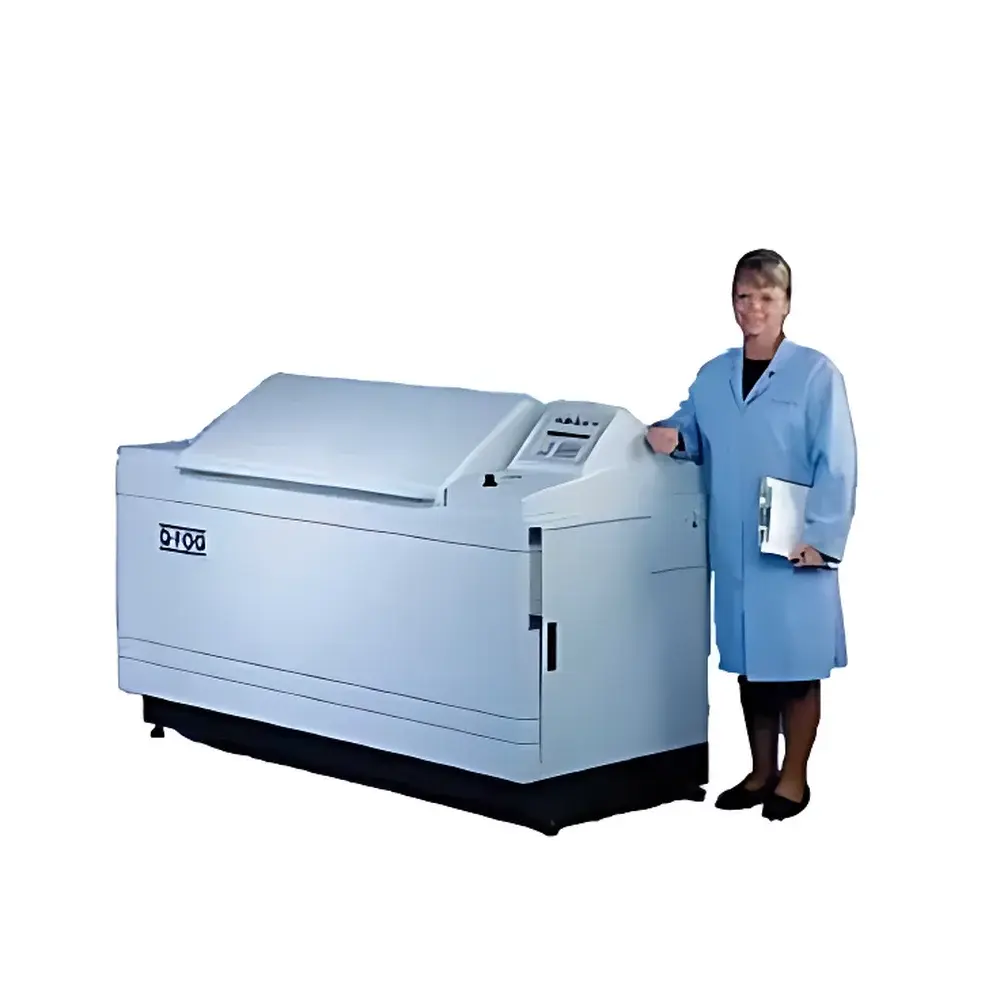
Q-LAB Q-FOG CCT Salt Spray Test Chamber
| Brand | Q-LAB |
|---|---|
| Origin | USA |
| Model | Q-FOG CCT |
| Compliance | ASTM B117, ASTM G85, ISO 9227, BS 3900 F4/F9, DIN 50021 |
| Temperature Range | Ambient to 50°C (operational control stability ±2°C) |
| Salt Solution Delivery | Pneumatic air-assisted atomization with adjustable spray rate (typically 1.0–2.0 mL/80 cm²/h per ASTM B117) |
| Humidity Control | 100% RH capability (CCT-specific) |
| Chamber Volume | Standard 600 L (custom sizes available) |
| Construction | Fiberglass-reinforced polymer (FRP) chamber body with corrosion-resistant stainless steel hardware |
| Control System | 7-inch full-color touchscreen interface with programmable multi-step cycling logic |
Overview
The Q-LAB Q-FOG CCT Salt Spray Test Chamber is an engineered environmental test system designed for accelerated corrosion evaluation under rigorously controlled, multi-phase cyclic conditions. Unlike single-mode salt fog chambers, the CCT variant implements a fully automated sequence of salt spray, high-humidity soak (100% RH), and low-humidity dry phases—enabling precise replication of real-world automotive and industrial corrosion mechanisms governed by electrochemical degradation pathways. Its operational foundation lies in the controlled generation and delivery of neutral or acidic salt aerosols (e.g., NaCl, CuCl₂-acidified solutions) via pneumatic atomization, combined with independent thermal and humidity regulation across each cycle segment. This architecture supports standardized test protocols where time-dependent ion transport, electrolyte film formation, drying-induced stress, and hygroscopic re-wetting collectively drive material failure—making it indispensable for validating protective coatings, galvanized substrates, and multi-layer assemblies in R&D, quality assurance, and regulatory compliance laboratories.
Key Features
- Integrated cyclic corrosion testing (CCT) capability: seamless transition between salt spray, 100% RH humid soak, and forced-air dry phases within a single chamber
- Fiberglass-reinforced polymer (FRP) chamber construction ensures long-term resistance to chloride-laden atmospheres and eliminates metallic contamination risks
- Precision-engineered air saturation system with heated bubble tower (except Prohesion mode) delivers consistent droplet size distribution and uniform spray deposition per ISO 9227 Annex A
- Independent dual-heating system: chamber wall heaters maintain ambient temperature stability, while dedicated air heaters regulate inlet air temperature during dry cycles
- Steam-based humidification module with PID-controlled steam generator enables rapid and stable 100% RH attainment without condensate pooling
- 7-inch industrial-grade touchscreen HMI with intuitive drag-and-drop cycle editor, real-time parameter logging, and user-level access control
- Compliance-ready architecture supporting audit trails, electronic signatures, and data export formats compatible with LIMS integration
Sample Compatibility & Compliance
The Q-FOG CCT accommodates flat panels, stamped components, assembled subassemblies, and coated fasteners up to 600 mm × 600 mm × 300 mm (W×D×H) in standard configuration. Fixturing options include non-metallic racks, adjustable angle holders, and insulated mounting plates to prevent galvanic coupling artifacts. The system meets the physical and procedural requirements of ASTM B117 (neutral salt spray), ASTM G85 Annex A (acetic acid salt spray), Annex D (Prohesion), ISO 9227 (general corrosion testing), and major OEM specifications including GMW14872, Ford CETP 00.00-L-467, VW PV1210, and Renault D17 2020. All critical parameters—including solution pH, temperature deviation, spray collection rate, and RH ramp rates—are traceable to NIST-calibrated instrumentation and documented per GLP and ISO/IEC 17025 laboratory practice guidelines.
Software & Data Management
The embedded Q-FOG Control Software v5.x provides full cycle definition, execution monitoring, and post-test analysis without external PCs. Users define multi-stage profiles with up to 99 steps, each specifying duration, temperature setpoint, humidity target, spray activation, and airflow mode. Real-time graphs display chamber temperature, RH, and spray status; all values are timestamped and stored internally with 1-second resolution. Data export supports CSV and PDF report generation with embedded metadata (operator ID, calibration date, solution lot number). For regulated environments, optional 21 CFR Part 11 compliance packages include role-based login, electronic signature capture, audit trail archiving, and immutable record retention—validated per IQ/OQ protocols and aligned with FDA and EMA expectations for materials qualification studies.
Applications
This chamber serves as a primary tool for corrosion performance benchmarking across aerospace fastener systems, automotive under-hood components, marine-grade aluminum alloys, zinc-nickel electroplated surfaces, and powder-coated steel enclosures. It is routinely deployed in supplier qualification programs requiring adherence to SAE J2334 cyclic corrosion methodology, in durability validation of EV battery housings exposed to coastal road salts, and in comparative studies of self-healing polymer coatings under dynamic wet-dry transitions. Research institutions utilize its reproducible cycling fidelity to correlate electrochemical impedance spectroscopy (EIS) measurements with macroscopic blistering and delamination onset—establishing quantitative structure-property relationships for next-generation anti-corrosion chemistries.
FAQ
What distinguishes the Q-FOG CCT from the SSP model?
The CCT adds full 100% RH humid soak capability and integrated dry cycle control—enabling true automotive-style cyclic corrosion testing (CCT), whereas the SSP supports only salt spray and dry phases.
Is the chamber suitable for testing painted automotive body panels?
Yes—its uniform spray distribution, precise temperature ramping, and repeatable humidity transitions meet OEM requirements for evaluating edge coverage, stone-chip resistance, and cathodic delamination on e-coated steel substrates.
How is solution concentration verified during operation?
Users perform periodic gravimetric verification using calibrated conductivity meters and certified reference standards; solution reservoirs feature level sensors and automatic refill triggers to maintain consistent density throughout extended test runs.
Can test data be exported for third-party review or regulatory submission?
Yes—CSV exports include raw sensor timestamps, setpoints, deviations, and operator annotations; PDF reports are digitally signed and embed instrument calibration certificates per ISO/IEC 17025 documentation requirements.
Does the system support remote monitoring or network integration?
Standard Ethernet connectivity enables SNMP-based status polling and OPC UA interface for integration into enterprise MES or SCADA platforms—no proprietary middleware required.



