
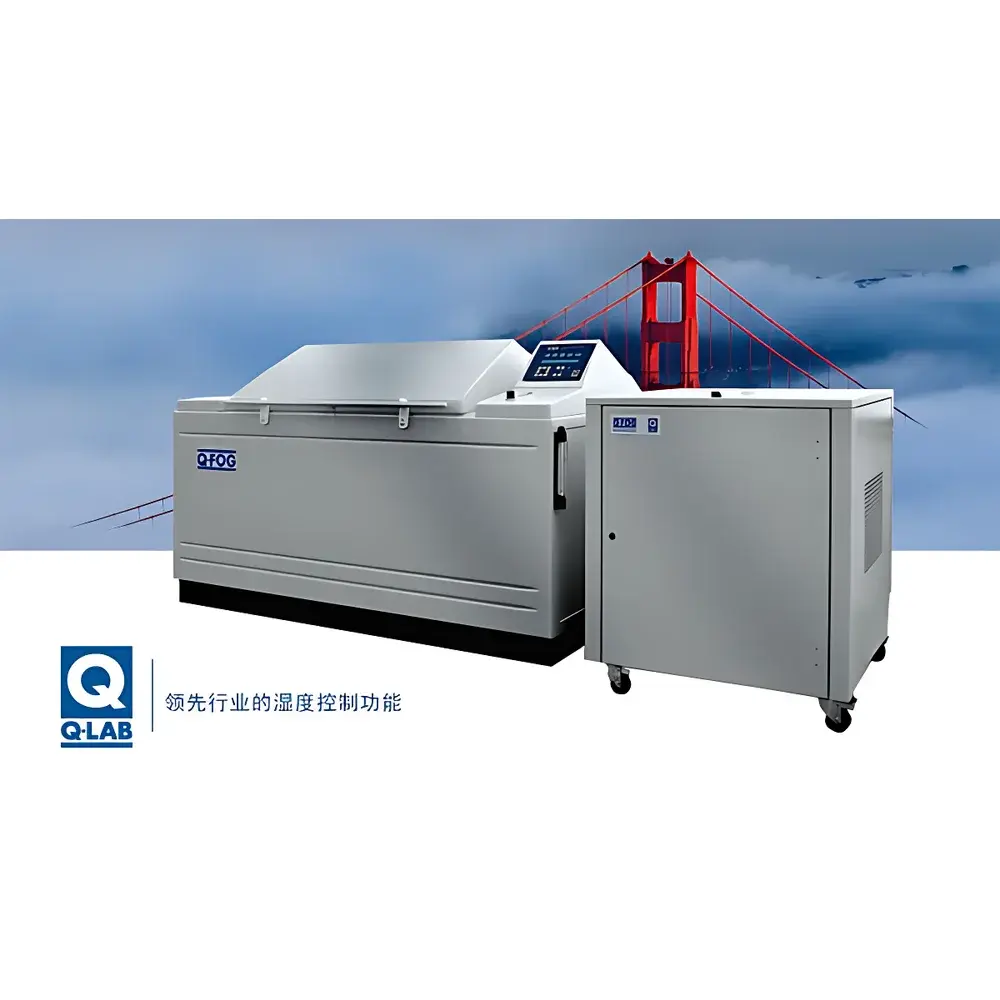
Q-Lab Q-FOG CCT Series Cyclic Corrosion Test Chamber
| Brand | Q-LAB |
|---|---|
| Origin | USA |
| Model | CCT |
| Compliance | ASTM B117, ISO 9227, ISO 11997, ASTM G85 (Annex A1–A5), SAE J2334, GMW 14872, VDA 621-415, JIS Z 2371, DIN 50021, BS EN ISO 7253 |
| Humidity Range | 100% RH (CCT-specific) |
| Temperature Control | Spray, Dry, and Humidify Modes with Independent Heating Systems |
| Chamber Capacity | Standard configurations available (e.g., CCT-1100, CCT-2100) |
| Control System | Touchscreen Programmable Controller with Multi-Step Cycling Capability |
| Construction | Fiberglass-Reinforced Polymer (FRP) Cabinet, Corrosion-Resistant Interior |
Overview
The Q-Lab Q-FOG CCT Series Cyclic Corrosion Test Chamber is an engineered solution for accelerated corrosion testing under dynamically controlled, multi-phase environmental conditions. Unlike conventional salt spray chambers operating solely under static ASTM B117 or ISO 9227 protocols, the CCT model implements programmable cyclic exposure sequences—integrating salt fog, dry-off, and high-humidity (100% RH) phases within a single, unified chamber. This architecture replicates real-world atmospheric degradation mechanisms observed in automotive, aerospace, and coated-metal applications, where corrosion initiates not only during active chloride deposition but also during hygroscopic condensation and electrochemical activity in humid interstitial layers. The system leverages Q-Lab’s proprietary corrosion solution delivery, saturated air conditioning, and precision thermal management to ensure repeatability across laboratories and compliance with globally recognized test standards.
Key Features
- Triple-mode environmental simulation: Salt spray, forced-air drying, and saturated steam humidification—all fully automated and independently controllable.
- Fiberglass-reinforced polymer (FRP) chamber construction with corrosion-resistant internal surfaces, ensuring long-term integrity under aggressive saline and acidic vapor exposure.
- Integrated touchscreen controller supporting up to 99 user-defined test cycles, each comprising multiple steps with programmable dwell times, temperature setpoints, and humidity transitions.
- Precision air saturation system: Compressed air passes through a heated water-filled bubbling tower prior to nozzle mixing (except Prohesion® mode), ensuring consistent droplet size distribution and stable fog density per ASTM G85 Annex A1.
- Dedicated steam generator with PID-controlled heating element for rapid, stable 100% RH generation—exclusive to the CCT configuration and critical for simulating dew formation in automotive OEM specifications (e.g., GMW 14872, VDA 621-415).
- Modular design accommodating standard chamber volumes (e.g., CCT-1100: 1100 L; CCT-2100: 2100 L), with optional accessories including specimen racks, solution reservoirs, and exhaust scrubbers.
Sample Compatibility & Compliance
The Q-FOG CCT accommodates flat panels, stamped components, assembled subassemblies, and coated fasteners up to 1.2 m in height. Specimen mounting fixtures are non-metallic and chemically inert to prevent galvanic interference. The chamber meets or exceeds requirements of over 20 international corrosion testing standards—including ISO 11997-1/2 (cyclic corrosion), ASTM G85 Annexes A1–A5 (modified salt spray), SAE J2334 (automotive cyclic corrosion), and VDA 621-415 (German automotive condensation cycling). Its design supports GLP-compliant operation when paired with Q-Lab’s optional data logging and audit trail software modules, enabling traceability for regulated industries subject to ISO/IEC 17025 or IATF 16949 requirements.
Software & Data Management
The embedded controller logs time-stamped environmental parameters (chamber temperature, relative humidity, spray duration, and cycle phase status) at user-selectable intervals (1–60 sec). Optional Ethernet connectivity enables remote monitoring via Q-Lab’s Web-Based Remote Access (WBRA) interface. For full regulatory compliance, the Q-FOG CCT integrates with Q-Lab’s optional Q-Cloud™ platform—supporting 21 CFR Part 11–compliant electronic signatures, role-based access control, and immutable audit trails. All test programs and raw sensor data are exportable in CSV or XML format for integration into LIMS or enterprise QA systems.
Applications
- Automotive component validation: Painted body panels, galvanized steel, aluminum die-cast housings, and brake calipers per OEM-specific cyclic protocols (e.g., Ford CETP, BMW GS 95024).
- Coating performance evaluation: Electrodeposited primers, powder coatings, and conversion coatings under combined thermal, hygric, and ionic stress.
- Materials qualification for marine and offshore environments: Stainless steels, duplex alloys, and protective polymer laminates exposed to simulated coastal fog-dry-condense sequences.
- R&D of corrosion inhibitors and self-healing coatings: Quantitative assessment of time-to-white-rust, red-rust onset, and blister propagation kinetics under reproducible multi-phase aging.
- Supplier quality assurance: Third-party verification of coating adhesion, scribe creep, and substrate undercutting in accordance with ISO 10289 or ASTM D1654.
FAQ
What distinguishes the CCT model from the SSP or CRH models?
The CCT uniquely incorporates a dedicated steam humidification system enabling true 100% RH conditioning—essential for automotive cyclic tests requiring condensation phases. The SSP supports only salt spray and dry cycles; the CRH adds humidity but lacks the CCT’s precise dew-point control and integrated steam generator.
Can the CCT perform ASTM B117 testing?
Yes—the CCT operates in standalone salt spray mode with full compliance to ASTM B117, including temperature uniformity (±2°C), pH control (6.5–7.2), and fog collection rate (1.0–2.0 mL/80 cm²/hour).
Is calibration documentation included?
Each unit ships with NIST-traceable calibration certificates for temperature sensors and humidity transducers, valid for 12 months. Optional annual recalibration services are available through Q-Lab’s global service network.
How is solution concentration monitored and maintained?
Operators manually prepare and replenish sodium chloride or acidified copper chloride solutions per test standard requirements. The system includes level sensors and low-reservoir alarms but does not auto-dose or analyze solution chemistry.
What maintenance is required for long-term reliability?
Routine tasks include weekly cleaning of nozzles and bubblers, monthly inspection of steam generator scale buildup, quarterly verification of air saturation tower water level, and annual replacement of compressed air filters and humidity sensor filters.



