
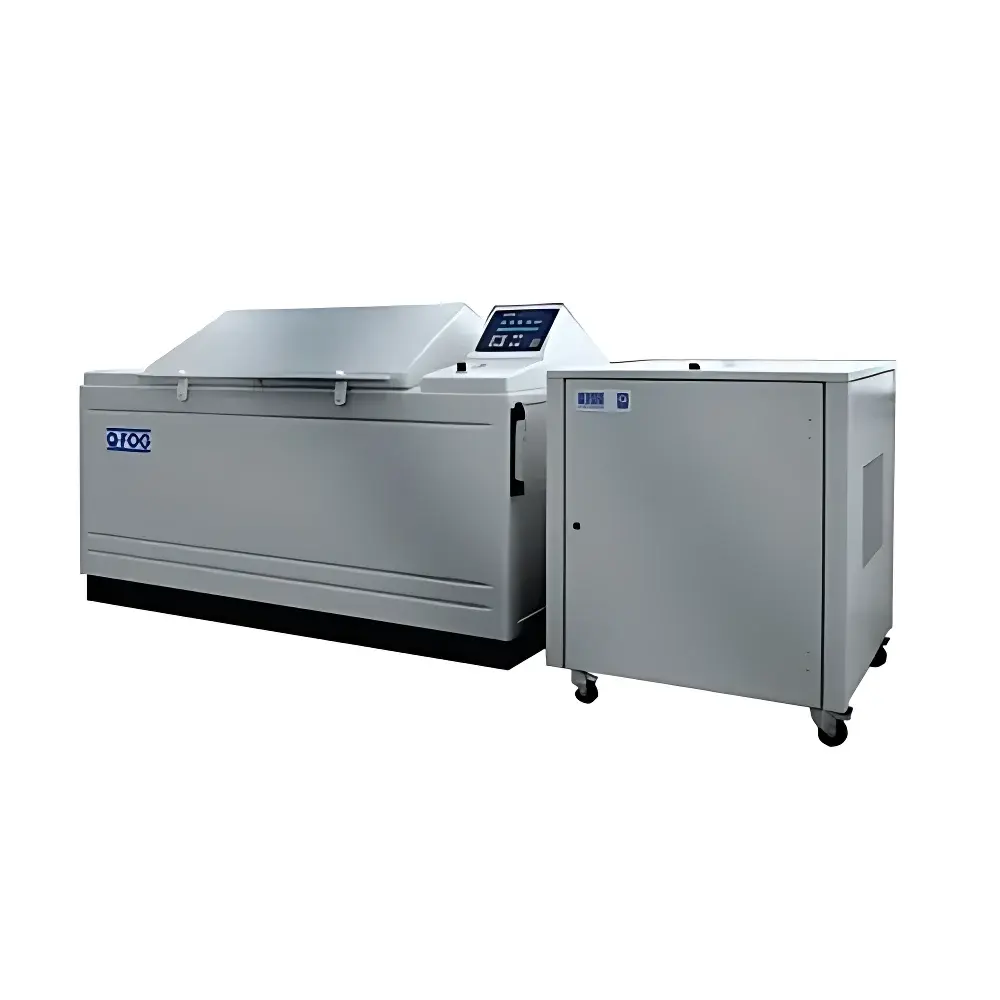
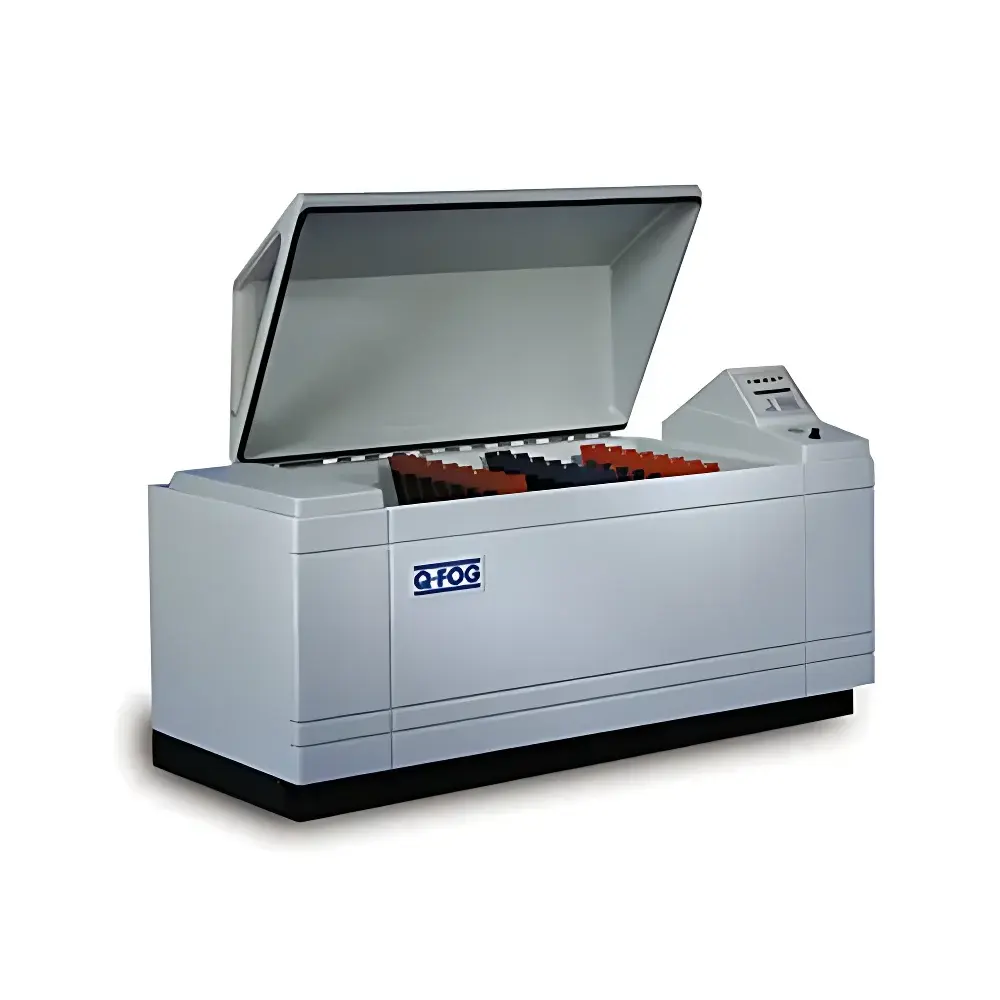
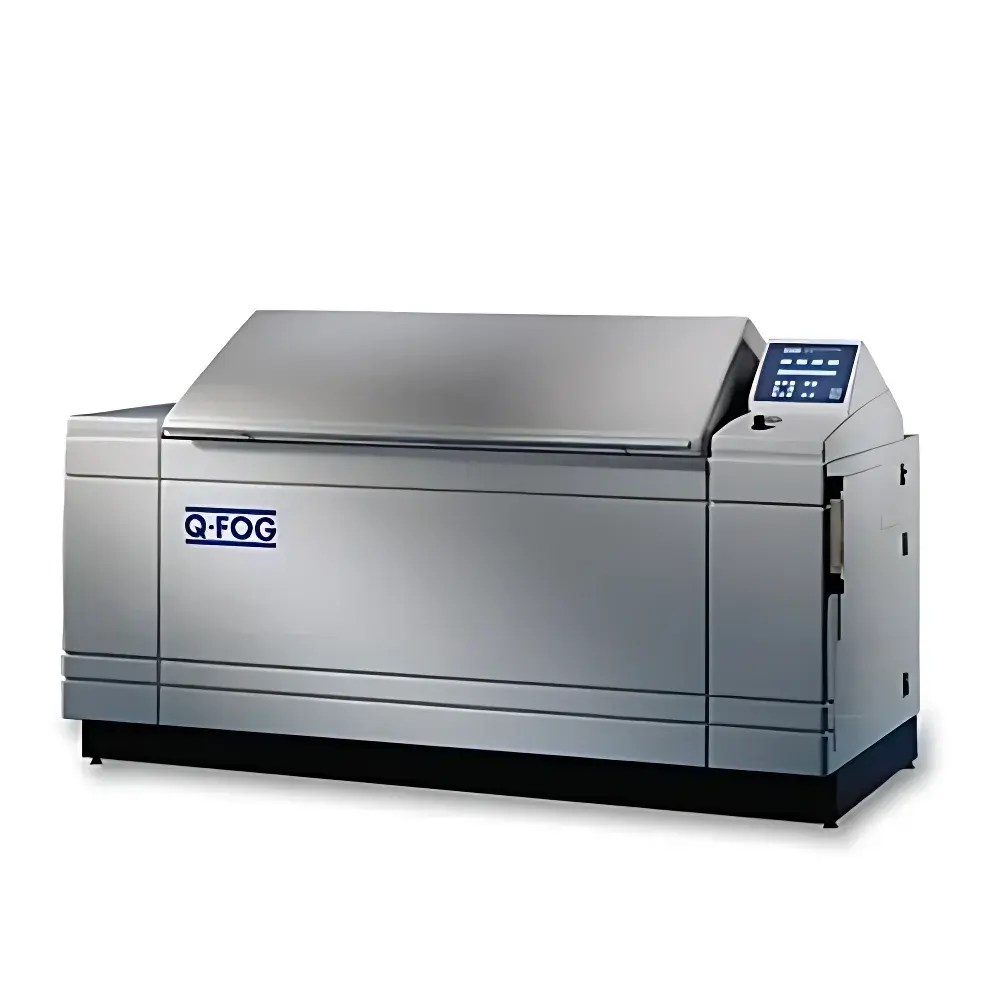
Q-Lab Q-FOG CCT1100 Cyclic Corrosion Test Chamber
| Brand | Q-Lab |
|---|---|
| Origin | USA |
| Model | Q-FOG CCT1100 |
| Spray Mode | Continuous Atomization |
| Spray Rate | 1–5 L/h per 180 cm² |
| Nozzle Pressure | 0.7–1 kg/cm² |
| Fog Removal Method | Air-Pressure-Assisted Exhaust |
| Salt Fog Deposition Rate | 1–2 mL per 80 cm²·h |
| Temperature Range | 10–80 °C |
Overview
The Q-Lab Q-FOG CCT1100 is a fully programmable cyclic corrosion test chamber engineered for high-fidelity simulation of real-world atmospheric degradation mechanisms. Unlike conventional salt spray chambers limited to static ASTM B117 conditions, the CCT1100 implements precisely controlled, multi-stage environmental cycles—including salt fog, high-humidity (up to 100% RH), drying, and ambient conditioning—enabling accelerated evaluation of coating integrity, galvanic corrosion, crevice attack, and underfilm corrosion in automotive, aerospace, electronics, and infrastructure materials. Its core architecture leverages Q-Lab’s proprietary dual-heater system (internal chamber heater + external air heater), rapid-response cooling fan, and steam-based humidity generation to achieve sub-5-minute transitions between critical test phases—essential for replicating field-relevant corrosion kinetics governed by electrochemical dissolution, hygroscopic salt deliquescence, and moisture-driven cathodic reactions.
Key Features
- True cyclic capability: independent control of salt fog, 100% RH humidification, forced-air drying, and ambient soak phases within a single chamber—eliminating cross-contamination and inter-chamber transfer errors.
- High-precision fog dispersion: variable-speed peristaltic pump regulates brine flow rate; adjustable compressed-air pressure controls droplet trajectory and deposition uniformity—ensuring reproducible fog density across the full 1100 L test volume (ASTM D2247-compliant deposition mapping verified).
- Robust FRP construction: fiber-reinforced polymer housing with thick-walled insulation minimizes thermal inertia, enabling rapid temperature ramping (e.g., 25 °C → 60 °C in <3 min) and stable setpoint maintenance under dynamic load.
- Integrated 120 L solution reservoir with inline filtration and low-level acoustic alarm—reducing operator intervention and supporting unattended operation for ≥7-day test sequences.
- Ergonomic access design: low-profile base and gas-spring-assisted hinged lid facilitate loading of specimens up to 554 kg (1200 lb); optional fixtures include 15° tilt sample racks (F-9008-K), 20 mm diameter suspension rods (F-9014-K), and customizable grid supports.
- Optical monitoring interface: reinforced acrylic viewport with integrated LED illumination enables real-time visual assessment without opening the chamber or disrupting test conditions.
Sample Compatibility & Compliance
The CCT1100 accommodates flat panels (75 × 150 mm standard), 3D components, and assemblies via modular mounting hardware. Its 1100 L internal volume supports large-scale validation per ISO 16701 (cyclic corrosion testing for automotive coatings), ASTM G85 Annex A5 (Prohesion® cycle), SAE J2334, and GMW 14872. All wetted components—including steam generator, brine lines, and reservoir—are constructed from corrosion-resistant materials (PVDF, CPVC, stainless steel 316) compatible with ASTM D1141 synthetic seawater and pH-adjusted chloride solutions. The system meets CE marking requirements and supports audit-ready documentation for GLP/GMP environments when paired with Q-Lab’s optional 21 CFR Part 11-compliant software package.
Software & Data Management
Controlled via Q-Lab’s Windows-based Q-FOG Controller Software, the CCT1100 enables creation, storage, and execution of multi-step test profiles with time-synchronized parameter logging (temperature, RH, fog status, elapsed time). Each cycle step defines target setpoints, ramp rates, dwell durations, and safety interlocks (e.g., max temperature cutoff, low-brine shutoff). Audit trails record user actions, profile modifications, and alarm events with timestamped entries. Optional data export formats include CSV, PDF reports, and direct integration with LIMS platforms via OPC UA or Modbus TCP protocols. Firmware updates are delivered through Q-Lab’s secure customer portal, ensuring ongoing compliance with evolving IEC 61000-4 electromagnetic compatibility standards.
Applications
- Automotive OEMs validating primer-surfacer-topcoat systems against cyclic exposure per Ford CETP, VW PV1210, and Chrysler MS-AK-901.
- Aerospace suppliers assessing aluminum alloy anodizing and chromate conversion coatings per AMS 2700 and MIL-DTL-5541.
- Electronics manufacturers evaluating conformal coating performance on PCBAs under mixed-flow environments (salt + humidity + thermal cycling).
- Infrastructure material developers qualifying zinc-aluminum-magnesium (ZAM) coated steels per EN ISO 14713-3 for marine service life prediction.
- Academic corrosion laboratories conducting mechanistic studies on localized pitting initiation using in-situ electrochemical impedance spectroscopy (EIS) probes mounted through dedicated chamber ports.
FAQ
What distinguishes the CCT1100 from basic salt spray chambers?
The CCT1100 implements fully automated, programmable environmental cycling—not just static salt fog. It integrates precise 100% RH humidification, controlled drying, and ambient conditioning in one chamber, eliminating manual specimen transfer and enabling correlation with real-world corrosion failure modes.
Is deionized water required for operation?
Yes. The steam generator and brine preparation system require ≤1 µS/cm resistivity water to prevent scaling, ensure consistent RH control, and maintain calibration stability over extended test durations.
Can the CCT1100 perform ASTM B117 testing?
Yes. It fully complies with ASTM B117 salt spray requirements—including specified fog deposition rate (1–2 mL/80 cm²·h), temperature uniformity (±2 °C), and solution pH—while offering expanded functionality beyond the standard.
What maintenance intervals are recommended?
Daily: visual inspection of fog nozzles and reservoir level. Weekly: cleaning of steam generator tank and brine filter. Quarterly: verification of temperature/RH sensor calibration using NIST-traceable references. Annual: comprehensive preventive maintenance including fan bearing inspection and air pressure regulator recalibration.
Does the system support remote monitoring?
Yes. With optional Ethernet connectivity and Q-Lab’s Q-FOG Remote Access Module, users can monitor real-time chamber status, receive email/SMS alerts for alarms, and initiate emergency shutdown from offsite locations—critical for 24/7 reliability validation programs.



