
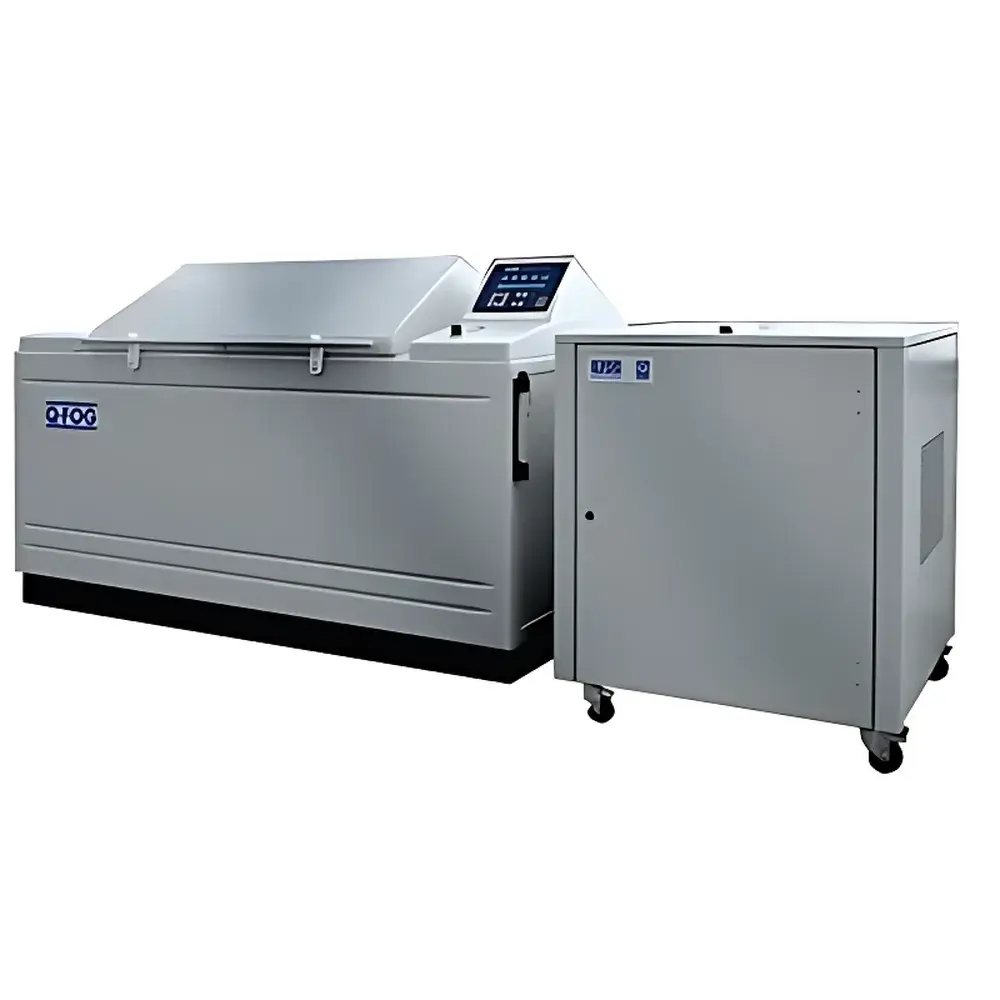

Q-LAB Q-FOG CRH600 Salt Spray Test Chamber
| Brand | Q-LAB |
|---|---|
| Origin | USA |
| Model | Q-FOG CRH600 |
| Salt Fog Deposition Rate | Adjustable and Calibratable per ASTM B117 & ISO 9227 |
| Temperature Range | 10°C to 70°C (operational, with ±0.5°C uniformity) |
| Humidity Control | 10–99% RH, programmable via integrated air pre-conditioning system |
| Cycle Programming | Multi-step sequences including salt spray, dry-off, high-humidity soak, and ambient recovery |
| Compliance | ASTM B117, ASTM G85 (Annexes A1–A5), ISO 9227, ISO 11997, GMW14872, SAE J2334, VW PV1210, Ford CETP, Renault D17 2025, Chrysler MS-AE-0004 |
Overview
The Q-LAB Q-FOG CRH600 Salt Spray Test Chamber is an advanced environmental test system engineered for high-fidelity simulation of corrosive atmospheric conditions—particularly those encountered in coastal, industrial, and automotive service environments. Unlike basic salt fog cabinets that rely solely on static NaCl mist generation, the CRH600 implements a fully integrated, microprocessor-controlled multi-phase corrosion cycle architecture grounded in electrochemical and hygrothermal acceleration principles. Its core innovation lies in the patented air pre-conditioning module, which enables precise, independent regulation of relative humidity (10–99% RH) and temperature (10–70°C) during each phase of a test sequence—without compromising chamber uniformity or introducing condensation artifacts. This capability supports true cyclic corrosion testing (CCT), where specimens undergo dynamically alternating exposures to salt deposition, controlled drying, saturated humid soak, and ambient stabilization—mimicking real-world degradation mechanisms such as crevice corrosion, galvanic coupling, and chloride-induced pitting.
Key Features
- Triple-phase environmental control: simultaneous and independent regulation of salt fog concentration, temperature, and relative humidity across all test phases
- Air pre-conditioning system with heated/humidified supply air ducting ensures stable RH ramping and eliminates localized condensation on test specimens
- Programmable spray nozzle array with adjustable droplet size distribution (median diameter ≈ 15–30 µm) and calibrated deposition rate (1.0–2.0 mL/80 cm²/hr per ASTM B117)
- Corrosion-resistant 316 stainless steel interior construction with seamless welded joints and double-gasketed observation window
- Integrated solution delivery subsystem featuring auto-refill reservoirs, conductivity monitoring, and pH-stabilized NaCl/acidified CuCl₂/CuSO₄ formulation support
- Compliance-ready audit trail: full event logging (temperature, RH, spray status, door openings), user access controls, and optional 21 CFR Part 11–compliant electronic signatures
Sample Compatibility & Compliance
The Q-FOG CRH600 accommodates flat panels (up to 610 × 914 mm), assembled components, coated fasteners, painted sheet metal, and multi-material automotive subassemblies. Specimen racks are configurable with non-metallic polymer-coated supports to prevent galvanic interference. The chamber meets stringent international regulatory requirements for qualification testing in regulated industries: it is validated per IQ/OQ protocols aligned with ISO/IEC 17025 and supports GLP/GMP documentation workflows. All standard test methods—including ASTM B117 (neutral salt spray), ASTM G85 Annex A3 (acidified salt fog), ISO 11997-1/2 (cyclic corrosion), and OEM-specific specifications (e.g., GMW14872, Ford CETP 00.00-L-467, VW PV1210)—are executable without hardware modification. Calibration certificates traceable to NIST standards are provided for temperature, RH, and deposition rate sensors.
Software & Data Management
Operation is managed via Q-LAB’s proprietary CRH Control Software v5.x, a Windows-based application supporting both local touchscreen and remote network operation. The interface provides real-time graphical display of all chamber parameters, drag-and-drop cycle programming, and automated pass/fail evaluation against user-defined thresholds. Data export conforms to ASTM E2911 and ISO/IEC 17025 reporting formats (CSV, PDF, XML). Audit logs include timestamped operator IDs, parameter changes, alarm events, and calibration history—retained for ≥10 years. Optional integration with LIMS platforms (e.g., LabVantage, Thermo Fisher SampleManager) is supported via OPC UA and RESTful API endpoints. Electronic records comply with FDA 21 CFR Part 11 requirements when configured with role-based authentication and digital signature modules.
Applications
The CRH600 serves as a primary qualification tool in R&D labs and QC departments across aerospace (ASTM D3359 adhesion validation), automotive (OEM coating durability, brake caliper corrosion resistance), electronics (PCB conformal coating integrity), and infrastructure (galvanized rebar, marine-grade fasteners). It is routinely employed to benchmark zinc-nickel plating performance, evaluate self-healing polymer coatings, assess aluminum alloy anodizing stability under chloride stress, and validate cathodic protection systems for offshore equipment. In academic corrosion science, its reproducible multi-phase cycling enables mechanistic studies of intergranular attack kinetics and hydrogen embrittlement onset under variable RH transients.
FAQ
What distinguishes the CRH600 from SSP and CCT models?
The CRH600 extends CCT functionality with active, programmable humidity control across all cycle phases—not just the soak stage—enabling precise RH ramping and dwell profiles critical for simulating dew-point transitions and hygroscopic salt deliquescence.
Can the CRH600 perform ASTM B117 testing?
Yes—fully compliant with ASTM B117, including mandatory chamber uniformity verification, solution pH and conductivity monitoring, and deposition rate calibration using standardized funnels.
Is remote monitoring supported?
Yes, via Ethernet-connected CRH Control Software with TLS-encrypted web interface, SNMP alerts, and email/SMS notification triggers for critical alarms.
What maintenance intervals are recommended?
Daily: solution level check and nozzle inspection; Weekly: humidity sensor verification and drain line flush; Annually: full calibration of temperature/RH sensors and pressure regulator servicing per Q-LAB Service Bulletin SB-CRH-2023-01.
Does the system support custom test method development?
Yes—users may define proprietary multi-step cycles with up to 999 segments, each specifying temperature setpoint, RH target, spray duration, airflow mode, and dwell time, with conditional branching based on elapsed time or sensor feedback.



