
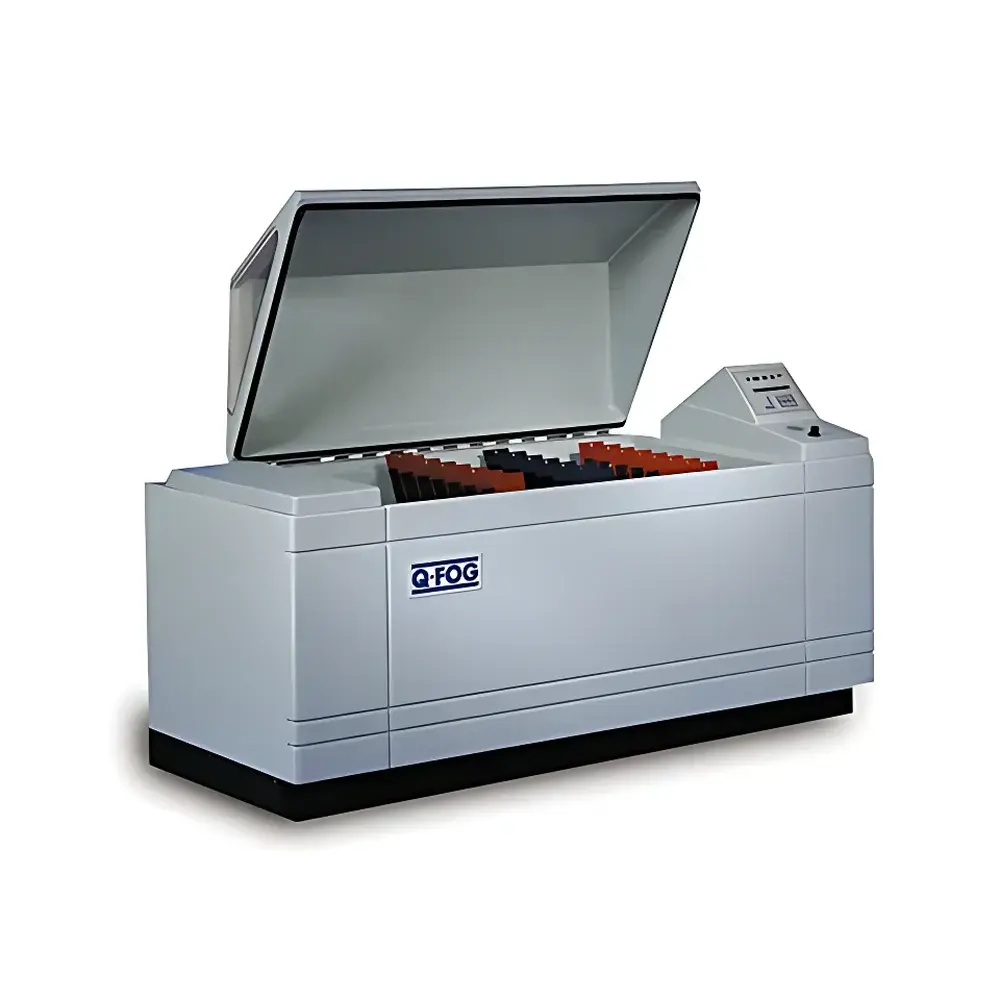
Q-Lab Q-FOG SSP Salt Spray and Cyclic Corrosion Test Chamber
| Brand | Q-Lab |
|---|---|
| Origin | USA |
| Model | Q-FOG SSP |
| Spray Mode | Continuous Spray |
| Spray Rate | 1–5 L/h per 180 cm² |
| Nozzle Air Pressure | 0.7–1 kg/cm² |
| De-misting Method | Pneumatic Air-Driven Fog Exhaust |
| Salt Solution Reservoir Capacity | 120 L |
| Operating Temperature Range | Ambient to 50°C (controlled per cycle phase) |
| Cycle Phases | Salt Fog, Dry-off, Rest (Static), Optional Humidity (CCT only) |
| Compliance | ASTM B117, ASTM G85 (Annex A1–A5), ISO 9227, BS 3900 F4/F9, DIN 50021 |
Overview
The Q-Lab Q-FOG SSP is a precision-engineered cyclic corrosion test chamber designed to replicate real-world atmospheric degradation mechanisms through programmable, multi-phase environmental exposure sequences. Unlike conventional single-condition salt spray chambers operating solely under ASTM B117 (35°C continuous neutral salt fog), the Q-FOG SSP implements scientifically validated cyclic protocols—including Prohesion®, ASTM G85 Annex A1 (acidified salt fog/dry), and custom-defined sequences—that simulate the natural wet-dry, temperature-fluctuating, and humidity-varying conditions responsible for electrochemical corrosion in service environments. Its core architecture integrates independent control of fog generation, thermal transition kinetics, and air handling—enabling rapid, repeatable shifts between salt fog, dry-off, and rest phases with high reproducibility across laboratories and production lots.
Key Features
- Programmable Multi-Phase Cycling: Executes up to four distinct exposure conditions—salt fog, hot dry-off, ambient rest, and (in CCT models) 100% RH—with microprocessor-based timing and temperature control per phase.
- Precise Fog Delivery System: Dual-regulated fog generation: a variable-speed peristaltic pump governs solution flow rate (1–5 L/h per 180 cm²), while an adjustable air pressure regulator (0.7–1 kg/cm²) controls droplet dispersion distance and uniformity—decoupling deposition rate from nozzle-to-specimen geometry.
- Rapid Thermal Transitions: Direct internal heating elements combined with high-capacity forced-air cooling/drying fans enable sub-10-minute transitions between fog (e.g., 35°C) and dry-off (e.g., 60°C), eliminating thermal inertia issues associated with water-jacketed chambers.
- Integrated 120-L Solution Reservoir: Features built-in saltwater filtration, low-level solution alarm, and purified water requirement (≥1 MΩ·cm resistivity) to prevent nozzle clogging and ensure long-term operational stability—supporting uninterrupted testing for ≥7 days per fill.
- Diagnostic & Safety Architecture: Self-diagnostic controller with predictive maintenance alerts, real-time fault logging, automatic safety shutdown on critical failures (e.g., heater overtemp, low solution level), and full audit trail capability for GLP/GMP-compliant validation.
- Operator-Centric Design: Front-access low-profile chamber with hinged top lid; optimized interior layout for easy specimen loading; intuitive touchscreen interface supporting both preset standards (ASTM, ISO, DIN) and user-defined cycles via simple parameter entry.
Sample Compatibility & Compliance
The Q-FOG SSP accommodates flat panels (75 mm × 150 mm) at 15° inclination (standard configuration), with capacity options of 160 specimens (SSP-600/CCT-600) or 240 specimens (SSP-1100/CCT-1100). Optional fixtures include universal 20 mm diameter hanging rods for 3D components and adjustable-angle panel racks (F-9008-K, F-9011-K). All configurations maintain strict compliance with specimen spacing requirements defined in ASTM B117 (≥25 mm edge clearance) and ISO 9227 (uniform fog distribution verified via six-collection-bottle kit, sold separately). The system meets regulatory expectations for method traceability under FDA 21 CFR Part 11 when paired with Q-Lab’s optional data logging and electronic signature modules.
Software & Data Management
Control firmware supports full-cycle programming with time/temperature/fog-on parameters per phase, plus conditional branching (e.g., “if humidity >95%, delay dry-off by 5 min”). Real-time monitoring displays current phase, elapsed time, chamber temperature, and solution level. Exportable CSV logs capture timestamped chamber status, setpoints, and alarm events—structured for integration into LIMS or quality management systems. Optional Q-Lab’s Q-FOG Controller Software enables remote configuration, batch cycle deployment, and automated report generation aligned with ISO/IEC 17025 documentation requirements.
Applications
The Q-FOG SSP serves as a primary qualification tool for evaluating corrosion resistance of coated metals, electroplated surfaces, automotive trim, aerospace fasteners, marine hardware, and printed circuit board finishes. It is widely adopted in R&D labs for comparative screening of primer/topcoat systems, in QC departments for incoming material verification against OEM specifications (e.g., GMW14872, Ford CETP), and in third-party testing facilities accredited to ISO/IEC 17025. Its ability to run Prohesion® cycles makes it especially valuable for assessing industrial coil coatings and architectural aluminum anodized finishes where chloride-induced pitting and filiform corrosion dominate field failure modes.
FAQ
What standards does the Q-FOG SSP support?
ASTM B117, ASTM G85 (Annex A1–A5), ISO 9227, BS 3900 F4/F9, DIN 50021, JIS Z2371, and custom protocols defined per customer specifications.
Is deionized water mandatory?
Yes—purified water with resistivity ≥1 MΩ·cm is required to prevent scaling and nozzle blockage; tap or distilled water alone is insufficient.
Can I run humidity-only cycles on the SSP model?
No—100% relative humidity cycling is exclusive to the CCT-series models; the SSP supports only salt fog, dry-off, and rest phases.
How often does the peristaltic pump tubing require replacement?
Typical service interval is 6–12 months depending on usage frequency; one-year maintenance kits (F-9020-K) include eight replacement tubes, air filters, and solution filters.
Does the Q-FOG SSP provide calibration certificates?
Yes—NIST-traceable temperature and fog deposition calibration services are available upon request, with documented uncertainty budgets compliant with ISO/IEC 17025.



