
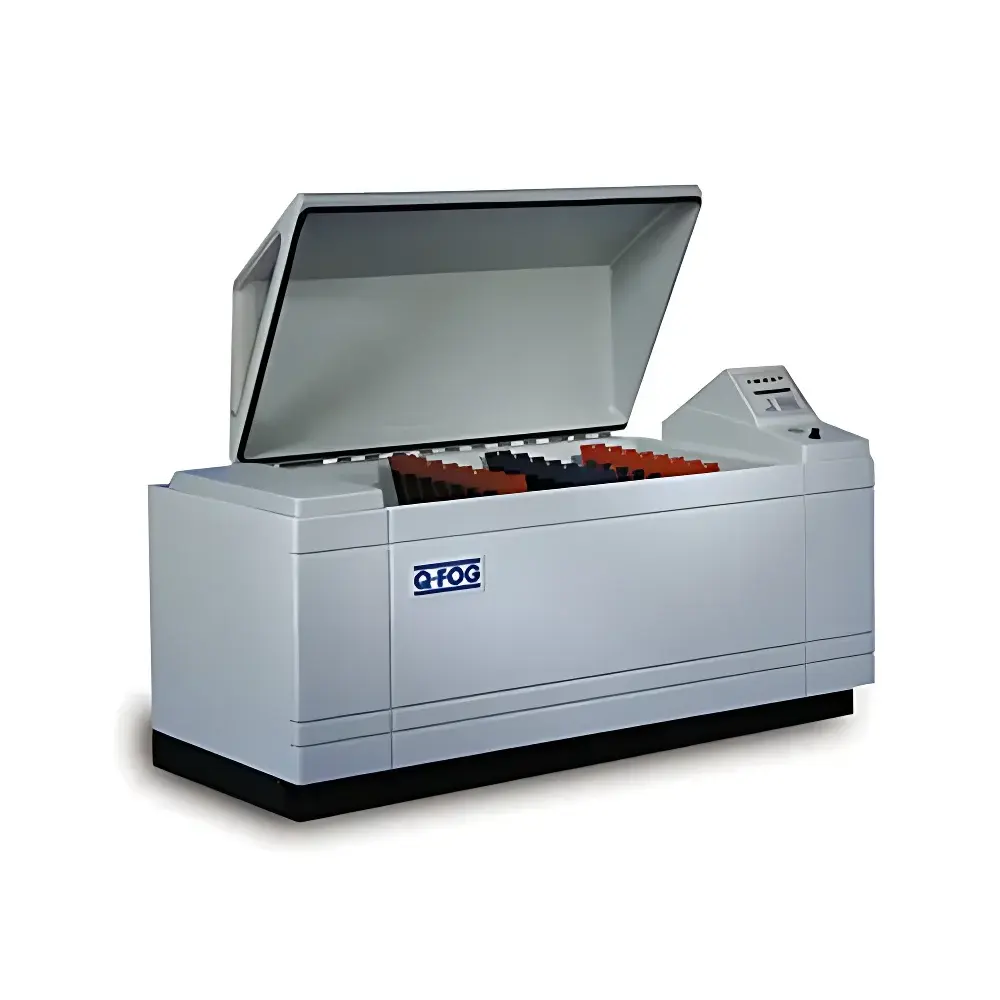
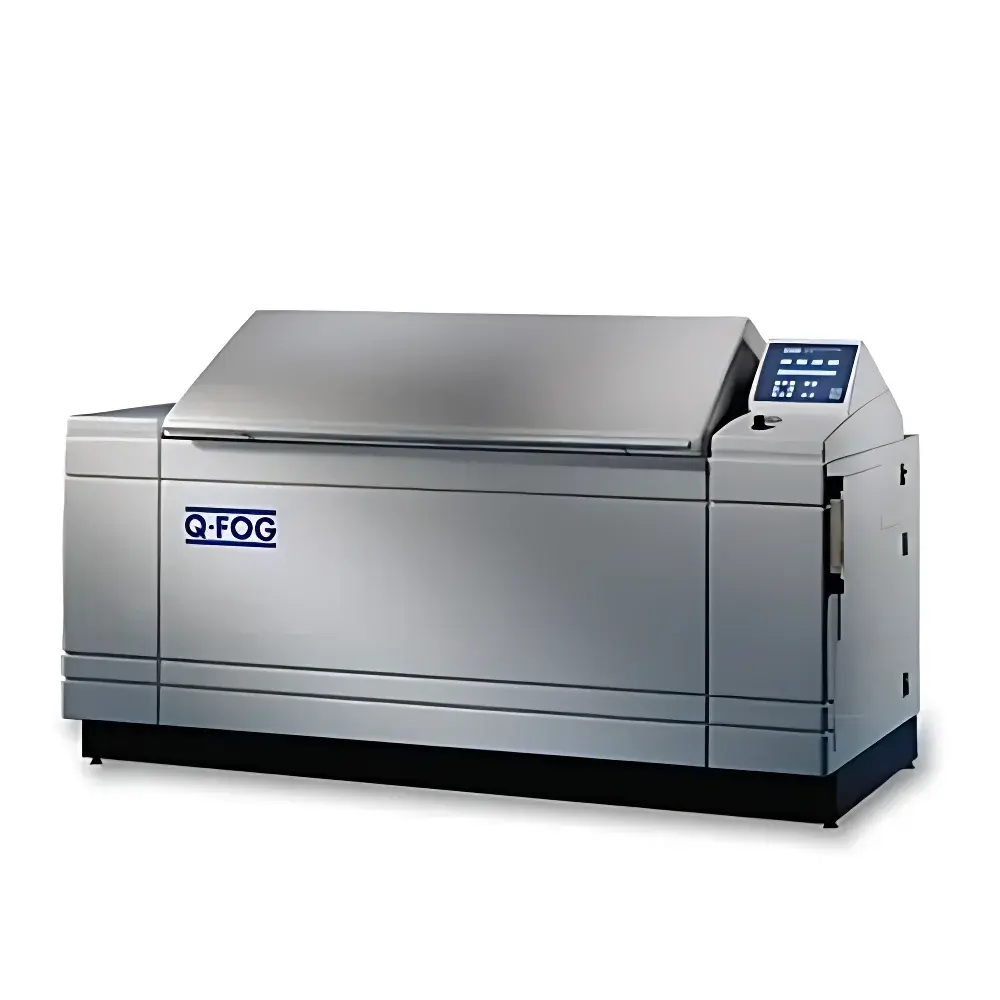
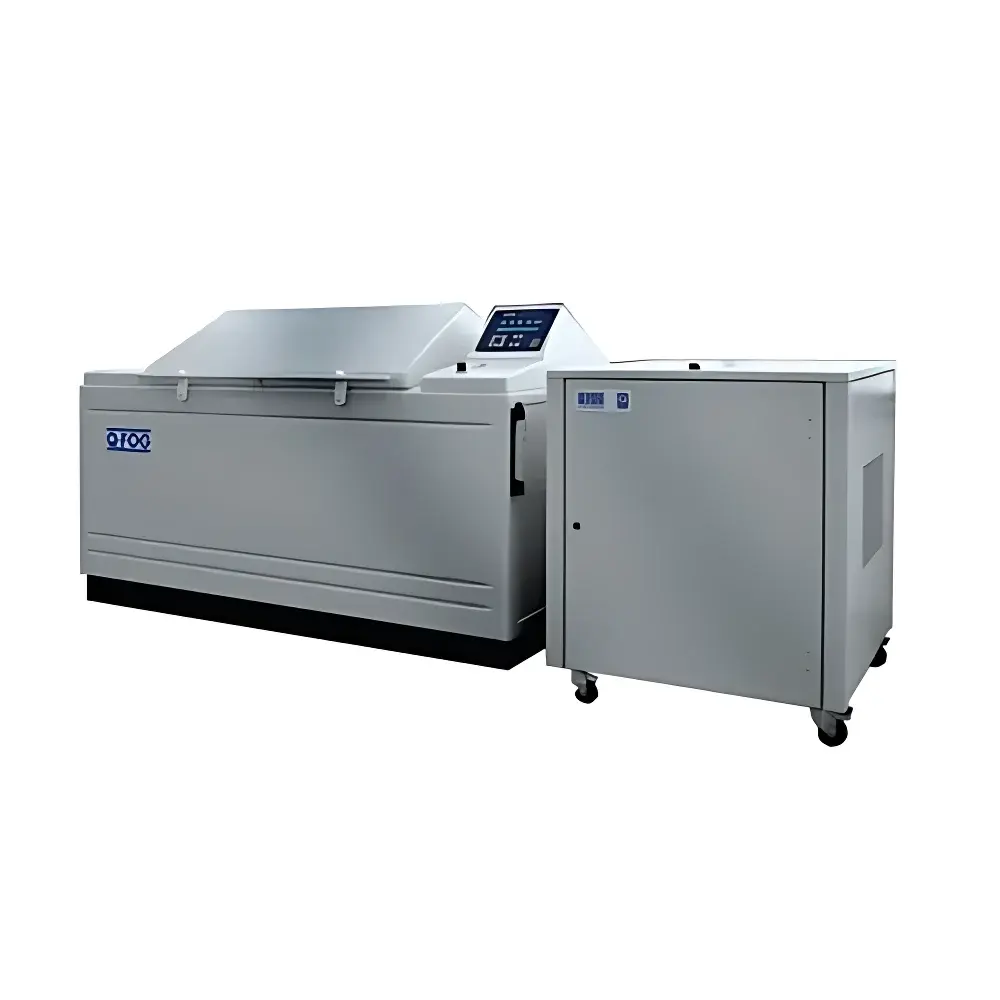
Q-Lab Q-FOG SSP600 Salt Spray Test Chamber
| Brand | Q-Lab |
|---|---|
| Origin | USA |
| Model | Q-FOG SSP600 |
| Spray Mode | Continuous Spray |
| Spray Rate | 1–5 L/h per 180 cm² |
| Nozzle Pressure | 0.7–1 kg/cm² |
| Fog Removal Method | Air-Compression Exhaust |
| Salt Fog Deposition Rate | 1–2 mL per 80 cm²·h |
| Temperature Range | 20–60 °C |
Overview
The Q-Lab Q-FOG SSP600 Salt Spray Test Chamber is an ASTM B117- and ISO 9227-compliant corrosion testing system engineered for high-reproducibility accelerated salt fog exposure. It operates on the principle of controlled continuous nebulization of standardized saline solution (typically 5% NaCl by mass) under regulated temperature and pressure conditions, generating a uniform, gravimetrically verified fog deposition across test specimens. Unlike humidity-cycling chambers, the SSP600 is purpose-built for traditional salt spray and Prohesion™ protocols—emphasizing rapid thermal response, precise deposition control, and long-term operational stability without integrated high-humidity or condensation cycles. Its reinforced fiberglass-reinforced polymer (FRP) construction eliminates internal metallic structural components, ensuring immunity to chamber corrosion and eliminating cross-contamination risks from rust or leaching. The unit is designed for laboratories requiring strict adherence to international corrosion test standards while maintaining low total cost of ownership through simplified maintenance architecture and extended solution reservoir runtime.
Key Features
- Fiberglass-reinforced polymer (FRP) chamber body with zero internal steel framework—eliminates corrosion-induced structural degradation and ensures long-term dimensional stability.
- Variable-speed peristaltic pump enabling precise, repeatable salt fog deposition rate control (1–2 mL/80 cm²·h), independently adjustable from nozzle air pressure (0.7–1 kg/cm²).
- Integrated 120 L internal solution reservoir with built-in saltwater filtration and low-level audible/visual alarm—supports uninterrupted operation for ≥7 days under typical test cycles.
- Microprocessor-based controller with intuitive touchscreen interface; supports user-defined test profiles, real-time status monitoring, and full diagnostic logging.
- Self-diagnostic system with proactive maintenance alerts, fault code reporting, automatic safety shutdown, and event-triggered notifications for critical parameters (e.g., temperature deviation, low solution level, pressure loss).
- Rapid thermal response architecture: high-wattage internal heaters combined with high-CFM cooling/drying fans enable fast transitions between ambient and elevated temperatures (20–60 °C), essential for Prohesion™ cycling fidelity.
Sample Compatibility & Compliance
The Q-FOG SSP600 accommodates up to 160 standard test panels (75 mm × 150 mm) on removable, corrosion-resistant sample racks. It fully complies with ASTM B117 (Standard Practice for Operating Salt Spray (Fog) Apparatus), ISO 9227 (Corrosion tests in artificial atmospheres — Salt spray tests), ASTM G85 Annexes A1–A5 (Prohesion™, SO₂, acidic salt, cyclic acidified salt fog), DIN 50021, BS 3900 F4 & F9, and GB/T 10125. It does not support 100% RH conditioning or humidity-dry cycling—functions reserved for CCT-series models. All compliance-critical parameters—including fog deposition uniformity, pH stability (6.5–7.2), and temperature setpoint accuracy (±2 °C)—are validated per manufacturer’s calibration protocol and traceable to NIST-traceable references. The chamber meets general laboratory safety requirements per IEC 61010-1 and is compatible with GLP documentation workflows when paired with optional Q-Lab’s Q-Support software audit trail module.
Software & Data Management
The embedded controller provides local programming, real-time parameter display, and cycle progress tracking. While the SSP600 lacks Ethernet connectivity or cloud integration out-of-the-box, its event log exports via USB flash drive in CSV format—including timestamps, setpoints, actual values, alarm codes, and maintenance flags. For regulated environments, Q-Lab’s optional Q-Support software (v5.0+) enables PC-based remote monitoring, automated report generation (PDF/Excel), electronic signature support, and 21 CFR Part 11-compliant audit trails—including user access logs, parameter change history, and electronic record retention. Calibration certificates, maintenance records, and test run metadata are stored separately and can be archived in accordance with ISO/IEC 17025 document control policies.
Applications
The Q-FOG SSP600 is routinely deployed in quality assurance labs for evaluating coating adhesion, galvanic protection integrity, passivation effectiveness, and material resistance to chloride-induced pitting and crevice corrosion. Typical use cases include pre-qualification of automotive trim coatings (SAE J2334), aerospace fastener plating (AMS 2700), marine hardware finishes (MIL-STD-810H Method 509.6), and architectural metal cladding systems (AAMA 2603/2604). Its Prohesion™ capability makes it suitable for simulating industrial coastal or de-icing salt environments where alternating wet/dry and thermal transients accelerate failure modes not captured by static salt fog alone. It is widely adopted by Tier-1 suppliers, independent testing laboratories (e.g., SGS, Intertek), and R&D departments validating ASTM D610, D714, D1654, and ISO 4628 series rating standards.
FAQ
Does the Q-FOG SSP600 support humidity cycling or condensation phases?
No. The SSP600 is configured exclusively for continuous salt spray and Prohesion™ cycling (salt fog + dry-off). Humidity hold (100% RH) and condensation phases require the CCT-series chamber.
What type of water must be used in the SSP600?
Deionized or distilled water with conductivity ≤1 µS/cm is mandatory. Tap or softened water will cause nozzle clogging, pump wear, and invalid test results due to mineral precipitation.
Is the salt fog deposition rate independently verifiable during operation?
Yes. The standard collection funnel method per ASTM B117 Section 7.2 is supported; eight 10-cm² funnels distributed across the test area allow gravimetric verification every 24 hours.
Can the SSP600 be integrated into a LIMS or enterprise QA system?
Direct integration is not native, but Q-Support software with OPC UA or REST API extensions (via Q-Lab’s Enterprise Integration Kit) enables bidirectional data exchange with validated LIMS platforms under controlled validation protocols.
What is the recommended preventive maintenance interval?
Q-Lab recommends quarterly inspection of nozzles, pump tubing, and air pressure regulators; semiannual verification of temperature sensors and deposition uniformity; and annual full calibration per Q-Lab Service Bulletin SB-SSP-01.



