
Q-Lab Q-FOG SSP600 Salt Spray Test Chamber
| Brand | Q-Lab |
|---|---|
| Origin | USA |
| Model | SSP600 |
| Chamber Capacity | 640 L |
| Sample Capacity | 160 × 75 mm × 150 mm test panels |
| Salt Solution Delivery | Variable-speed peristaltic pump |
| Temperature Range | Ambient to 50 °C (operational range per ASTM B117 & ISO 9227) |
| Corrosion-Resistant Construction | Fiberglass-reinforced polymer (FRP) interior, no internal steel structure |
| Compliance | ASTM B117, ASTM G85 (Annex A5 Prohesion), ISO 9227, DIN 50021, BS 3900 F4/F9, GB/T 10125 |
| Humidity Control | Not supported (SSP series lacks 100% RH conditioning) |
| Internal Reservoir | 120 L deionized water-compatible tank with level sensor and inline salt solution filter |
Overview
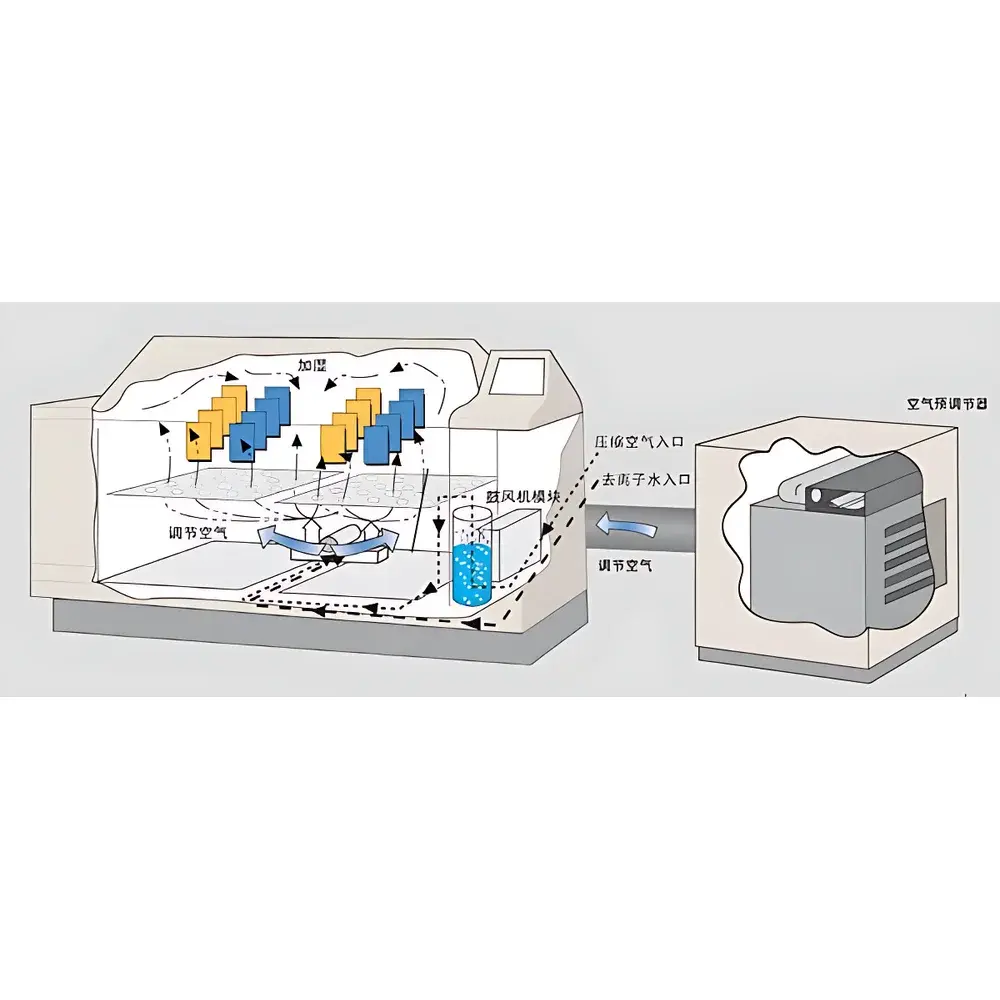
The Q-Lab Q-FOG SSP600 Salt Spray Test Chamber is an entry-level, high-reliability cyclic corrosion testing system engineered for precision execution of standardized salt fog exposure protocols. It operates on the principle of continuous or intermittent atomization of a conditioned sodium chloride (NaCl) or modified electrolyte solution onto test specimens under controlled thermal conditions. Unlike conventional humidity-controlled chambers, the SSP600 is purpose-built for salt spray and Prohesion-type cycling—where rapid transitions between salt fog, ambient dwell, and low-humidity drying phases simulate aggressive atmospheric degradation mechanisms without requiring saturated humidity conditioning. Its all-FRP (fiberglass-reinforced polymer) construction eliminates internal metallic components, ensuring long-term resistance to chloride-induced pitting and galvanic corrosion within the chamber cavity. Designed for laboratories performing routine compliance testing, quality assurance validation, and comparative material screening, the SSP600 delivers reproducible, traceable results aligned with globally recognized corrosion standards.
Key Features
- Fiberglass-reinforced polymer (FRP) chamber interior—zero ferrous structural elements—to prevent chamber corrosion and cross-contamination
- Variable-speed peristaltic pump for precise, adjustable salt solution delivery (0.5–2.0 mL/h/cm² typical deposition rate, compliant with ASTM B117 requirements)
- Microprocessor-based controller with intuitive touchscreen interface for programming multi-step cycles (fog, dry, ambient dwell)
- Integrated self-diagnostic system providing real-time fault logging, maintenance alerts (e.g., reservoir level, pump status), and automatic shutdown upon critical parameter deviation
- 120 L internal solution reservoir with built-in level sensor, particulate filtration, and compatibility with deionized or distilled water only
- Rapid thermal response enabled by direct-chamber heating elements and high-CFM forced-air cooling/drying fans—no water-jacketed thermal mass to impede cycle transitions
- Chamber volume of 640 L accommodates up to 160 standard test panels (75 mm × 150 mm), optimized for rack-based sample loading and uniform spray distribution
Sample Compatibility & Compliance
The Q-FOG SSP600 supports flat-panel, coated-metal, electroplated, and polymer-coated substrates conforming to standard specimen geometry defined in ASTM B117, ISO 9227, and GB/T 10125. It is validated for Prohesion cycling (ASTM G85 Annex A5), which alternates NaCl fog with low-humidity drying and ambient rest phases—mimicking coastal-industrial exposure more closely than static salt fog alone. The system meets the physical and operational requirements of ISO/IEC 17025-accredited laboratories when operated with documented calibration procedures, traceable temperature sensors, and verified salt solution concentration (5.0 ± 0.1 % w/w NaCl). While not equipped for full humidity control (i.e., no 100 % RH conditioning), its design strictly adheres to the environmental parameters mandated for SSP-class testing per DIN 50021 and BS 3900 F4/F9. All firmware and controller logs are timestamped and exportable for GLP/GMP audit trails.
Software & Data Management
The embedded Q-FOG controller runs proprietary firmware supporting up to 100 user-defined test programs, each with up to 99 steps. Cycle data—including elapsed time, chamber temperature, pump activation status, and alarm history—is stored internally for ≥30 days and exportable via USB to CSV format. No external PC dependency is required for routine operation; however, optional Q-Lab’s Q-FOG Software Suite (Windows-based) enables remote monitoring, automated report generation (PDF/Excel), and integration with LIMS environments. All system events—including power interruptions, manual overrides, and calibration reminders—are logged with ISO 8601 timestamps. The controller complies with FDA 21 CFR Part 11 requirements when used with electronic signature-enabled software modules and appropriate access controls.
Applications
The SSP600 is routinely deployed in automotive OEM supplier qualification (e.g., fastener plating, brake caliper coatings), aerospace component passivation verification, marine hardware durability assessment, and electronics enclosure corrosion resistance validation. It serves as a primary tool for QC labs conducting incoming material inspection per ASTM B117, R&D teams evaluating primer adhesion under cyclic stress, and certification bodies performing third-party conformity testing for ISO 9001 or IATF 16949 systems. Its Prohesion capability makes it especially suitable for accelerated evaluation of organic coatings where chloride ingress combined with thermal cycling drives blistering and undercutting failure modes—phenomena poorly replicated by static salt fog alone.
FAQ
Does the SSP600 support 100% relative humidity conditioning?
No. The SSP600 is limited to salt fog, ambient dwell, and forced-air drying. For full humidity cycling (including 100% RH soak), the CCT-series models are required.
What type of water must be used in the internal reservoir?
Deionized or distilled water only. Tap or softened water will cause scaling, clogging, and premature pump failure.
Is the chamber temperature independently calibrated?
Yes—each unit ships with NIST-traceable temperature sensor calibration certificate; field recalibration is supported using certified reference probes.
Can test data be exported for regulatory submission?
Yes. All cycle logs, alarms, and timestamps are exportable in CSV format; optional Q-FOG Software Suite adds PDF reporting with digital signatures for 21 CFR Part 11 compliance.
What maintenance intervals are recommended?
Salt solution filter replacement every 3 months or 500 hours; pump tubing replacement every 6 months; full chamber cleaning after every 1000 hours of operation or per internal log prompts.



