
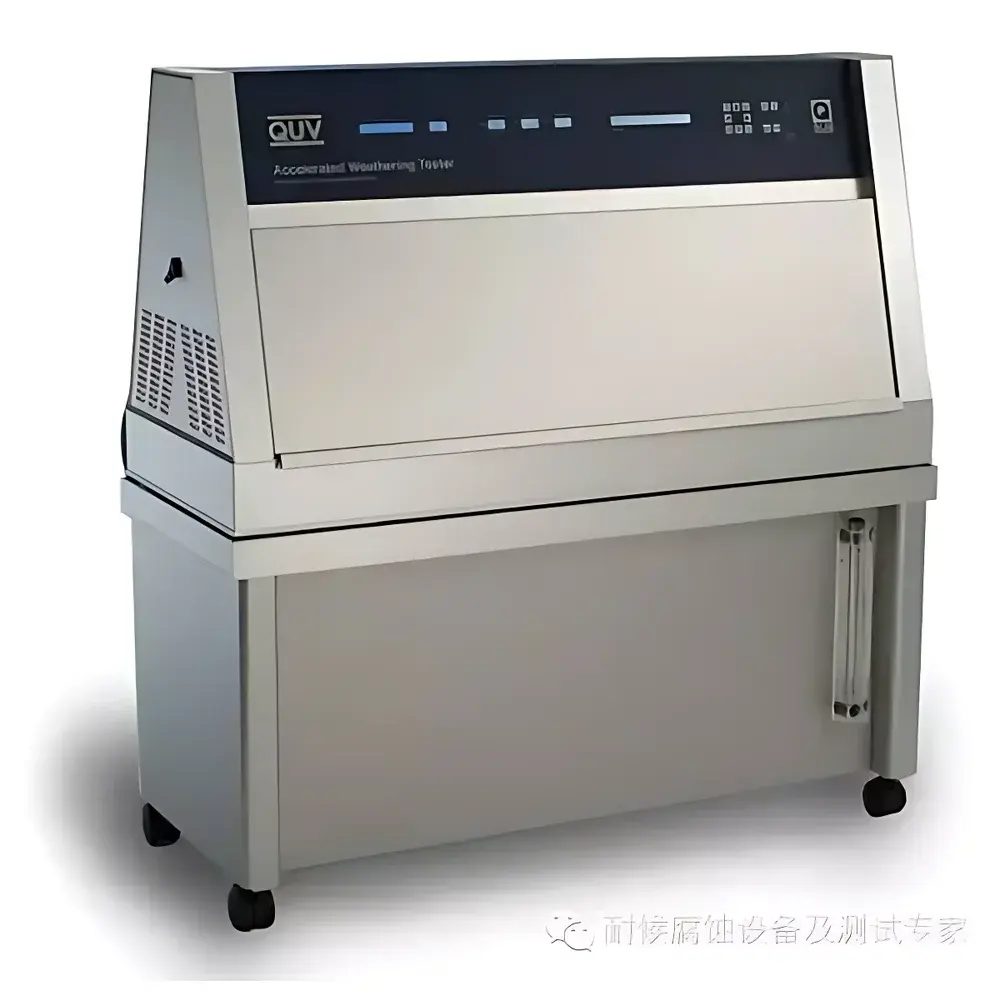
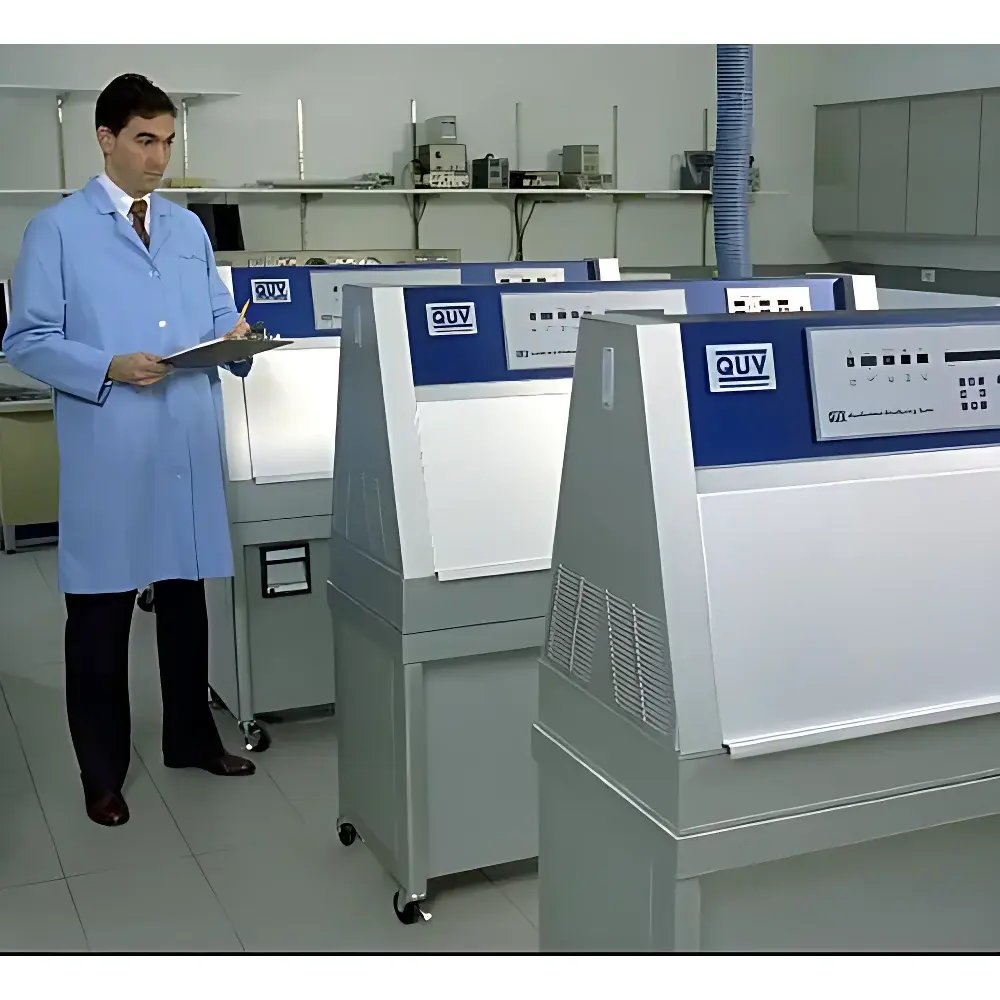
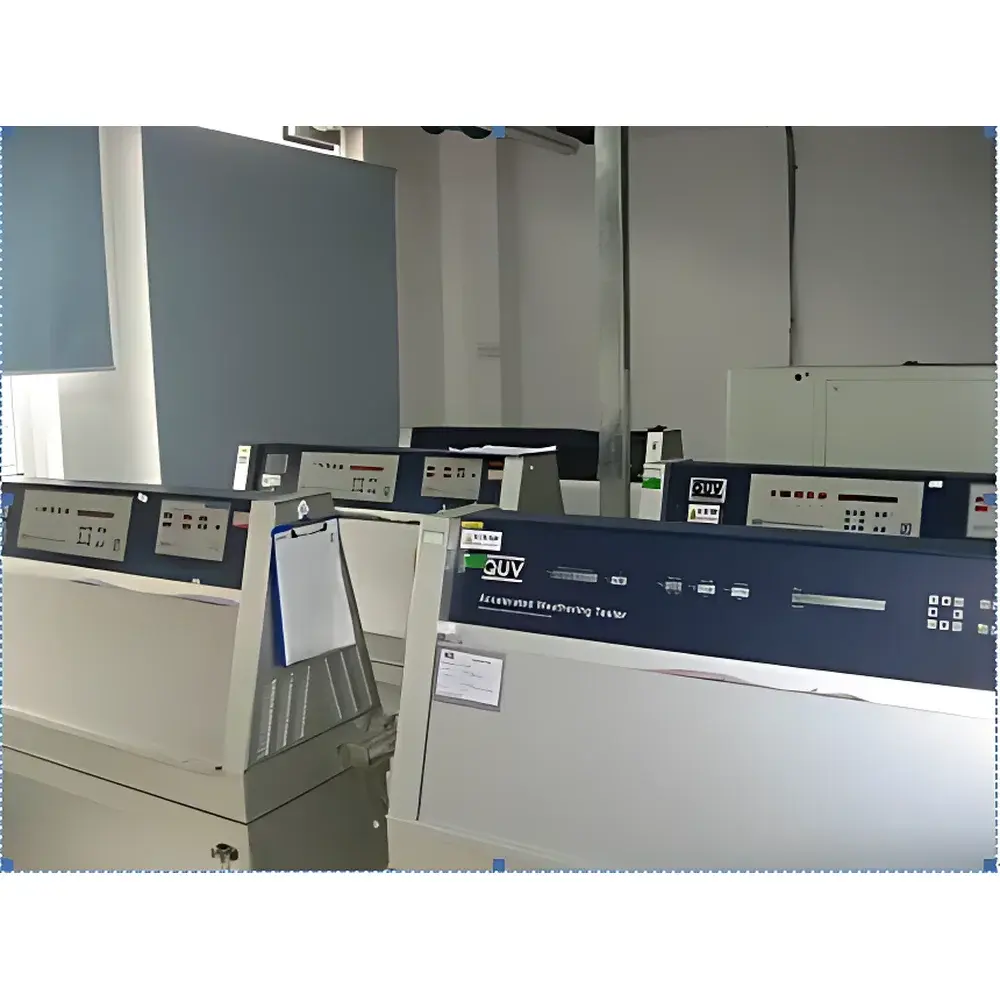
Q-LAB QUV Accelerated Weathering Tester
| Brand | Q-LAB |
|---|---|
| Origin | USA |
| Manufacturer Type | Authorized Distributor |
| Origin Category | Imported |
| Model | QUV Accelerated Weathering Tester |
| Price | Upon Request |
| UV Wavelength Range | 280–340 nm |
| Sample Chamber Dimensions (L×W×H) | Available Upon Request |
| Illumination Temperature Range | Available Upon Request |
| Black Panel Temperature Range | Available Upon Request |
Overview
The Q-LAB QUV Accelerated Weathering Tester is an industry-standard ultraviolet (UV) exposure system engineered for precision simulation of solar UV radiation damage on polymeric, coated, and composite materials. Unlike full-spectrum xenon arc testers, the QUV employs fluorescent UV lamps to replicate the most photochemically aggressive portion of natural sunlight—the short-wavelength UV region (280–340 nm)—which accounts for >95% of polymer degradation mechanisms including chain scission, oxidation, and chromophore breakdown. This targeted spectral approach enables accelerated, reproducible, and cost-efficient evaluation of material durability under controlled cyclic conditions of UV irradiance, condensation humidity, and elevated temperature. The system operates on the principle of controlled photodegradation kinetics, where UV photon energy drives photochemical reactions in organic matrices, while thermal acceleration (via black panel or air temperature control) enhances reaction rates without altering fundamental degradation pathways.
Key Features
- Fluorescent UV lamp options: UVA-340 (simulating terrestrial sunlight UV), UVA-351 (filtering through window glass), and UVB-313EL (high-intensity, accelerated screening—used only with explicit user consent per ISO 4892-3 Annex B)
- Programmable irradiance control with real-time feedback via calibrated UV sensor
- Condensation cycle generation via heated water reservoir and controlled chamber wall cooling—mimicking nocturnal dew formation without mechanical spray nozzles
- Optional water spray function for simulating rain-induced thermal shock and surface erosion (QUV/Spray configuration)
- Black panel thermometer (BPT) and chamber air temperature monitoring compliant with ASTM G154 Class I/II requirements
- Robust stainless-steel chamber construction with quartz-filtered UV-transparent lid for uniform irradiance distribution
- Integrated safety interlocks, lamp end-of-life detection, and automatic lamp cycling logic
Sample Compatibility & Compliance
The QUV accommodates flat specimens up to 76 mm × 152 mm (standard rack dimensions), with optional fixtures for curved, multi-angle, or small-part mounting. It supports rigid substrates (metal panels, plastic sheets), flexible films, textiles, and coated composites—provided samples meet dimensional stability and thermal expansion constraints during cycling. All QUV models are designed and validated to meet international regulatory and industry testing standards, including but not limited to: ASTM G154 (Standard Practice for Operating Fluorescent Ultraviolet (UV) Lamp Apparatus for Exposure of Non-Metallic Materials), ASTM D4587 (Standard Practice for Fluorescent UV-Condensation Exposures of Paint and Related Coatings), ISO 4892-3 (Plastics — Methods of Exposure to Laboratory Light Sources — Part 3: Fluorescent UV Lamps), JIS K 5600-7-8, SAE J2020, and GMW 14124. Data traceability, calibration records, and operational logs support GLP/GMP audit readiness and FDA 21 CFR Part 11 compliance when integrated with Q-LAB’s optional QUV Software Suite.
Software & Data Management
The QUV operates via embedded microcontroller firmware supporting pre-programmed test cycles (e.g., UV/condensation, UV/spray, multi-step ramp profiles) and manual parameter adjustment. Optional Q-Support™ software enables remote monitoring, real-time irradiance trending, event logging (lamp start/end, cycle transitions, temperature excursions), and export of CSV-formatted datasets for statistical analysis. All test parameters—including cumulative UV dose (kJ/m² @ 340 nm), black panel temperature history, and condensation duration—are time-stamped and stored with device serial number and operator ID. Audit trails include user authentication, parameter change history, and calibration certificate references—fully aligned with ISO/IEC 17025 documentation requirements for accredited laboratories.
Applications
The QUV is widely deployed across R&D, quality assurance, and regulatory submission workflows for automotive exterior trim (PP, TPO, PC/ABS), architectural coatings (acrylics, fluoropolymers), aerospace sealants, photovoltaic encapsulants (EVA, POE), textile UV stabilizers, roofing membranes (TPO, EPDM), and medical device packaging films. Its predictive capability is particularly valued in comparative ranking studies (e.g., formulation optimization, supplier qualification) and failure mode analysis—such as correlating gloss loss (ASTM D523) or color shift (ΔE CIE L*a*b*, ASTM D2244) with UV dose thresholds. While not intended for absolute lifetime prediction, QUV data provides statistically robust relative rankings that correlate strongly with field performance under similar climatic exposure regimes (e.g., Arizona desert, Florida subtropical).
FAQ
How does the QUV differ from xenon arc weatherometers like the Q-SUN?
The QUV uses fluorescent UV lamps targeting only the 280–400 nm band, prioritizing photochemical efficiency and test speed. The Q-SUN reproduces full-spectrum sunlight (295–800 nm), enabling evaluation of visible-light fading and IR thermal effects—but at higher operational cost and lower UV intensity per watt.
Can the QUV simulate daylight exposure behind glass?
Yes—using UVA-351 lamps, which replicate the UV spectrum transmitted through standard window glass (cut-off ~320 nm), making it suitable for indoor product validation per ISO 105-B02 and AATCC TM16.
Is UVB-313EL recommended for all materials?
No—UVB-313EL emits significant energy below 310 nm, inducing non-representative degradation in many polymers. Its use requires documented customer agreement and is restricted to screening applications per ISO 4892-3 Clause 7.3.
What maintenance intervals are required?
Lamp replacement every 1,600–2,000 hours (UVA-340/UVA-351) or 500–1,000 hours (UVB-313EL); quarterly calibration of UV sensor and black panel thermometer; annual verification of condensation uniformity per ASTM G154 Annex A3.
Does the QUV meet ISO/IEC 17025 accreditation requirements?
Yes—when operated with documented procedures, traceable calibration certificates (NIST-traceable UV radiometer), and version-controlled firmware/software, the QUV satisfies measurement uncertainty and record-keeping clauses of ISO/IEC 17025:2017 Section 7.7.



