
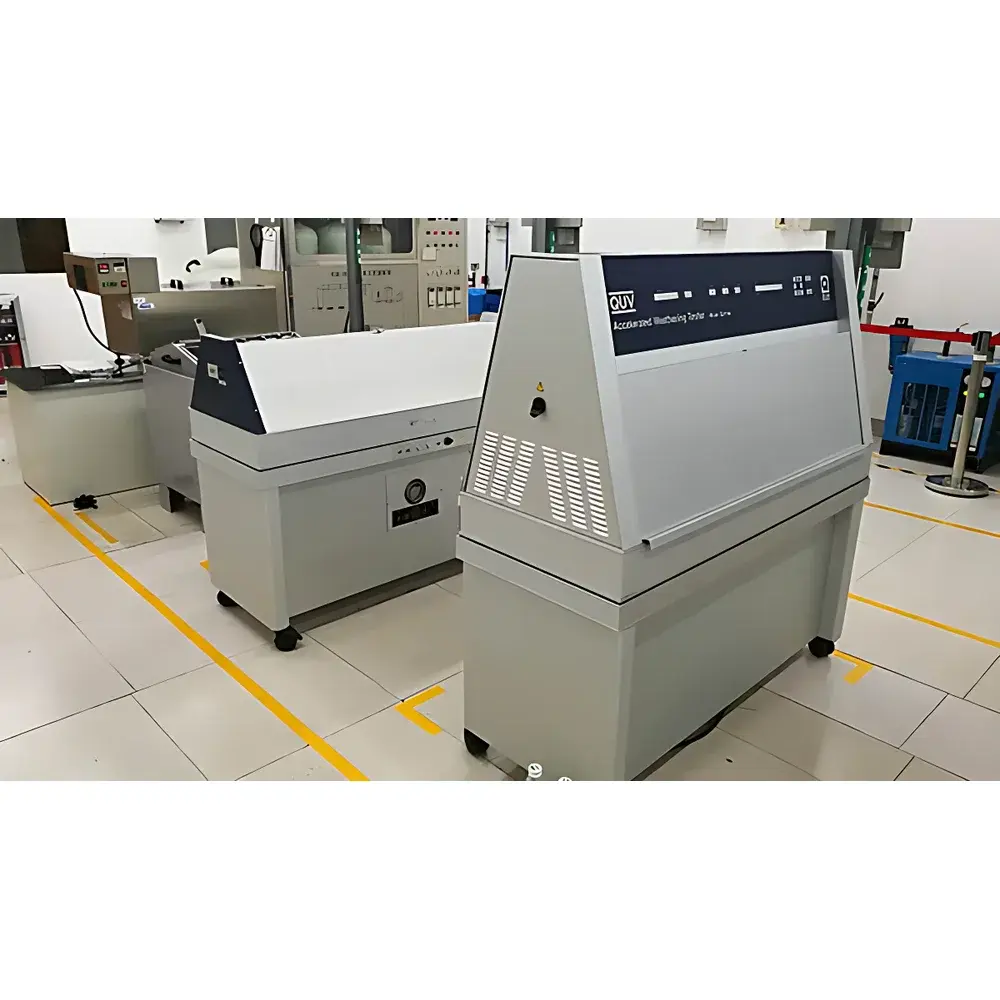
Q-LAB QUV Accelerated Weathering Tester
| Brand | Q-LAB |
|---|---|
| Origin | USA |
| Manufacturer Type | Authorized Distributor |
| Product Origin | Imported |
| Model | QUV Accelerated Weathering Tester |
| Quotation | Available Upon Request |
| UV Wavelength Range | 320–400 nm (UVA/UVB) |
| Sample Capacity | Up to 48 specimens (75 mm × 150 mm) |
| Lamp Life | ≥5,000 hours |
| Compliance | ASTM G154, ISO 4892-3, SAE J2020, GB/T 14522, JIS D 0205 |
| Control System | Radiant Power Closed-Loop Feedback, Self-Diagnostic Alarms, Maintenance Reminders |
Overview
The Q-LAB QUV Accelerated Weathering Tester is an industry-standard benchtop environmental test chamber engineered for precision simulation of solar ultraviolet (UV) radiation, condensation, and water spray exposure. It operates on the principle of controlled fluorescent UV irradiation—using calibrated UVA or UVB lamp arrays—to replicate photochemical degradation mechanisms observed in real-world outdoor service environments. Unlike broad-spectrum xenon arc or carbon arc systems, the QUV platform isolates the most damaging spectral region (295–400 nm) responsible for polymer chain scission, pigment fading, surface oxidation, and loss of mechanical integrity. Its design adheres to the fundamental premise that accelerated testing yields comparative—not absolute—durability rankings; results are statistically meaningful only when used to rank material performance relative to reference standards under identical exposure protocols.
Key Features
- Fluorescent UV lamp technology with spectrally defined output: UVA-340 (optimal solar UV match, 295–365 nm), UVB-313EL (high-intensity, accelerated screening), or UVA-351 (window-filtered UV for indoor applications)
- Radiant power closed-loop control system continuously monitors and adjusts UV irradiance in real time, ensuring repeatability across laboratories and over extended test durations
- Condensation cycle simulates nocturnal dew formation via heated water reservoir and controlled chamber temperature gradient—fully compliant with ASTM G154 Cycle 1 and ISO 4892-3 Method A
- Optional water spray function replicates thermal shock and surface erosion effects of rainfall (ASTM G154 Cycle 4)
- Integrated self-diagnostic firmware provides real-time fault detection, lamp aging alerts, and scheduled maintenance prompts—minimizing operator intervention
- Robust stainless-steel construction with insulated double-wall chamber, digital PID temperature control, and NIST-traceable calibration support
- Standard sample capacity: 48 positions for 75 mm × 150 mm flat specimens; compatible with custom fixtures for 3D parts, coatings on panels, or textile swatches
Sample Compatibility & Compliance
The QUV tester accommodates rigid and flexible substrates—including thermoplastics, thermosets, elastomers, paints, pigments, automotive trim, architectural coatings, and packaging films—without requiring complex mounting hardware. Specimen holders maintain uniform irradiance distribution and thermal equilibrium across all test positions. The system meets full regulatory alignment with key international standards: ASTM G154 (Standard Practice for Operating Fluorescent Ultraviolet (UV) Lamp Apparatus for Exposure of Non-Metallic Materials), ISO 4892-3 (Plastics — Methods of Exposure to Laboratory Light Sources — Part 3: Fluorescent UV Lamps), SAE J2020 (Automotive Exterior Materials UV Exposure), and GB/T 14522 (Chinese national standard for UV weathering of non-metallic materials). All operational parameters—including irradiance setpoints, temperature profiles, and cycle timing—are fully configurable and auditable, supporting GLP/GMP documentation requirements and FDA 21 CFR Part 11-compliant data integrity frameworks when paired with Q-LAB’s optional software packages.
Software & Data Management
When integrated with Q-LAB’s optional SOLAR EYE™ software, the QUV system enables automated test method execution, real-time irradiance trending, multi-parameter logging (chamber temperature, black panel temperature, UV intensity), and export-ready reporting in PDF, CSV, or XML formats. The software supports user-defined test sequences, pass/fail criteria thresholds, and automatic generation of compliance certificates traceable to internal calibration logs. All data entries include timestamped audit trails, electronic signatures, and version-controlled method storage—ensuring full alignment with ISO/IEC 17025 laboratory accreditation requirements. Remote monitoring via Ethernet or optional Wi-Fi module allows centralized fleet management across multiple instruments in global R&D or QC labs.
Applications
- Formulation screening of UV stabilizers, HALS additives, and pigment systems in polymer R&D
- Quality control of automotive exterior coatings (e.g., OEM clearcoats, plastic bumpers) per SAE J2020
- Performance validation of architectural sealants, roofing membranes, and façade cladding materials
- Comparative durability assessment of textile dyes, inkjet inks, and printed electronics exposed to indoor lighting conditions (UVA-351 mode)
- Regulatory submission support for FDA-regulated medical device packaging and ISO 10993 biocompatibility studies involving UV-mediated material degradation
- Correlation studies between laboratory QUV cycles and natural Florida or Arizona outdoor exposure sites (e.g., using Q-LAB’s proprietary correlation databases)
FAQ
What is the difference between UVA-340 and UVB-313EL lamps?
UVA-340 lamps emit a spectrum closely matching terrestrial sunlight down to 295 nm and are recommended for high-correlation outdoor durability studies. UVB-313EL lamps emit shorter-wavelength UV below 295 nm, inducing faster degradation—ideal for rapid QC screening but with reduced field correlation.
Can the QUV simulate window-filtered sunlight?
Yes—UVA-351 lamps replicate the UV spectrum transmitted through standard architectural glass, making them suitable for testing interior automotive components, office furniture finishes, and museum display materials.
Is black panel temperature (BPT) measured and controlled?
The QUV optionally integrates a black panel thermometer (per ASTM G154 Annex A2) for direct surface temperature monitoring; BPT is not actively controlled but logged as a critical exposure parameter alongside chamber air temperature.
How often do UV lamps require replacement?
Lamp life is rated at ≥5,000 hours under continuous operation; however, routine irradiance recalibration every 500–1,000 hours is recommended to maintain measurement traceability and test reproducibility.
Does the QUV comply with FDA 21 CFR Part 11 requirements?
With SOLAR EYE™ software and appropriate IT infrastructure configuration (electronic signatures, audit trails, role-based access), the system supports Part 11 compliance for regulated pharmaceutical, medical device, and food packaging applications.



