
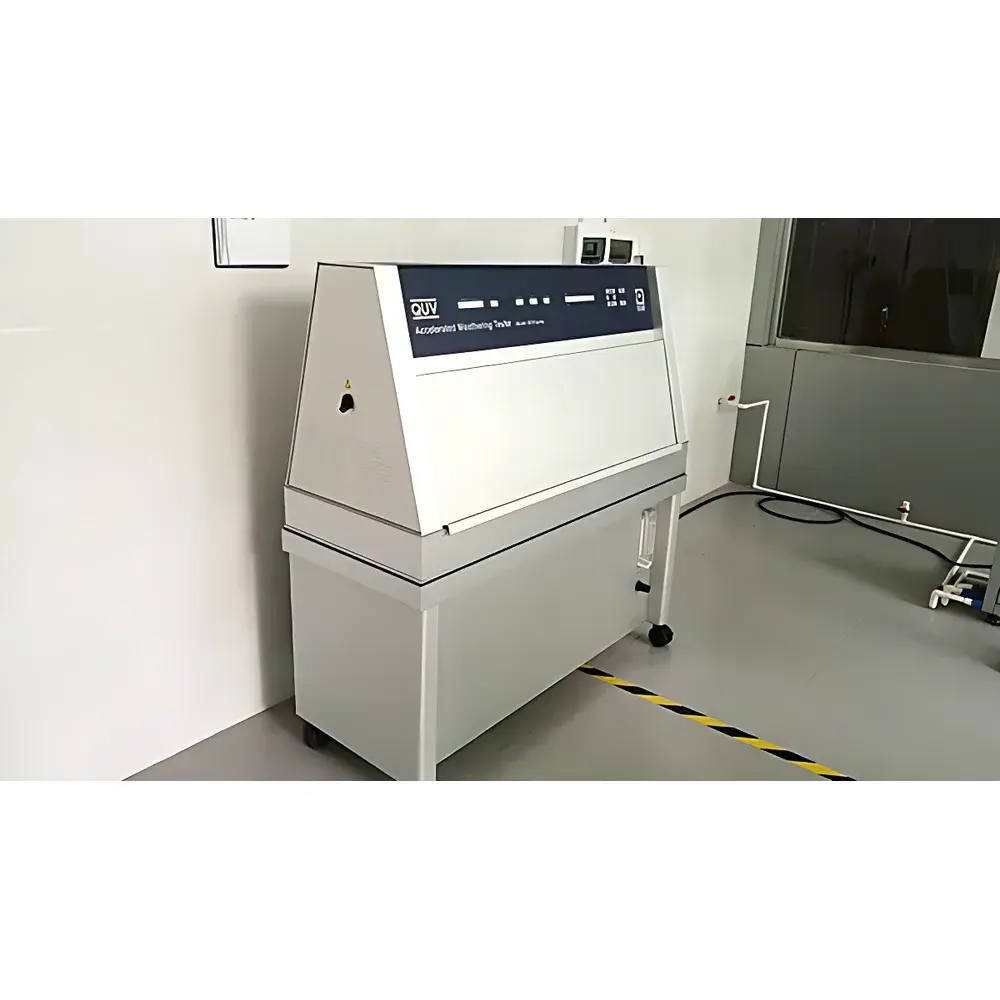
Q-LAB QUV Advanced UV Accelerated Weathering Tester
| Brand | Q-LAB |
|---|---|
| Origin | USA |
| Model | QUV Advanced |
| UV Wavelength Range | 320–400 nm (UVA-340/UVB-313 spectral options) |
| Black Panel Temperature Range | 35–80 °C |
| Irradiance Control | SOLAR EYE® closed-loop feedback system |
| Chamber Dimensions | Custom-configurable (standard internal volume: 160 L) |
| Lamp Life | ≥5,000 hours |
| Compliance | ASTM G154, ISO 4892-3, JIS D0205, SAE J2020, GB/T 14522, DIN 75220, BS EN 1062-5 |
Overview
The Q-LAB QUV Advanced UV Accelerated Weathering Tester is an industry-standard benchtop environmental test chamber engineered for precision simulation of solar ultraviolet (UV) radiation and condensation-driven moisture exposure. Unlike full-spectrum xenon arc or carbon arc systems, the QUV leverages fluorescent UV lamp technology—specifically UVA-340 and UVB-313 lamps—to isolate and accelerate the photochemical degradation mechanisms responsible for polymer chain scission, pigment fading, surface oxidation, and embrittlement in organic materials. Although UV energy constitutes only ~5% of total solar irradiance, it drives >80% of photodegradation in outdoor-exposed polymers due to its high photon energy per quantum. The QUV’s design adheres to the fundamental principle of accelerated testing: delivering controlled, reproducible UV dose (W/m²·nm) and thermal-hygrometric stress cycles that correlate quantitatively with real-world field performance—enabling predictive lifetime modeling under ISO 4892-3 and ASTM G154 protocols.
Key Features
- SOLAR EYE® Irradiance Control System: A patented closed-loop optical feedback mechanism continuously monitors UV intensity at the specimen plane using a calibrated photodiode sensor; automatically adjusts lamp power to maintain setpoint irradiance within ±2% tolerance across lamp aging and voltage fluctuations.
- Condensation Simulation: Uses heated water reservoir and controlled chamber wall temperature gradients to generate uniform, non-dripping condensate layers on test specimens—mimicking nocturnal dew formation per ASTM G154 Cycle 1 and ISO 4892-3 Method A.
- Lamp Flexibility & Spectral Fidelity: Supports interchangeable UVA-340 (295–365 nm, peak 340 nm) for high-fidelity sunlight correlation, or UVB-313 (280–360 nm, peak 313 nm) for aggressive acceleration—both traceable to NIST standards via Q-LAB’s UC-series calibration instruments.
- Robust Thermal Management: Precision black panel temperature control (35–80 °C) ensures accurate specimen surface heating during UV exposure; independent chamber air temperature monitoring prevents thermal overshoot during condensation phases.
- Self-Diagnostics & Maintenance Intelligence: Onboard firmware logs lamp operating hours, detects lamp end-of-life signatures, triggers maintenance alerts, and archives calibration history for GLP/GMP audit readiness.
- Low Total Cost of Ownership: Average lamp replacement interval exceeds 5,000 hours; minimal water consumption (<1 L/cycle); no complex cooling compressors or ozone scrubbers required.
Sample Compatibility & Compliance
The QUV accommodates flat-panel specimens up to 150 mm × 75 mm × 20 mm (standard rack configuration), with optional multi-tier racks supporting higher throughput. Test specimens must be non-volatile, thermally stable below 80 °C, and compatible with prolonged UV exposure without outgassing contaminants into the chamber. The system complies fully with international regulatory frameworks governing material durability validation: ASTM G154 (Standard Practice for Operating Fluorescent Ultraviolet (UV) Lamp Apparatus for Exposure of Non-Metallic Materials), ISO 4892-3 (Plastics — Methods of Exposure to Laboratory Light Sources — Part 3: Fluorescent UV Lamps), JIS D0205 (Automotive Paint Durability), SAE J2020 (Automotive Exterior Materials), and GB/T 14522 (Chinese National Standard for UV Aging Tests). All irradiance calibrations are traceable to NIST SRM 2242 and certified per ISO/IEC 17025 requirements.
Software & Data Management
The QUV Advanced operates via embedded microcontroller with intuitive membrane keypad interface; no PC dependency for basic operation. For enhanced data governance, optional Q-LAB’s QUV Connect software enables remote monitoring, real-time irradiance/temperature trending, automated report generation (PDF/CSV), and electronic signature support compliant with FDA 21 CFR Part 11 Annex 11. Audit trails record all parameter changes, calibration events, and user logins with time-stamped, immutable entries. Calibration certificates generated by UC10/UV smart sensors include uncertainty budgets and NIST-traceable reference data—fully satisfying ISO 17025 accreditation requirements for accredited testing laboratories.
Applications
Used extensively in R&D, QC, and regulatory submission labs across global supply chains, the QUV delivers actionable aging data for formulation screening, raw material qualification, and product lifecycle validation. Key application domains include: automotive exterior coatings (clearcoats, basecoats, plastics), architectural sealants and elastomers, medical device polymer housings, aerospace composite resins, packaging films (PET, PE, PP), printed electronics substrates, and cosmetic packaging polymers. Its ability to decouple UV dose from visible/IR thermal load makes it uniquely suited for evaluating UV stabilizer efficacy, HALS (hindered amine light stabilizer) performance, and pigment photostability—supporting accelerated development timelines while maintaining statistical confidence in field correlation.
FAQ
What is the difference between UVA-340 and UVB-313 lamp spectra?
UVA-340 lamps emit energy from 295–365 nm, closely matching terrestrial sunlight UV below 365 nm; ideal for realistic outdoor correlation. UVB-313 lamps emit shorter wavelengths (280–360 nm), including highly energetic sub-320 nm photons absent in natural sunlight—used when maximum acceleration is prioritized over spectral fidelity.
Is irradiance calibration mandatory for ISO/ASTM compliance?
Yes. ASTM G154 Section 7.3 and ISO 4892-3 Clause 6.2 require periodic verification of irradiance output using traceable instrumentation (e.g., UC10/UV sensor + UC1 display). Uncalibrated systems invalidate test reports for regulatory submissions.
Can the QUV replicate rain or thermal shock?
No. The QUV simulates UV + condensation only. For spray, thermal cycling, or humidity ramping, Q-LAB’s Q-SUN xenon weatherometer or custom hybrid chambers are recommended per ASTM G155 or ISO 4892-2.
What maintenance intervals are recommended?
Lamp replacement every 5,000 hours (or annually, whichever occurs first); condensate water reservoir cleaning weekly; quartz lamp sleeve inspection quarterly; full system calibration biannually using UC-series tools.



