
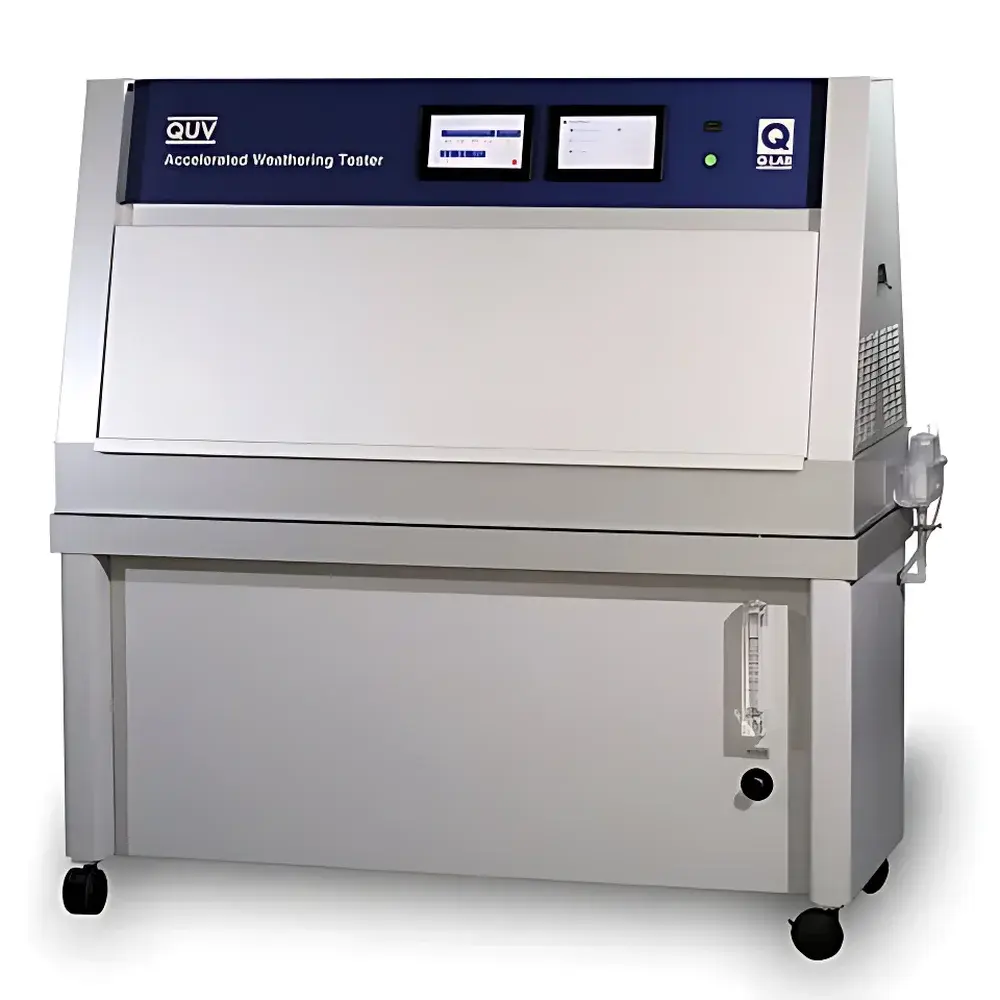
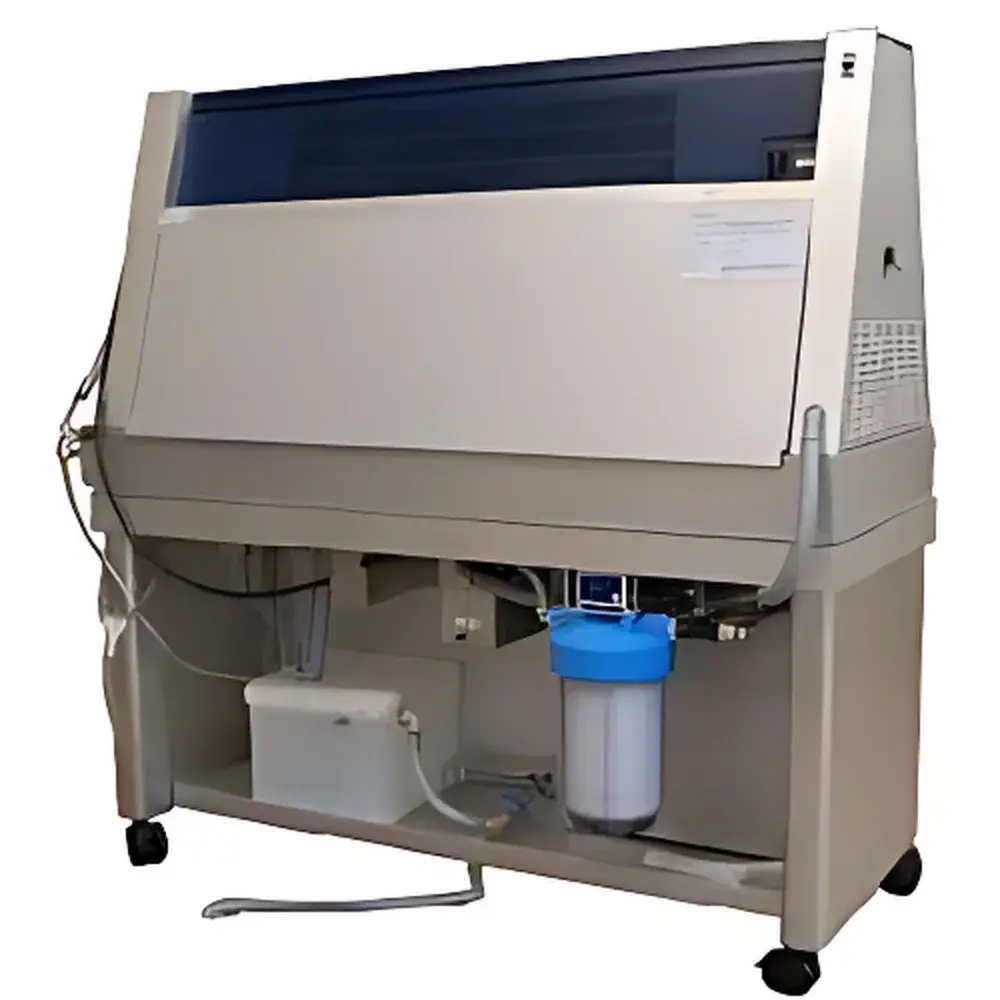
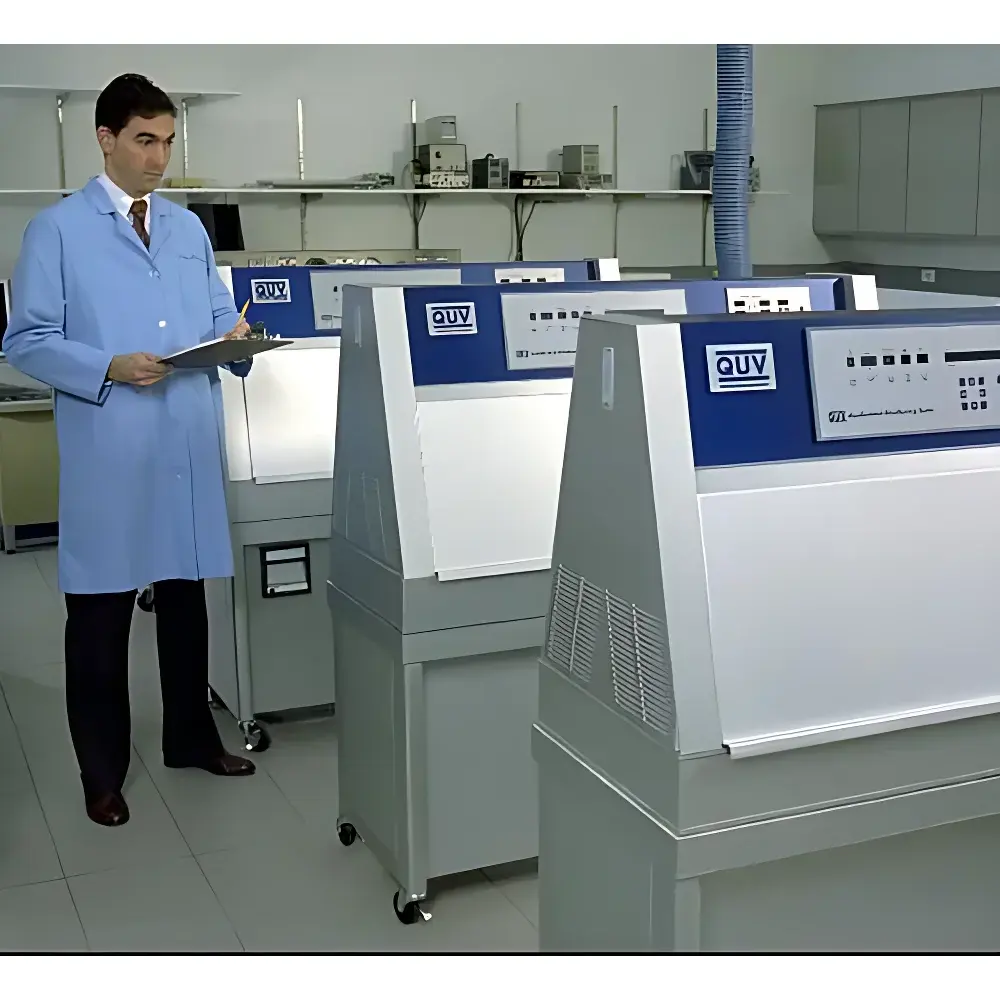
Q-Lab QUV Advanced UV Accelerated Weathering Tester
| Brand | Q-LAB |
|---|---|
| Origin | USA |
| Model | QUV |
| Irradiance Range | Adjustable |
| UV Lamp Power | Adjustable |
| Humidity Range | Adjustable |
| Black Panel Temperature Range | Up to 80 °C |
| UV Wavelength Options | UVA-340, UVB-313, UVC (IEC-compliant), Cool White |
| Chamber Dimensions | Custom Configurations Available |
| Test Duration | Programmable |
Overview
The Q-Lab QUV Advanced UV Accelerated Weathering Tester is an industry-standard benchtop environmental test chamber engineered for precision simulation of solar ultraviolet (UV) radiation, moisture condensation, and thermal cycling—key stressors driving polymer degradation, pigment fading, coating delamination, and surface embrittlement in real-world outdoor exposure. Unlike broad-spectrum xenon arc or carbon arc systems, the QUV leverages fluorescent UV lamp technology grounded in fundamental photochemical principles: UV photons (295–400 nm) induce bond scission in organic molecules—particularly C–C, C–H, and C–O bonds—accelerating oxidative chain reactions, hydrolysis, and chromophore destruction. Its design follows the photobiological weighting function of terrestrial sunlight, with spectral output calibrated to match ASTM G154 Annex A1 and ISO 4892-3 requirements. The system operates on a cyclic protocol—UV irradiation followed by dark condensation or optional water spray—mimicking diurnal weathering mechanisms where UV-driven photochemistry dominates daytime degradation while nocturnal moisture absorption enables hydrolytic attack and interfacial stress buildup.
Key Features
- Modular lamp architecture supporting interchangeable UV sources: UVA-340 (295–365 nm, solar-spectrum matched), UVB-313 (280–360 nm, high-energy acceleration), UVC (254 nm, for IEC 60335-1 compliance), and Cool White (for indoor lighting simulation)
- Solar Eye irradiance control system (standard on QUV/se and QUV/spray models) enabling closed-loop regulation of UV intensity from 0.35 to 1.75× peak summer noon solar irradiance (W/m² @ 340 nm), ensuring inter-laboratory reproducibility per ISO/IEC 17025 guidelines
- Black panel temperature control (30–80 °C) with platinum RTD sensing and PID feedback—maintaining ±0.5 °C stability over full operating range
- Condensation cycle generation via heated water reservoir and controlled chamber wall cooling—producing sustained dew-point conditions without mechanical humidifiers or compressed air
- Optional water spray module delivering calibrated 0.5–1.0 L/min deionized water at 25–40 °C, simulating thermal shock and mechanical erosion consistent with ASTM D4329 and SAE J2020
- Stainless steel 316L chamber construction with quartz UV-transmissive lamp housings and corrosion-resistant sample racks compliant with ASTM D4587 mounting geometry
Sample Compatibility & Compliance
The QUV accommodates flat-panel specimens up to 120 mm × 240 mm × 12 mm (per rack), including coated metals, polymer films, textile swatches, automotive trim, architectural sealants, and pharmaceutical packaging substrates. It meets or exceeds regulatory and industrial test method requirements across global frameworks: ISO 4892-1/-3, ASTM G151/G154/D4329/D4587/D4799, JIS K 5600-7-8/K 3750, SAE J2020, GM 9125P, Ford CETP 00.00-L-467, NACE TM01-84, and IEC 60335-1 Clause 22.11 (UVC variant). Data generated supports GLP-compliant reporting and FDA 21 CFR Part 11 audit trails when integrated with Q-Lab’s QUVMaster™ software.
Software & Data Management
QUVMaster™ v5.2 provides validated instrument control, real-time monitoring of irradiance (W/m² @ 340 nm), black panel temperature (°C), and condensation duration (min). It logs timestamped metadata—including lamp hours, calibration dates, and operator ID—for traceability. Export formats include CSV, PDF test reports, and XML for LIMS integration. Automated alarm escalation (email/SNMP) triggers on parameter deviation exceeding user-defined thresholds. Software validation documentation (IQ/OQ/PQ protocols) is available for regulated industries requiring GxP compliance.
Applications
The QUV delivers quantitative aging data critical for R&D formulation screening, QC release testing, and failure analysis across sectors: automotive OEMs validate headlamp lens yellowing resistance (SAE J2527); coatings manufacturers correlate QUV cycles to Florida exterior exposure per ASTM D2244; medical device firms assess UV stability of polyolefin tubing under ISO 10993-12; and electronics suppliers evaluate conformal coating adhesion loss after 1,000 h QUV exposure. Its predictive validity is empirically established through decades of correlation studies with natural weathering sites (e.g., Miami, Arizona, and South Florida exposure racks).
FAQ
What distinguishes UVA-340 from UVB-313 lamps?
UVA-340 replicates terrestrial UV spectrum down to 295 nm, providing high-fidelity correlation with outdoor exposure. UVB-313 emits shorter wavelengths (<313 nm) not present in ground-level sunlight, enabling accelerated testing where correlation is secondary to speed.
Can the QUV replicate full-spectrum sunlight?
No—it is optimized for UV-driven degradation mechanisms. For visible-light and near-IR effects (e.g., thermal expansion, IR-induced softening), xenon arc testers such as Q-SUN are recommended.
Is calibration traceable to NIST standards?
Yes—Q-Lab’s UV radiometers are calibrated against NIST-traceable reference detectors, with certificate of calibration included with each sensor replacement.
How often must lamps be replaced?
UVA-340 and UVB-313 lamps require replacement every 1,600–2,000 operational hours to maintain spectral fidelity and irradiance accuracy per ASTM G154 Section 7.3.
Does the system support unattended operation?
Yes—fully programmable cycles, email alerting, and power-fail recovery enable 24/7 operation with minimal supervision.



