
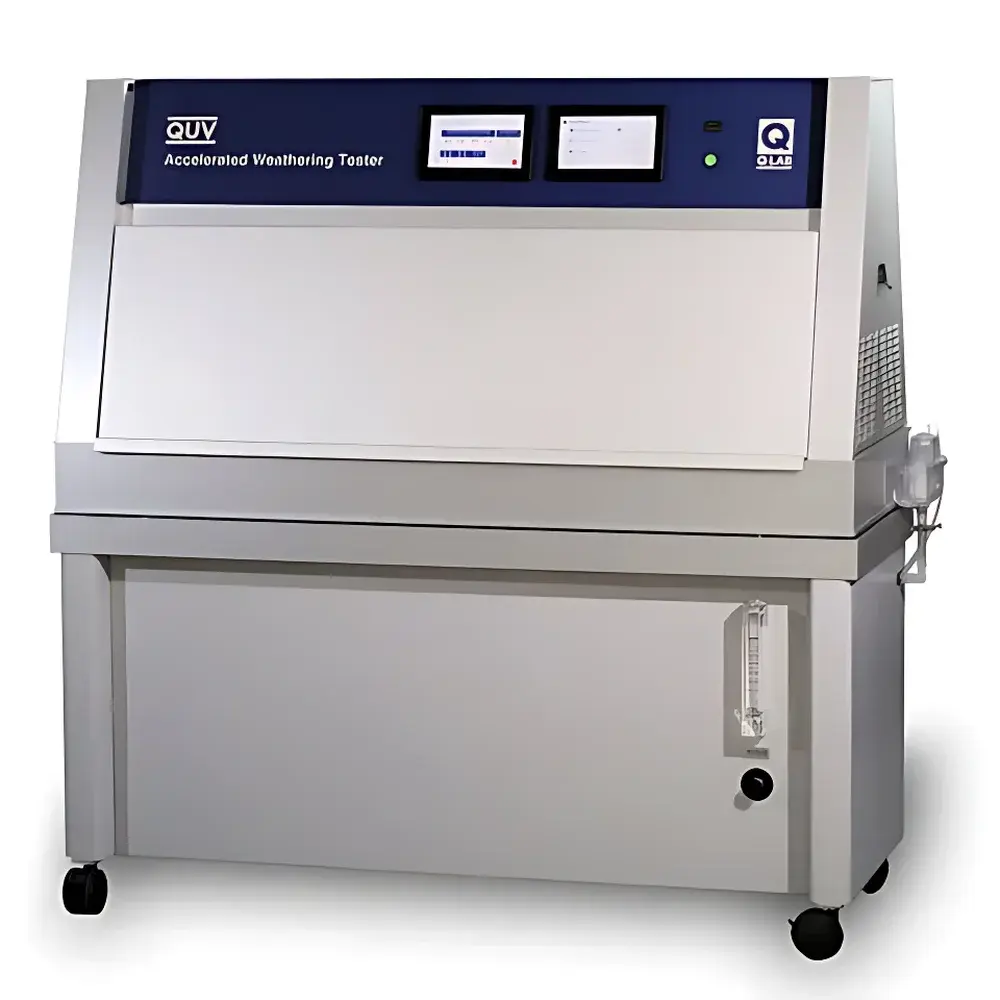
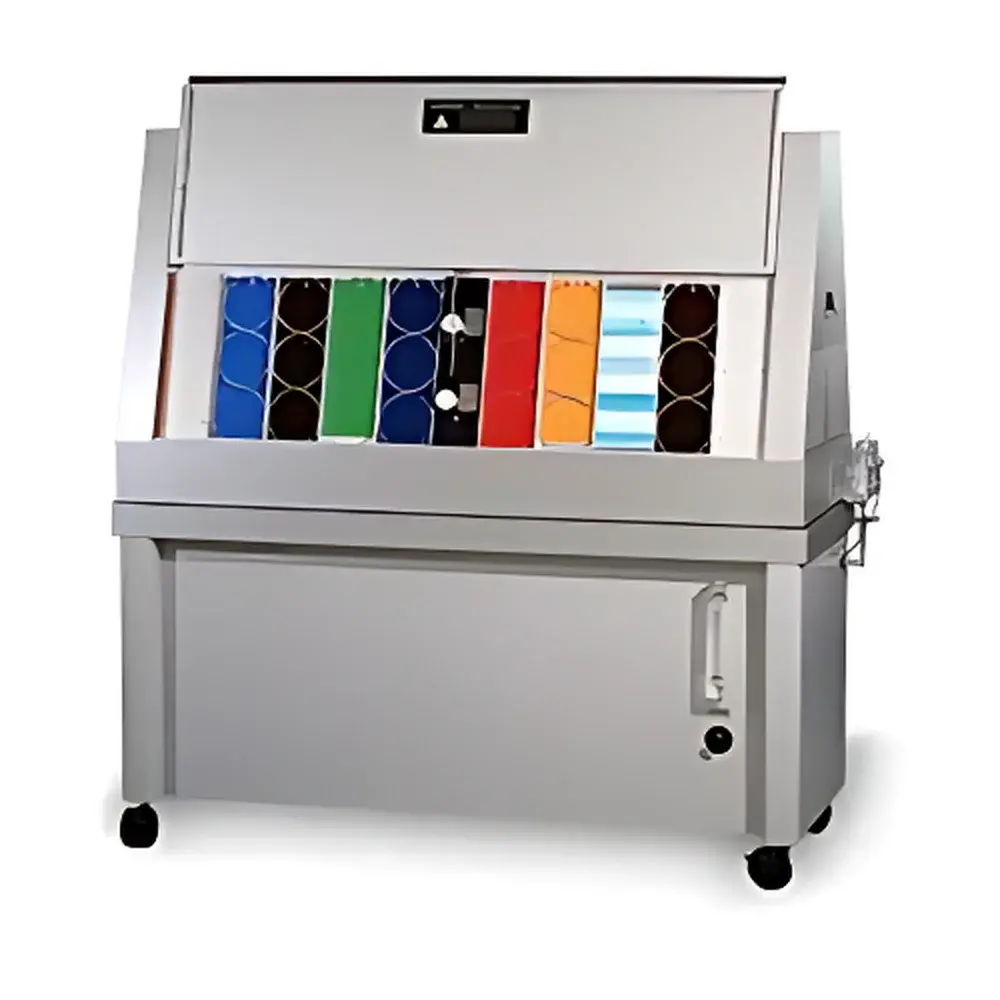
Q-LAB QUV Advanced UV Accelerated Weathering Tester
| Brand | Q-LAB |
|---|---|
| Origin | USA |
| Model | QUV/se / QUV/spray / QUV/basic / QUV/cw / QUV/uvc |
| UV Lamp Options | UVA-340, UVB-313EL+, UVA-351, UVC-254, Cool White |
| Irradiance Control | Closed-loop Solar Eye® system (QUV/se, QUV/spray, QUV/uvc, QUV/cw) |
| Condensation Cycle | 40–60 °C, duration programmable |
| UV Exposure Temperature Range | 45–80 °C (QUV/se, QUV/spray) |
| Sample Capacity | Up to 50 specimens (75 × 150 mm) |
| Chamber Dimensions (W×H×D) | 137 × 135 × 53 cm |
| Weight | 136 kg |
| Power Supply | 120 V ±10%, 1φ, 60 Hz, 14–16 A or 230 V ±10%, 1φ, 50/60 Hz, 7–8 A |
| Lamp Life | 8,000 h (standard irradiance) |
| Compliance | ASTM G154, ASTM G151, ISO 4892-3, ISO 4892-1, JIS D0205, SAE J2020, IEC 60335-1, IEC 61215-2, USP <661>, FDA 21 CFR Part 11 (via optional software audit trail), GLP/GMP-ready data logging |
Overview
The Q-LAB QUV Advanced UV Accelerated Weathering Tester is an industry-standard benchtop instrument engineered for precision simulation of solar ultraviolet (UV) radiation and moisture-induced degradation mechanisms in polymeric, coating, automotive, aerospace, and photovoltaic materials. Based on the fundamental principle of controlled UV photolysis—where short-wavelength UV photons (295–400 nm) induce bond scission, oxidation, and chromophore formation—the QUV replicates the dominant weathering stressors responsible for >90% of outdoor polymer degradation, despite UV constituting only ~5% of total solar energy. Unlike broad-spectrum xenon arc testers, the QUV employs fluorescent UV lamps with spectrally stable emission profiles, enabling highly reproducible, accelerated aging under rigorously defined spectral bands. Its core architecture integrates three synergistic environmental modules: UV irradiation (programmable intensity and spectral output), condensation (simulating dew deposition via heated water reservoir and chamber wall thermal gradient), and optional water spray (for thermal shock and surface erosion simulation). This tri-modal exposure paradigm aligns with ISO 4892-3 Annex B and ASTM G154 Section 6 protocols for non-metallic materials.
Key Features
- Multi-lamp spectral flexibility: Interchangeable UVA-340 (295–365 nm, solar-spectrum matched), UVB-313EL+ (280–360 nm, high-acceleration), UVA-351 (window-glass filtered), UVC-254 (germicidal), and Cool White fluorescent lamps—each certified to NIST-traceable spectral power distribution (SPD) curves.
- Solar Eye® closed-loop irradiance control: Four calibrated UV sensors at specimen plane continuously monitor irradiance; real-time feedback adjusts lamp power to maintain setpoint within ±3% tolerance, eliminating manual recalibration and ensuring compliance with ISO 9001, ISO/IEC 17025, and ASTM E2436.
- Condensation cycle fidelity: Chamber wall temperature control maintains a 10–15 K differential vs. air temperature, generating uniform dew-layer condensation over 4–16 hr cycles—validated against ASTM D4587 Annex A and ISO 11507 Clause 7.2 as the most representative moisture mechanism for outdoor aging.
- Modular platform design: Five base models (QUV/basic, QUV/se, QUV/spray, QUV/cw, QUV/uvc) allow configuration scalability—from budget-conscious validation (basic) to full regulatory-grade testing (se + spray + UVC for IEC 60335-1 appliance certification).
- Robust thermal management: PID-controlled black panel thermometer (BPT) and chamber air sensor enable independent monitoring of specimen surface temperature (45–80 °C) and ambient conditions, critical for Arrhenius-based acceleration factor modeling per ISO 11507:2019 Annex C.
- Low-maintenance engineering: Lamp life rated at 8,000 hours under standard irradiance; self-diagnostic firmware logs operational anomalies, lamp aging trends, and calibration status—reducing downtime and supporting ISO 17025 technical record requirements.
Sample Compatibility & Compliance
The QUV accommodates flat-panel specimens up to 75 × 150 mm (50 positions) or custom fixtures for 3D parts, with standardized mounting angles (75° from horizontal) per ASTM G154. It supports rigid plastics (PP, ABS, PC), organic coatings (automotive clearcoats, architectural paints), elastomers (EPDM, silicone), adhesives (ASTM C1184), roofing membranes (ANSI/RMA IPR-1), textile substrates (AATCC TM 186), and photovoltaic encapsulants (IEC 61215-2). All models comply with global regulatory frameworks: ASTM G151/G154 for general UV exposure; ISO 4892-3 for plastics; JIS K 5600-7-8 for Japanese industrial coatings; SAE J2020 for automotive exterior components; and IEC 60335-1 Annex Q for household appliance UV resistance. Optional UC-100 irradiance calibrator provides traceable NIST-certified verification, satisfying ISO/IEC 17025 Clause 6.5.2 and FDA 21 CFR Part 11 electronic record integrity requirements when paired with Q-LAB’s QUV Data Logger software.
Software & Data Management
The Q-LAB QUV Data Logger (v5.2+) enables secure, audit-trail-enabled test execution and reporting. It records time-stamped irradiance (W/m²/nm), black panel temperature (°C), chamber humidity (%RH), condensation duration, and spray cycle timing at user-defined intervals (1–60 sec resolution). Data export complies with ASTM E2436 Annex A for spreadsheet interoperability and includes digital signatures, operator ID, and calibration certificate references. For GLP/GMP environments, optional 21 CFR Part 11 compliance package adds role-based access control, electronic signatures, and immutable audit logs with tamper-evident hashing. Raw data files are stored in vendor-neutral CSV format, compatible with LIMS integration and statistical process control (SPC) platforms such as Minitab or JMP.
Applications
The QUV is deployed across R&D, QC, and regulatory submission workflows. In automotive OEM labs, it validates paint chip resistance per GM 9125P and corrosion undercoat durability per Ford CETP 00.00-L-467. PV module manufacturers use UVA-340 cycling per IEC 61215-2 to assess EVA yellowing and backsheet delamination kinetics. Coating formulators apply ASTM D4799 to correlate QUV delta-E (CIE L*a*b*) with Florida outdoor exposure after 2,000 hrs. Aerospace composites undergo UV/condensation cycling per Boeing BMS 7-101 to quantify matrix microcracking onset. Pharmaceutical packaging developers leverage UVA-351 lamps to model indoor shelf-life degradation of light-sensitive blister packs per USP . Independent testing labs utilize QUV datasets in ASTM D3794-compliant coating qualification dossiers submitted to EPA Safer Choice and EU Ecolabel programs.
FAQ
What is the difference between UVA-340 and UVB-313EL+ lamps?
UVA-340 lamps emit UV energy from 295 nm to 365 nm, closely matching terrestrial sunlight below 320 nm—the most damaging region for polymers. UVB-313EL+ lamps extend output down to 280 nm, delivering higher photon flux but potentially inducing non-representative degradation pathways; they are recommended for rapid screening or ultra-durable materials per ASTM D4329.
Can the QUV meet ISO 4892-3 requirements for plastic testing?
Yes—the QUV/se and QUV/spray models fully satisfy ISO 4892-3:2013 Annex A (Method A: UV condensation) and Annex B (Method B: UV spray), including mandatory irradiance control, black panel temperature monitoring, and spectral verification per Clause 6.2.
How often must irradiance be calibrated?
With Solar Eye® control, recalibration is required only annually or after lamp replacement. The UC-100 calibrator performs full-spectrum verification in <5 minutes, generating ISO 17025-compliant calibration certificates.
Is water spray necessary for all tests?
No—spray is optional and application-specific. It is essential for simulating thermal shock in automotive trim or stress corrosion in metal-polymer assemblies (SAE J2020), but condensation alone suffices for most coating and plastic evaluations per ASTM D4587.
Does Q-LAB provide validation documentation for IQ/OQ/PQ protocols?
Yes—L-8012 Technical Bulletin lists all applicable standards, while Q-LAB’s Validation Support Package includes FAT/SAT checklists, traceable calibration records, and 21 CFR Part 11 implementation guides for regulated industries.



