
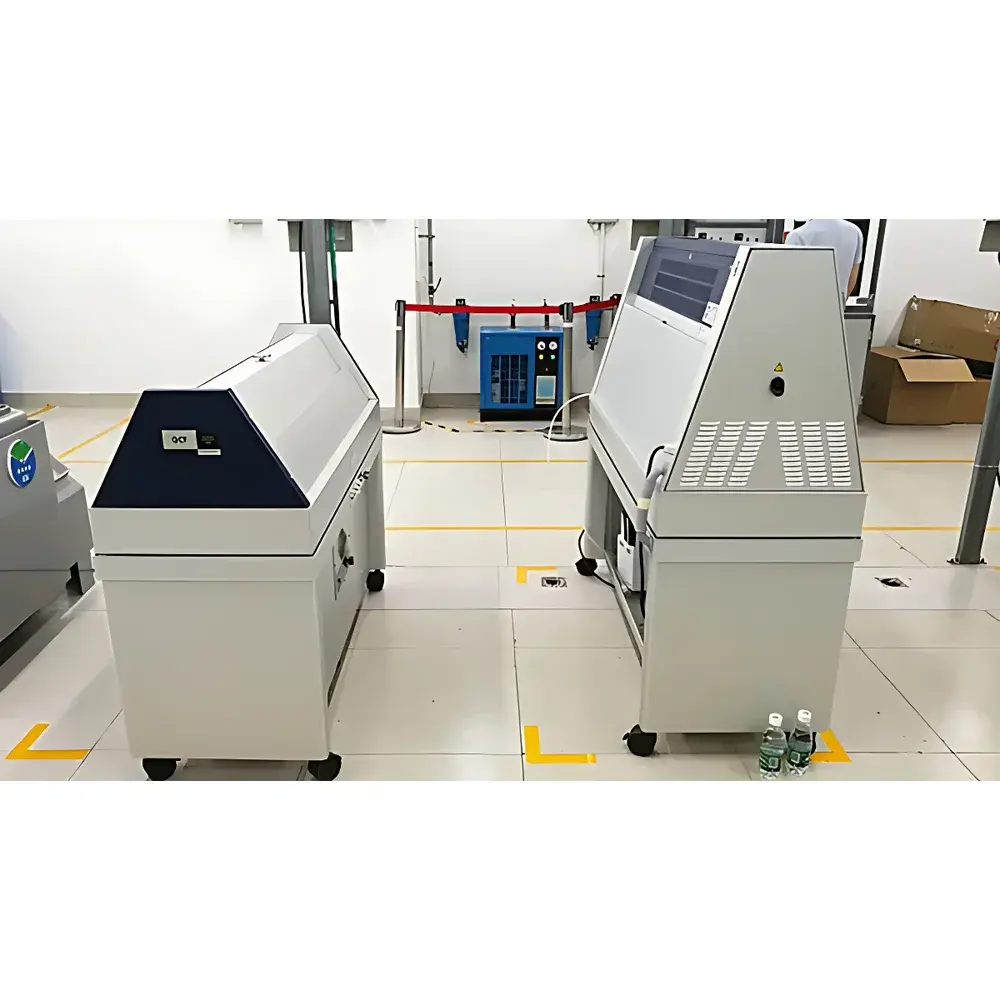
Q-LAB QUV Advanced UV Accelerated Weathering Tester
| Brand | Q-LAB |
|---|---|
| Origin | USA |
| Model | QUV |
| UV Wavelength Range | 280–400 nm |
| Sample Capacity | Up to 48 × 75 mm × 150 mm specimens |
| Black Panel Temperature Range (Irradiation) | 35–80 °C |
| Black Panel Temperature Range (Condensation) | 45–60 °C |
| Chamber Dimensions (L×W×H) | Custom-configurable per model variant (QUV/basic, QUV/se, QUV/spray, QUV/cw) |
| Condensate Water Consumption | 8 L/cycle |
| Spray Water Consumption | 7 L/min (QUV/spray only) |
| Inlet Water Pressure | 0.2–5.5 bar (varies by model) |
| Compliance | ASTM G151, ASTM G154, ISO 11507, ISO 4892-3, JIS D0205, SAE J2020, AATCC TM186, ASTM D4587, ASTM D3424, ASTM D4329, NACE TM-01-84, EN/PrEN 927-6 |
Overview
The Q-LAB QUV Advanced UV Accelerated Weathering Tester is an industry-standard benchtop instrument engineered for reproducible simulation of solar ultraviolet (UV) radiation and moisture-induced degradation mechanisms in polymeric, coating, textile, and composite materials. Unlike broad-spectrum xenon arc or carbon arc systems, the QUV employs fluorescent UV lamps with precisely defined spectral power distributions (SPD), enabling targeted acceleration of photochemical degradation pathways—primarily driven by UV photons in the 280–400 nm range. This wavelength band corresponds to the most energetic portion of terrestrial sunlight capable of cleaving covalent bonds in organic molecules, initiating chain scission, oxidation, and crosslinking reactions. The system integrates controlled UV irradiance, black panel temperature regulation, and condensation-based humidity cycling to replicate critical outdoor aging stressors—including photolysis, thermal oxidation, and hydrolytic attack—in a highly accelerated yet physically representative manner.
Key Features
- Fluorescent UV lamp options: UVA-340 (closely matches solar UV below 365 nm), UVB-313 (enhanced short-wave UV for aggressive screening), UVA-351 (simulates through-window exposure), QFS-40 (for fluorescence-inducing applications), and cool white fluorescent lamps (for visible-light control studies).
- Stable spectral output: Q-LAB guarantees lamp SPD consistency for 5,000 hours; no spectral drift with aging ensures test repeatability across laboratories and over time.
- Condensation cycle: Heated water reservoir generates saturated vapor at elevated temperature, maintaining 100% RH at sample surface without mineral deposits—using standard tap water and eliminating post-test residue.
- Precise black panel temperature control: Independent regulation during both irradiation and condensation phases (35–80 °C irradiation; 45–60 °C condensation), critical for accelerating secondary thermal-oxidative reactions without altering primary photochemistry.
- Modular platform architecture: Four base configurations—QUV/basic (basic UV/condensation), QUV/se (standard exposure), QUV/spray (UV + water spray + condensation), and QUV/cw (UV + condensation only)—allow alignment with specific material standards and failure mode priorities.
- Robust stainless-steel chamber construction with quartz-filtered UV optics, calibrated irradiance sensors, and NIST-traceable calibration protocols.
Sample Compatibility & Compliance
The QUV accommodates flat, curved, and three-dimensional specimens up to 75 mm × 150 mm (standard format); custom fixtures support lenses, automotive trim, roofing membranes, and molded plastic components. Its design conforms to over 50 international material testing standards—including ASTM G151 (accelerated exposure apparatus), ASTM G154 (fluorescent UV exposure), ISO 4892-3 (plastics—UV exposure), ISO 11507 (coatings), AATCC TM186 (textiles), and NACE TM-01-84 (corrosion-resistant coatings). All QUV models support GLP-compliant operation: audit trails, user access levels, electronic signatures, and 21 CFR Part 11–ready data logging are available via optional Q-LAB’s SOLAR-EYE™ software integration. Full traceability to NIST-certified reference materials and third-party validation reports are provided with each shipment.
Software & Data Management
While the base QUV operates via intuitive front-panel controls, full data integrity and regulatory compliance are achieved using Q-LAB’s SOLAR-EYE™ software suite. SOLAR-EYE enables real-time monitoring of irradiance (W/m² @ 340 nm), black panel temperature, chamber humidity, and cycle timing. It logs all operational parameters with timestamped, tamper-evident records compliant with FDA 21 CFR Part 11 and ISO/IEC 17025 requirements. Users can define multi-step test profiles—including ramped UV intensity, staggered condensation intervals, and conditional spray triggers—and export raw datasets in CSV, PDF, or XML formats compatible with LIMS and statistical analysis platforms (e.g., JMP, Minitab). Remote diagnostics, firmware updates, and automated calibration reminders further reduce downtime and ensure long-term metrological reliability.
Applications
- Coating formulation development: Quantifying gloss loss, chalking, blistering, and adhesion failure under standardized UV/condensation cycles (ASTM D4587, ISO 11507).
- Automotive exterior materials: Validating weatherability of bumpers, seals, and interior trims per GM 9125P, SAE J2020, and Nissan M0007.
- Roofing membrane qualification: Assessing cracking, tensile strength retention, and water resistance after accelerated aging (ASTM D4799, ANSI/RMA IPR-1).
- Medical device polymer stability: Supporting ISO 10993-12 extractables and leachables risk assessment under UV preconditioning.
- Printing ink and packaging film durability: Correlating QUV exposure to field performance in retail and outdoor signage applications (ASTM D3794, AATCC TM186).
- Photovoltaic encapsulant yellowing: Monitoring transmittance decay in EVA and POE layers per IEC 61215 and UL 1703.
FAQ
What UV lamp types are supported, and how do they differ in application?
The QUV accepts UVA-340 (solar-simulating), UVB-313 (high-energy screening), UVA-351 (indoor/filter-transmitted), QFS-40 (fluorescence excitation), and cool white lamps. Selection depends on target degradation mechanism and regulatory requirement.
Does the QUV require deionized water for condensation?
No—standard municipal tap water is sufficient. The condensate forms pure distilled-quality water on specimen surfaces due to phase-change purification.
How is irradiance calibrated and maintained?
Each unit includes a calibrated UV radiometer (340 nm channel) with annual recalibration traceable to NIST. Lamp replacement intervals are tracked automatically; Q-LAB provides certified lamp SPD reports with every batch.
Can the QUV be integrated into a centralized lab data management system?
Yes—via Ethernet-connected SOLAR-EYE™ software, which supports OPC-UA, REST API, and direct SQL database writes for enterprise LIMS or MES synchronization.
Is the QUV suitable for testing biological or pharmaceutical materials?
It is not designed for sterile or biocontainment environments. However, it is widely used for UV stability testing of polymer-based drug delivery devices, packaging, and medical-grade resins under ICH Q1B and USP guidelines.



