
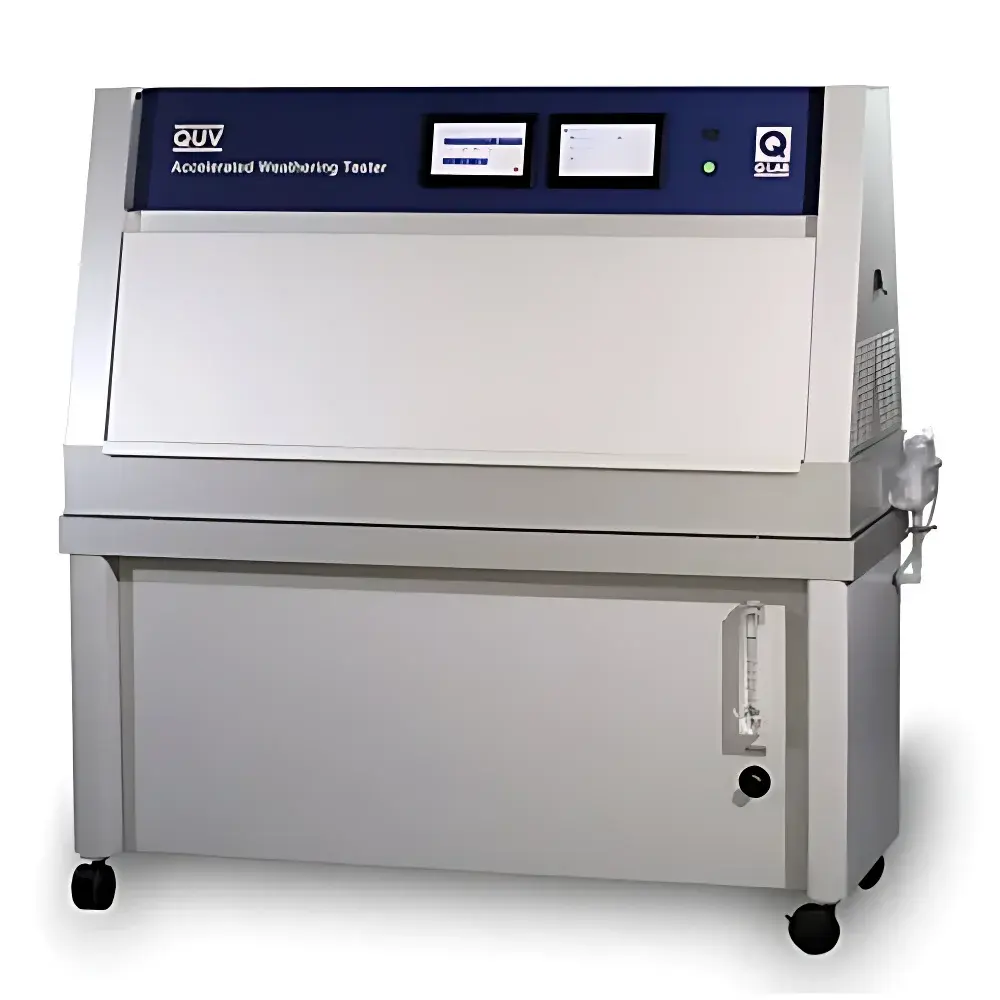
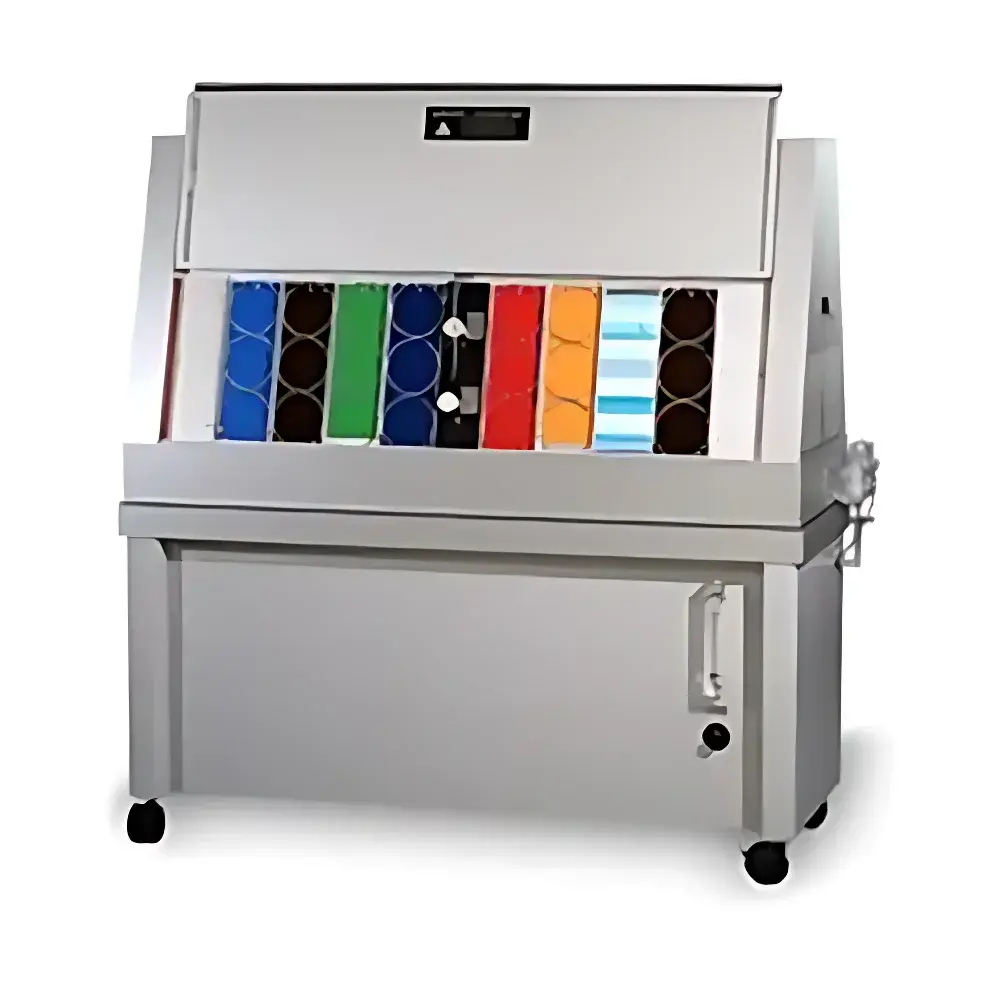
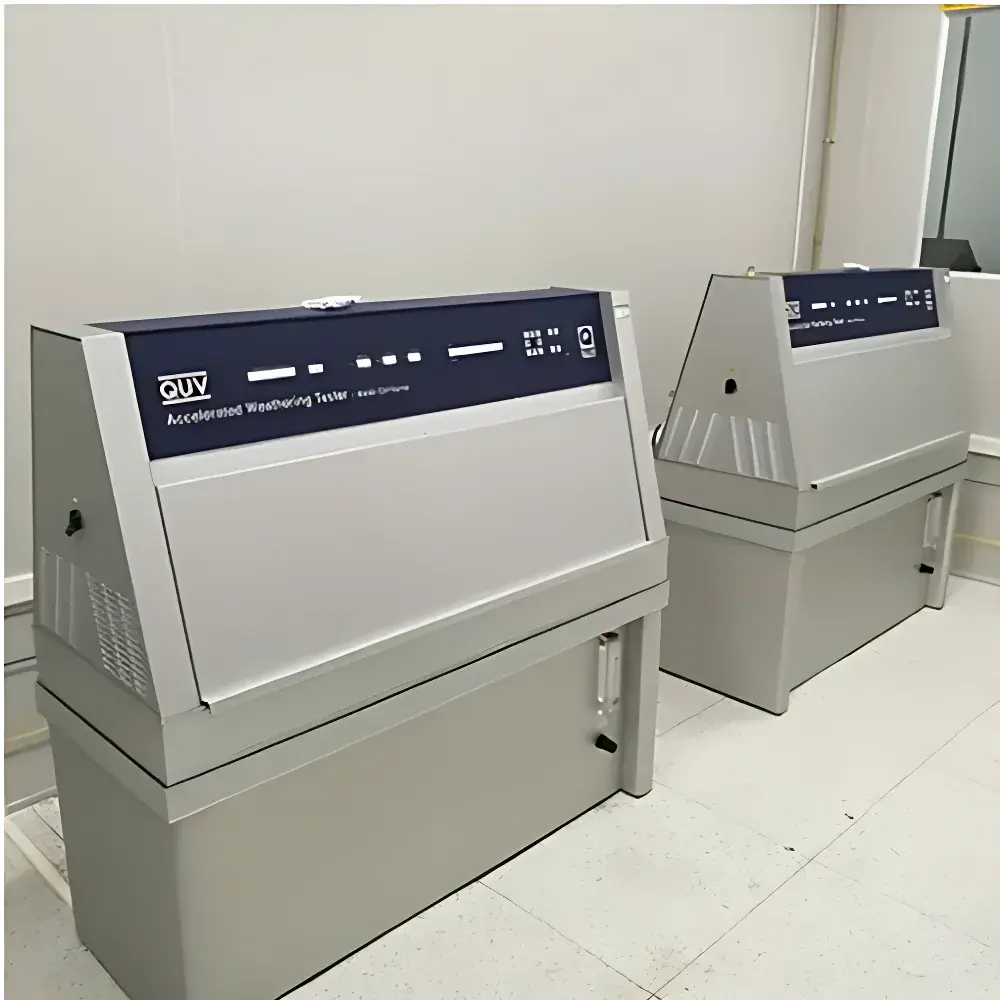
Q-LAB QUV/spray UV Aging Test Chamber
| Brand | Q-LAB |
|---|---|
| Origin | USA |
| Model | QUV/spray |
| Exposure Time Range | 1–5000 h |
| Irradiance Control | 10 W/m² (UVA-340 calibrated) |
| UV Lamp Options | UVA-340, UVB-313, Cool White |
| Condensation Temperature Range | 40–60 °C |
| Irradiation Temperature Range | 45–80 °C |
| Sample Capacity | 48 specimens (75 × 150 mm) |
| Power Supply | 120 V/60 Hz, 20 A or 230 V/50–60 Hz, 9 A |
| Water Consumption | 8 L/day (spray mode) |
| Compliance | ASTM G154, ISO 4892-3, SAE J2020, GB/T 14522, JIS D0205 |
Overview
The Q-LAB QUV/spray UV Aging Test Chamber is an industry-standard accelerated weathering instrument engineered for precision simulation of short-wavelength ultraviolet (UV) radiation, moisture condensation, and water spray—key environmental stressors responsible for photodegradation, chalking, gloss loss, cracking, and color fading in organic materials. Unlike full-spectrum xenon arc testers, the QUV/spray operates on the scientifically validated principle that UV radiation in the 295–365 nm range—particularly UVA-340 (peak at 340 nm) and UVB-313 (peak at 313 nm)—drives the majority of degradation mechanisms in outdoor-exposed coatings, plastics, and elastomers. Its design adheres to the fundamental photobiological premise that photon energy inversely correlates with wavelength; thus, short-wave UV photons induce bond scission and free radical formation more efficiently than visible or near-infrared radiation. The chamber replicates natural diurnal cycles through programmable irradiation/condensation/spray sequences, enabling laboratory acceleration of field aging by factors of 3–10×, depending on material sensitivity and test protocol.
Key Features
- Integrated Spray Functionality: Unique among QUV platforms, the /spray configuration adds controlled, timed water spray during dark cycles—mimicking dew formation followed by rain wash-off, critical for evaluating blistering, adhesion loss, and hydrolytic degradation in automotive clearcoats and architectural paints.
- SunEye Irradiance Control System: A closed-loop, real-time feedback system continuously monitors UV intensity via a calibrated broadband sensor and dynamically adjusts lamp output to maintain ±3% setpoint stability over lamp lifetime—ensuring traceable, reproducible irradiance per ASTM G154 Section 7.2.
- Multi-Language Touchscreen Interface: Industrial-grade 7-inch LCD with configurable UI in English, French, Spanish, Italian, and German—designed for global lab environments and aligned with IEC 61000-4-3 EMC compliance requirements.
- Modular Lamp Architecture: Tool-free lamp replacement supports rapid interchange between UVA-340 (best solar match <365 nm), UVB-313 (accelerated, high-energy stress), and Cool White fluorescent lamps—enabling method-specific validation per ISO 4892-3 Annex B.
- Black Panel Thermometry: Dual black panel temperature sensors (standard) provide surface-relevant thermal loading data correlated to ASTM D7869 and SAE J2527, essential for correlating lab results with real-world substrate heating profiles.
Sample Compatibility & Compliance
The QUV/spray accommodates standardized flat-panel specimens (75 × 150 mm) mounted vertically on corrosion-resistant aluminum racks—optimized for uniform irradiance distribution and consistent spray coverage. It meets rigorous regulatory and quality system requirements: fully compliant with ASTM G154 (Cycle 1–6), ISO 4892-3 (Method A/B), SAE J2020, JIS D0205, and GB/T 14522. For GLP- and GMP-regulated laboratories, the system supports 21 CFR Part 11-compliant audit trails when paired with Q-Lab’s optional QUV Data Logger software (v5.2+), including electronic signatures, user access controls, and immutable test record archiving. All calibration certificates are NIST-traceable, and routine performance verification follows Q-Lab’s PQS (Performance Qualification Specification) protocol.
Software & Data Management
Control and monitoring are managed via Q-Lab’s proprietary QUV Control Software (v4.8+), which provides real-time graphing of irradiance, black panel temperature, chamber humidity, and spray cycle status. Exportable CSV logs include timestamped metadata (operator ID, test ID, lamp batch, calibration date) required for ISO/IEC 17025 accreditation. Optional Q-Support Cloud integration enables remote diagnostics, predictive lamp life alerts, and automated firmware updates—all hosted on AWS GovCloud infrastructure for HIPAA/FISMA-aligned data residency. Raw spectral data (via optional UV spectroradiometer add-on) is compatible with Q-Lab’s Spectral Analysis Toolkit for spectral mismatch correction per ISO 17987.
Applications
Primary application domains include automotive OEM paint qualification (e.g., Ford CETP 00.00-L-467, GMW 14872), aerospace coating durability (Boeing BMS 10-60), architectural cladding weatherability (AAMA 2604), and industrial maintenance coatings (NACE SP0108). It is routinely specified in QC/QA workflows for coil-coated metals, PVC window profiles, polyolefin geomembranes, and UV-curable inks. In R&D, the QUV/spray enables comparative ranking of pigment dispersion stability, photostabilizer efficacy (e.g., HALS vs. UVAs), and binder resin selection—supporting Design of Experiments (DoE) protocols with statistical process control (SPC) outputs.
FAQ
What UV lamp types are supported, and how do they differ in spectral output?
UVA-340 lamps replicate solar UV down to 295 nm with peak emission at 340 nm; UVB-313 lamps emit shorter, more aggressive wavelengths (280–360 nm) for extreme acceleration; Cool White lamps provide visible-light-only control cycles.
Does the QUV/spray meet FDA or pharmaceutical packaging validation requirements?
While not designed for sterile packaging validation, it satisfies USP photo-stability testing for primary packaging polymers when operated per ICH Q1B Option 2 (UV-only exposure), with documented irradiance mapping and temperature uniformity validation.
Can test parameters be exported for regulatory submission?
Yes—CSV and PDF reports include full metrological traceability: lamp calibration certificates (NIST-traceable), irradiance uniformity maps (±5% across sample plane), and black panel temperature homogeneity data (±2 °C), all exportable in 21 CFR Part 11–compliant format.
How often must the irradiance sensor be recalibrated?
Q-Lab recommends annual recalibration against a NIST-traceable reference standard; field verification using the included calibration tile is required before each test series per ASTM G154 Section 8.3.
Is deionized water mandatory for spray operation?
Deionized water is strongly recommended to prevent mineral deposits on specimens and nozzle clogging; conductivity ≤1 µS/cm is required for long-term reliability of the stainless-steel spray manifold.
Related Products



