
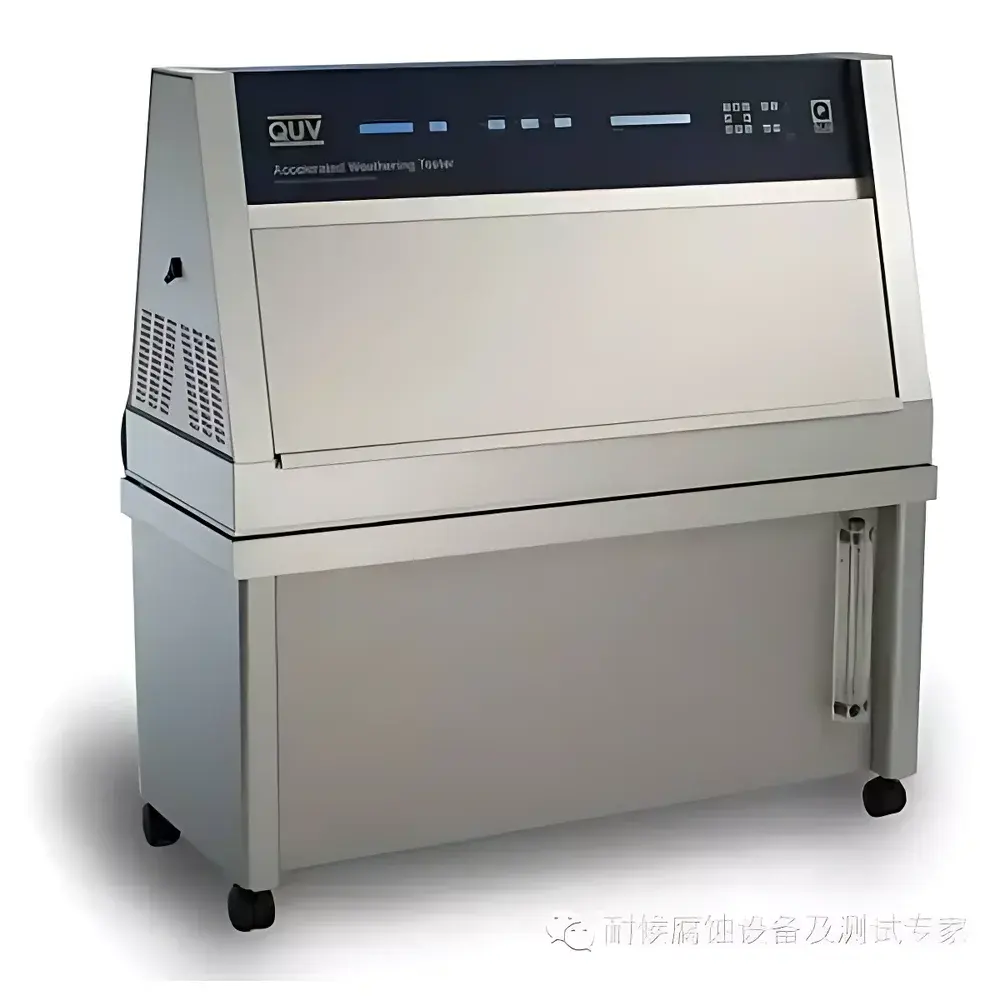
Q-LAB QUV/spray UV Weathering Test Chamber
| Brand | Q-LAB |
|---|---|
| Origin | USA |
| Model | QUV/spray |
| UV Wavelength Range | 280–400 nm |
| Illumination Temperature Range | 45–80 °C |
| Condensation Temperature Range | 40–60 °C |
| Chamber Capacity | 48 standard specimens (75 mm × 150 mm) |
| Irradiance Control Point | 340 nm |
| Adjustable Irradiance Range | 0.25–1.80 W/m² @ 340 nm |
| Irradiance Display Accuracy | ±0.01 W/m² |
| Lamp Types | UVB-313EL, UVA-340, UVA-351 |
| Lamp Lifetime | Up to 5000 hours |
| Compliance Standards | ASTM G151, ASTM G154, ISO 4892-3, SAE J2020, GB/T 5237.2, HG/T 2454-2006, HG/T 3828-2006 |
| Power Supply | 230 V / 50 Hz, 1500 W (max) |
| Dimensions (W×D×H) | 137 × 53 × 135 cm |
| Weight | 136 kg |
| Water Consumption | Condensation — ~8 L/day (deionized water) |
Overview
The Q-LAB QUV/spray UV Weathering Test Chamber is an industry-standard accelerated weathering instrument engineered for precision simulation of critical outdoor degradation factors—primarily ultraviolet (UV) radiation, moisture (via condensation and spray), and thermal cycling. Based on the fundamental principles of photochemical degradation kinetics, the QUV/spray employs fluorescent UV lamps to deliver controlled spectral irradiance within the biologically and chemically active 280–400 nm range. Unlike broad-spectrum xenon arc systems, this chamber leverages narrowband UV sources—UVA-340 (mimicking terrestrial sunlight down to 295 nm), UVB-313EL (accelerated UV exposure), and UVA-351 (filtered through window glass)—to isolate and intensify photodegradation mechanisms relevant to polymer stabilization, coating durability, and pigment fade resistance. The integrated spray function delivers calibrated, uniform water application at 7 L/min via 12 nozzles, replicating natural rainfall dynamics including thermal shock upon impact. Simultaneously, a heated water pan generates saturated humidity to induce condensation—a dominant aging driver in real-world exposure—by exploiting temperature differentials between the specimen surface and chamber air. These three stressors—UV irradiation, condensation, and spray—are programmably sequenced into repeatable cycles, enabling reproducible, quantitative assessment of material performance under standardized test protocols.
Key Features
- Triple-stress capability: Independent, synchronized control of UV irradiation, condensation, and water spray—each validated for metrological traceability.
- Real-time irradiance monitoring and closed-loop regulation at 340 nm with ±0.01 W/m² display resolution and automated calibration input—eliminating manual entry errors and ensuring long-term measurement stability.
- Programmable controller with LED interface supporting multi-step cycle definition, parameter logging, and immediate status visualization (lamp status, temperature setpoint deviation, spray activation).
- Dual-zone temperature control: Illumination phase maintained at 45–80 °C; condensation phase regulated at 40–60 °C—both independently verified per ASTM G151 Annex A3 requirements.
- Standard specimen capacity: 48 positions for 75 mm × 150 mm panels, arranged for uniform irradiance distribution per ISO 4892-3 geometric specifications.
- Lamp compatibility with three certified spectral options (UVA-340, UVB-313EL, UVA-351), each with documented spectral power distribution (SPD) and NIST-traceable calibration certificates.
- Robust stainless-steel construction with insulated double-wall chamber, corrosion-resistant interior, and integrated deionized water delivery system for both condensation and spray subsystems.
Sample Compatibility & Compliance
The QUV/spray accommodates rigid flat specimens up to 75 mm × 150 mm × 10 mm thick—including painted metal substrates, extruded plastics, architectural coatings, automotive trim, and aerospace composites. Specimen mounting fixtures ensure consistent orientation relative to the lamp array, minimizing angular irradiance variance. All operational parameters—including irradiance setpoints, temperature ramps, cycle durations, and spray timing—are fully configurable to align with internationally recognized test standards. The system satisfies mandatory instrumentation requirements of ASTM G154 (standard practice for fluorescent UV exposure), ISO 4892-3 (plastics—methods of exposure to laboratory light sources), SAE J2020 (automotive exterior materials), and Chinese national standards GB/T 5237.2 (aluminum alloy architectural profiles) and HG/T 2454-2006 (synthetic resin emulsion exterior wall coatings). Its design supports GLP-compliant data integrity through unambiguous audit trails of all user-initiated changes and environmental deviations.
Software & Data Management
While the QUV/spray operates via an embedded microprocessor-based controller, it integrates seamlessly with Q-LAB’s optional SolarEye™ software suite for extended data acquisition, remote monitoring, and regulatory reporting. SolarEye enables export of time-stamped irradiance, temperature, and spray event logs in CSV or PDF formats compatible with LIMS environments. Critical parameters—including lamp operating hours, irradiance drift history, and calibration timestamps—are stored in non-volatile memory with write-protection against accidental overwrites. For laboratories subject to FDA 21 CFR Part 11 or ISO/IEC 17025 requirements, SolarEye supports role-based access control, electronic signatures, and full audit trail generation—including who changed what, when, and why—without requiring third-party middleware.
Applications
- Accelerated evaluation of UV stabilizers in polyolefins, PVC, and engineering thermoplastics per ASTM D4329.
- Correlation studies between QUV/spray cycles and real-world Florida or Arizona exposure data for automotive OEM qualification.
- Qualification of architectural sealants and elastomeric coatings under cyclic wet/dry conditions per ASTM C719.
- Photostability screening of pharmaceutical packaging materials under ICH Q1B guidelines (supplemental UV stress testing).
- Failure analysis of photovoltaic module encapsulants and backsheets using sequential UV + moisture ingress protocols.
- Development validation of anti-graffiti coatings and marine-grade antifouling paints subjected to combined UV/rain erosion stress.
FAQ
What UV lamp types are supported, and how do they differ in spectral output?
The QUV/spray accepts UVA-340 (best match to solar UV below 365 nm), UVB-313EL (higher-energy short-wave UV for aggressive screening), and UVA-351 (simulates UV transmitted through window glass). Each lamp type is supplied with NIST-traceable spectral irradiance data.
Is deionized water mandatory for both condensation and spray functions?
Yes. Deionized water is required to prevent mineral deposition on specimens and optical surfaces, ensuring irradiance consistency and eliminating spurious failure modes unrelated to UV chemistry.
How is irradiance calibration performed, and how often is it recommended?
Calibration uses a Q-LAB-calibrated radiometer (e.g., UC-100 or CR-10) and follows ASTM G130 procedures. Annual calibration is recommended; however, the system’s auto-calibration input feature allows rapid revalidation after lamp replacement or maintenance.
Can the QUV/spray replicate the full ASTM G155 xenon arc spectrum?
No. The QUV/spray is specifically designed for UV-dominated degradation pathways. For full-spectrum simulation including visible and near-IR heating effects, Q-LAB’s Q-SUN xenon test chambers are the appropriate platform.
What documentation is provided to support ISO/IEC 17025 accreditation?
Q-LAB supplies factory calibration certificates for irradiance sensors and temperature probes, uncertainty budgets per ISO/IEC 17025 Annex A, and a detailed Instrument Qualification (IQ/OQ/PQ) protocol template aligned with GxP expectations.



