
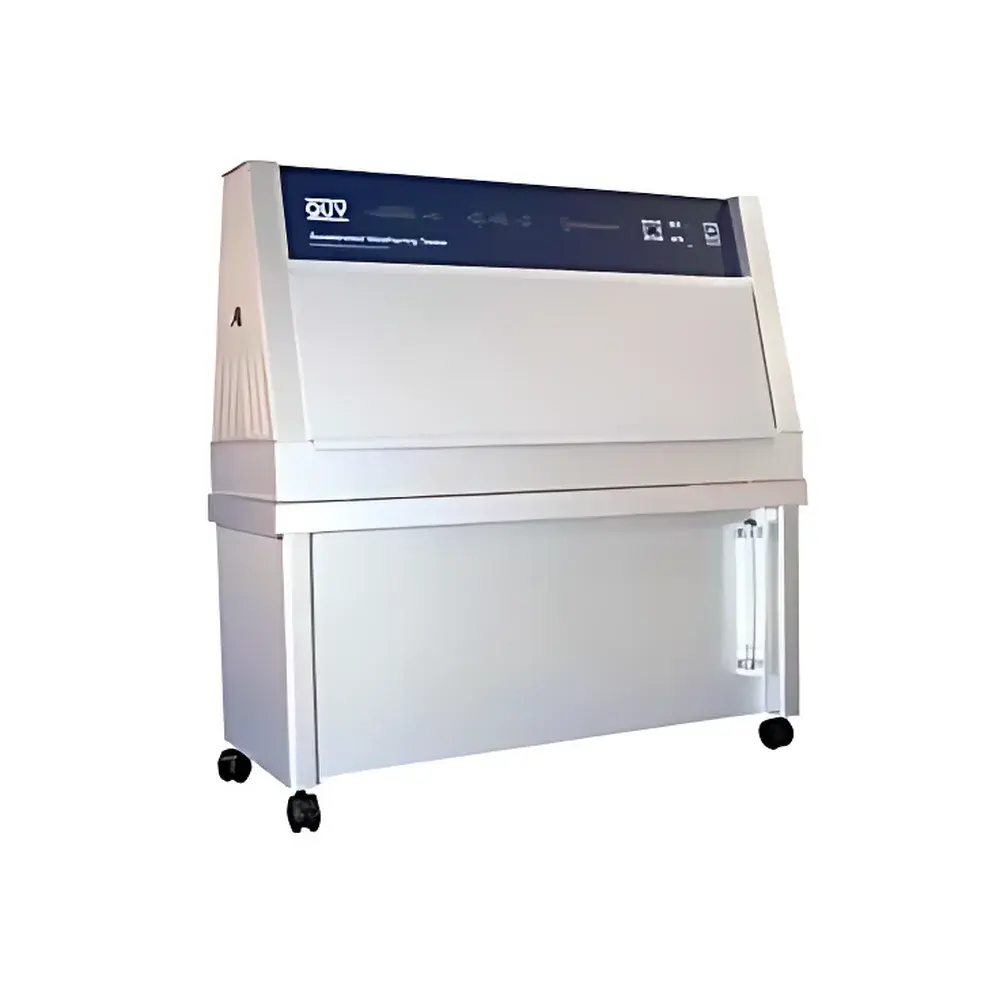
Q-LAB QUV UV Accelerated Weathering Tester
| Brand | Q-LAB |
|---|---|
| Origin | USA |
| Model | QUV |
| Temperature Range (Irradiance Mode) | 45–80 °C (Black Panel) |
| Temperature Range (Condensation Mode) | 35–60 °C (Black Panel) |
| UV Wavelength Options | UVA-340 (310–400 nm), UVA-351, UVB-313, QFS-40, Cool White Fluorescent |
| Chamber Dimensions (L×W×H) | 137 × 135 × 53 cm |
| Sample Capacity | Up to 48 specimens (75 × 150 mm) |
| Irradiance Control | Solar Eye feedback system (standard on QUV/se, QUV/spray, QUV/cw) |
| Compliance | ASTM G154, ISO 4892-3, SAE J2020, GB/T 14522, JIS D0205, MIL-STD-810, among others |
Overview
The Q-LAB QUV UV Accelerated Weathering Tester is an industry-standard benchtop instrument engineered for reproducible simulation of short-wavelength ultraviolet (UV) radiation exposure and condensation-driven moisture stress—two primary drivers of polymeric material degradation in outdoor service environments. Unlike broad-spectrum xenon arc or carbon arc systems, the QUV leverages fluorescent UV lamp technology to deliver highly stable, spectrally defined irradiance within the 290–400 nm range. Its core operational principle relies on controlled photolysis induced by calibrated UV photons, coupled with thermally driven condensation cycles that replicate dew formation on exposed surfaces. This dual-stress methodology enables accelerated assessment of photochemical degradation mechanisms—including chain scission, oxidation, chromophore bleaching, surface microcracking, gloss loss, chalking, and embrittlement—without introducing non-representative thermal or spectral artifacts.
Key Features
- Stable UV Spectral Output: UVA-340 lamps closely match terrestrial solar UV below 365 nm; UVB-313 provides enhanced short-wavelength acceleration for aggressive screening. All Q-LAB UV lamps are manufactured to strict spectral power distribution (SPD) tolerances and warrantied for 5,000 hours of operation without SPD drift.
- Black Panel Temperature Control: Precision-controlled black panel sensors (not air temperature) monitor specimen surface thermal load during irradiation and condensation phases. Independent setpoint ranges (e.g., 45–80 °C in irradiance mode; 35–60 °C in condensation mode) ensure compliance with ASTM G154 cycle specifications.
- Condensation Humidity Simulation: A heated water reservoir generates saturated vapor at elevated temperatures, maintaining 100% relative humidity across the test plane. Condensate forms as pure distilled-quality water—eliminating mineral deposits, streaking, or ionic contamination on samples.
- Solar Eye Irradiance Feedback System: Available on QUV/se, QUV/spray, and QUV/cw models, this closed-loop control continuously measures in-chamber irradiance at user-selected wavelengths (e.g., 0.73 W/m² @ 340 nm) and automatically adjusts lamp output to compensate for lamp aging, ambient fluctuations, and batch-to-batch variability.
- Modular Test Configurations: Four platform variants support distinct environmental profiles: QUV/basic (basic UV/condensation), QUV/se (Solar Eye + condensation), QUV/spray (UV/condensation + water spray), and QUV/cw (UV/condensation + cool white fluorescent for visible-light-sensitive materials).
Sample Compatibility & Compliance
The QUV accommodates flat, rigid, or moderately contoured specimens up to 75 × 150 mm (48 positions), with optional custom fixtures for lenses, molded parts, and 3D components. Its standardized exposure geometry and traceable irradiance calibration support full regulatory alignment with internationally recognized weathering standards—including ASTM G154 (Standard Practice for Operating Fluorescent Ultraviolet (UV) Lamp Apparatus for Exposure of Non-Metallic Materials), ISO 4892-3 (Plastics — Methods of Exposure to Laboratory Light Sources — Part 3: Fluorescent UV Lamps), SAE J2020 (Automotive Exterior Materials), GB/T 14522 (Chinese national standard for paint and coating testing), and JIS D0205 (Japanese automotive specification). All QUV models are designed for GLP-compliant operation, supporting audit-ready documentation when integrated with validated data logging and electronic signature workflows per FDA 21 CFR Part 11 requirements.
Software & Data Management
While the base QUV operates via intuitive front-panel controls, integration with Q-LAB’s QUV Software Suite enables automated cycle programming, real-time irradiance/temperature trending, event-triggered data export (CSV, PDF), and secure user access management. The Solar Eye system logs irradiance history with timestamped calibration events. For metrological traceability, Q-LAB provides NIST-traceable UC-series irradiance calibrators (UC, CR1) and smart sensors (UC10/UV, UC10/CW) compatible with AUTOCAL—a one-button, operator-independent recalibration protocol minimizing human error and ensuring inter-laboratory comparability. Calibration records are retained within device memory and exportable for internal QA audits or external accreditation reviews (e.g., ISO/IEC 17025).
Applications
The QUV serves critical roles across R&D, quality assurance, and regulatory submission workflows. It is routinely deployed for: evaluating UV stabilizer efficacy in automotive clearcoats and interior trim; validating weatherability claims for architectural sealants and roofing membranes; screening pigment durability in printing inks and signage films; qualifying polymer formulations for medical device housings under ISO 10993-12; assessing photostability of optical adhesives and lens coatings; and generating comparative lifetime projection data for ISO 4892-3-compliant technical dossiers. Its ability to decouple UV dose from thermal load makes it particularly valuable for distinguishing photochemical vs. thermally activated degradation pathways in complex polymer blends.
FAQ
What UV lamp types are supported, and how do they differ?
UVA-340 replicates solar UV down to 295 nm and is recommended for general outdoor exposure simulation. UVA-351 filters out wavelengths below 351 nm, mimicking UV transmitted through window glass. UVB-313 delivers exaggerated short-wave UV for rapid screening. QFS-40 and Cool White lamps serve specialized applications involving visible-light sensitivity or fluorescence induction.
Is irradiance calibration required, and how often?
Yes. Solar Eye-equipped units require periodic sensor calibration using a Q-LAB UC or CR1 reference instrument. Annual calibration is recommended under routine use; more frequent checks may be necessary in high-throughput or regulated environments.
Can the QUV simulate rain or thermal shock?
The QUV/spray model adds programmable water spray functionality during dark cycles to simulate thermal quenching and surface washing effects. However, it does not replicate freeze-thaw cycling or mechanical erosion—those require complementary Q-SUN xenon testing or custom environmental chamber integration.
What maintenance is required beyond lamp replacement?
Regular cleaning of the quartz lamp housing and condensation tray is essential. Water quality must meet local municipal specifications (no deionization or softening required). No scheduled lubrication or internal mechanical servicing is needed within the first 5 years of operation under normal lab conditions.



