
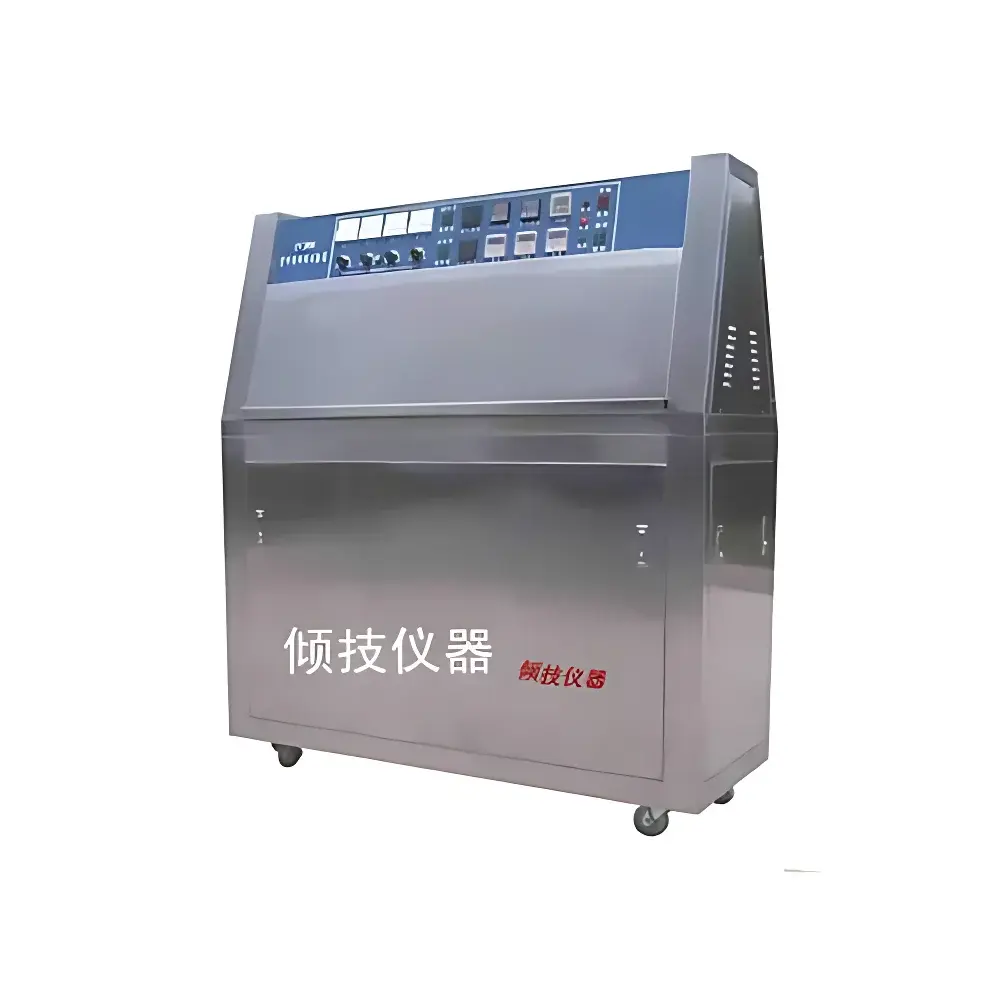
Q-Lab QUV1003 UV Accelerated Weathering Tester
| Origin | Shanghai, China |
|---|---|
| Manufacturer Type | Authorized Distributor |
| Origin Category | Domestic (China) |
| Model | QUV1003 (Spray-Type) |
| Price | USD 10,600 (FOB Shanghai) |
| Illumination Temperature Range | RT+10°C to 70°C |
| Black Panel Temperature Range | RT+10°C to 70°C |
| UV Wavelength | UV-B, 280–315 nm |
| Chamber Internal Dimensions (L×W×H) | 450 × 1165 × 500 mm |
| Temperature Uniformity | ±3°C |
| Humidity Range | ≥75% RH |
| Irradiation/Cold Condensation Cycles | 4 h UV / 4 h condensation or 8 h UV / 4 h condensation |
| Lamp Center-to-Center Spacing | 65–70 mm |
| Specimen-to-Lamp Distance | 55 mm |
| Standard Specimen Size | 75 × 150 mm |
| Water Requirement | Deionized or distilled water, ~8 L/day |
| External Dimensions (D×W×H) | 600 × 1325 × 1480 mm |
Overview
The Q-Lab QUV1003 UV Accelerated Weathering Tester is an engineered benchtop environmental test chamber designed to replicate the damaging effects of solar ultraviolet radiation, moisture, and thermal cycling on polymeric materials, coatings, elastomers, and composites. Based on the fundamental principles of accelerated photochemical degradation—primarily driven by UV-B photon absorption (280–315 nm)—the QUV1003 employs fluorescent UV lamps in conjunction with controlled condensation cycles to induce photooxidation, chain scission, and surface embrittlement under reproducible laboratory conditions. Unlike natural outdoor exposure—which may require months or years to yield measurable deterioration—the QUV1003 delivers accelerated aging data aligned with internationally recognized correlation protocols, enabling comparative ranking of material durability and formulation optimization within weeks. Its design adheres to the core physical mechanisms described in ASTM G154, ISO 4892-3, and GB/T 14522–1993, ensuring methodological consistency across global R&D and quality assurance laboratories.
Key Features
- UV-B fluorescent lamp array (280–315 nm) calibrated for spectral output stability and irradiance uniformity across the specimen plane
- Dual-mode operation: UV irradiation phase (selectable setpoints at 50°C, 60°C, or 70°C) and condensation phase (fixed at 50°C ±3°C), both with independent black panel temperature monitoring
- Spray functionality integrated into the UV cycle to simulate thermal shock and surface washing effects, enhancing realism for outdoor-exposed components
- Precision-engineered chamber geometry ensures ±3°C temperature uniformity and ≥75% RH during condensation—critical for consistent hydrolytic degradation kinetics
- Specimen rack accommodates standard 75 × 150 mm coupons at fixed 55 mm distance from lamp centers, maintaining compliance with ISO 4892-3 specimen positioning requirements
- Robust stainless-steel interior with quartz-protected lamp housings and corrosion-resistant hardware for long-term operational integrity
- Intuitive digital controller with programmable cycle sequencing, real-time parameter logging, and password-protected calibration access
Sample Compatibility & Compliance
The QUV1003 supports flat, rigid specimens up to 75 × 150 mm and 10 mm thickness—including painted panels, plastic sheets, automotive trim, architectural sealants, and textile laminates. Its operational envelope satisfies the exposure conditions specified in multiple international standards: ASTM G154 (Standard Practice for Operating Fluorescent Ultraviolet (UV) Lamp Apparatus for Exposure of Non-Metallic Materials), ISO 4892-3 (Plastics — Methods of exposure to laboratory light sources — Part 3: Fluorescent UV lamps), and GB/T 14522–1993 (Mechanical industrial products — Artificial climate accelerated testing methods for plastics, paints and rubbers). While not inherently GLP-compliant out-of-the-box, the system supports audit-ready documentation when paired with validated third-party data acquisition software meeting FDA 21 CFR Part 11 requirements for electronic records and signatures.
Software & Data Management
The QUV1003 operates via a built-in microprocessor-based controller with non-volatile memory for up to 10 user-defined test programs. Real-time parameters—including black panel temperature, chamber air temperature, UV irradiance (via optional sensor), and cycle stage—are displayed and logged internally at 1-minute intervals. Data export is supported via USB flash drive in CSV format for post-processing in Excel or statistical analysis platforms (e.g., JMP, Minitab). For enterprise integration, optional Ethernet-enabled controllers allow remote monitoring and centralized fleet management through Q-Lab’s Q-Support Suite—a secure, role-based platform supporting version-controlled SOPs, calibration history tracking, and deviation reporting per ISO/IEC 17025 quality management frameworks.
Applications
- Formulation screening of UV stabilizers, HALS additives, and pigment systems in automotive clearcoats and exterior plastics
- Comparative evaluation of weathering resistance in architectural cladding materials per AAMA 2604/2605 specifications
- Accelerated qualification of aerospace polymer composites under simulated tropical coastal environments
- QC release testing of medical device housing materials per ISO 10993-12 biocompatibility guidance
- Root-cause analysis of field failures involving chalking, gloss loss, or microcracking in photovoltaic module encapsulants
- Supporting IEC 61215 certification testing for PV backsheet durability (in conjunction with thermal cycling and damp heat protocols)
FAQ
What UV spectrum does the QUV1003 replicate, and why is UV-B emphasized?
The QUV1003 uses UV-B fluorescent lamps (280–315 nm), which correspond to the most photochemically active region of terrestrial solar UV. This band drives rapid polymer backbone cleavage and pigment degradation—making it ideal for accelerated screening where correlation to real-world failure modes (e.g., cracking in PVC window profiles) is prioritized over absolute time equivalence.
Can the QUV1003 meet ASTM D4329 or ISO 4892-3 without modification?
Yes—when operated per its default UV-B lamp configuration and specified temperature/humidity profiles, the QUV1003 satisfies the apparatus and exposure condition requirements of both standards. Full compliance requires documented lamp calibration, temperature uniformity verification, and adherence to specimen mounting procedures outlined in the respective standards.
Is deionized water mandatory for the spray function?
Yes. Use of deionized or distilled water is required to prevent mineral deposition on specimens and lamp surfaces, which would otherwise attenuate UV transmission and compromise irradiance stability over time.
How often must UV lamps be replaced to maintain test validity?
Per Q-Lab recommendations and ISO 4892-3 Annex B, UV-B lamps should be replaced after 1600 hours of cumulative operation—or sooner if irradiance drops below 90% of initial output—as verified by a NIST-traceable UV radiometer.
Does the QUV1003 support multi-user access control or electronic audit trails?
The base controller does not include electronic signature or audit trail capabilities. However, integration with Q-Support Suite (optional Ethernet module + licensed software) enables user authentication, change logs, and 21 CFR Part 11–compliant electronic records for regulated environments.



