
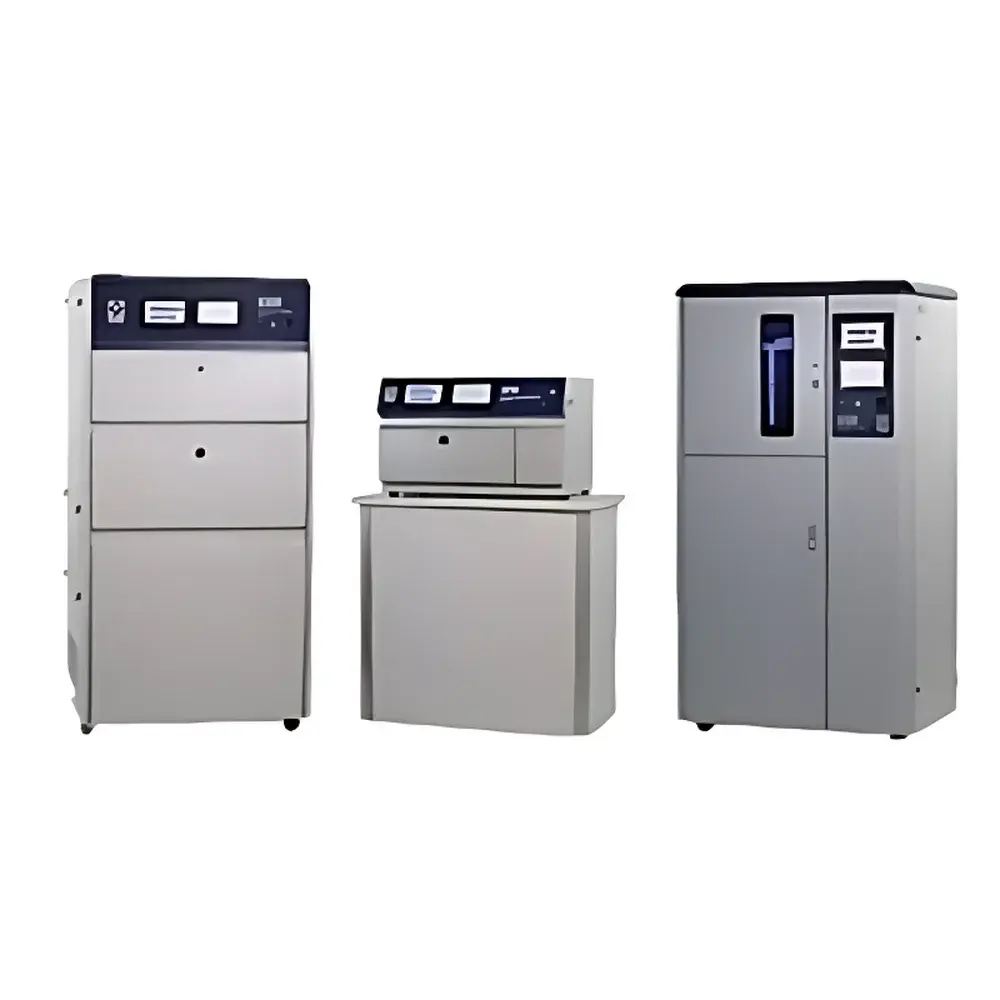
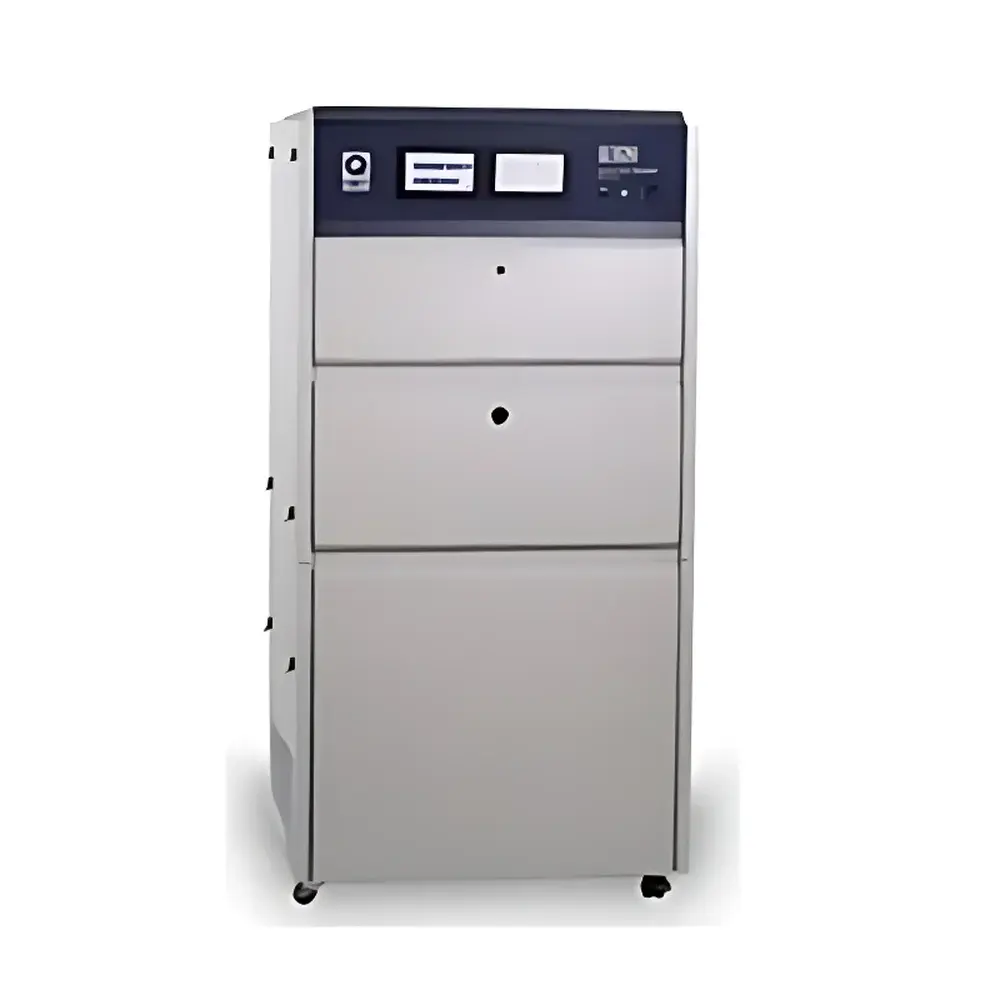
Q-LAB Q-SUN Xe-3-HBS Xenon Arc Weathering Test Chamber
| Brand | Q-LAB |
|---|---|
| Origin | USA |
| Model | Q-SUN Xe-3-HBS |
| Xenon Lamp Power | 1800 W |
| Irradiance Range | ≤1800 W/m² |
| Light Exposure Duration | 1–9999 h (continuously adjustable) |
| Humidity Control Range | Up to 95% RH |
Overview
The Q-LAB Q-SUN Xe-3-HBS Xenon Arc Weathering Test Chamber is an advanced, benchtop-scale environmental test system engineered for precise simulation of solar radiation, temperature, and humidity—critical parameters in accelerated weathering evaluation. It employs air-cooled xenon arc lamps to replicate the full solar spectrum (290–800 nm), with spectral fidelity validated against natural sunlight per ISO 4892-2 and ASTM G155. The “H” designation denotes integrated humidity control via steam-based humidification; the “B” signifies bidirectional water spray—delivering calibrated deionized water simultaneously to both front and back surfaces of specimens. This dual-spray capability enables compliance with stringent automotive standards including SAE J2527 and J2412, where rear-side moisture exposure is mandated. Unlike water-cooled systems, the Xe-3-HBS utilizes a compact, low-maintenance air-cooled lamp architecture, supporting operational continuity and reducing facility infrastructure demands.
Key Features
- Air-cooled 1800 W xenon arc lamp assembly with three parallel lamp tubes—each rated for ≥1500 hours of stable output before replacement.
- Automated irradiance control via Q-LAB’s SunEye® feedback system, supporting closed-loop regulation at user-selectable wavelengths: 340 nm (UV-A critical for polymer degradation), 420 nm (broadband visible), or TUV (total UV).
- Configurable optical filtering options—including Daylight-Q, Daylight-B/B, Window-Q, Window-B/SL, Extended UV-Q/B, and Window-IR—to match specific spectral requirements defined in ISO, ASTM, or OEM specifications.
- Humidity control range of 10–95% RH, achieved through precision steam injection and condensation management within the test chamber.
- Bidirectional spray system with two overhead nozzles delivering uniform deionized water application during either light or dark cycles—programmable per test protocol.
- Horizontal sample tray (45 × 72 cm active area) accommodating up to 55 standard 51 × 102 mm specimens or irregular 3D components using optional fixtures.
- Intuitive touchscreen interface with embedded data logging, real-time parameter monitoring, and password-protected user profiles for multi-operator environments.
Sample Compatibility & Compliance
The Q-SUN Xe-3-HBS accommodates flat, curved, and three-dimensional samples without requiring custom mounting adapters. Its horizontal orientation minimizes gravitational distortion during wetting cycles and ensures consistent spray coverage across heterogeneous geometries. The system supports regulatory testing per ISO 4892-2 (plastics), ASTM D4329 (plastics), ASTM D4459 (interior automotive materials), SAE J2527/J2412 (exterior automotive), AATCC TM16 (textiles), and GB/T 16422.2 (China national standard). All humidity and irradiance control functions are traceable to NIST-certified reference standards. The chamber design complies with IEC 61000-6-3 (EMC) and UL 61010-1 (safety), and supports audit-ready operation under GLP and GMP frameworks when paired with optional 21 CFR Part 11-compliant software modules.
Software & Data Management
The integrated controller records irradiance, chamber temperature, black panel temperature, relative humidity, and spray cycle timing at user-defined intervals (minimum 1-minute resolution). Data exports directly to CSV or Excel-compatible formats for post-test analysis. Optional Q-LAB’s SolarEye™ PC software provides extended remote monitoring, automated report generation (PDF/HTML), and historical trend comparison across multiple test runs. For regulated laboratories, the optional Compliance Package adds electronic signatures, audit trails, user access levels, and calibration lockout features aligned with FDA 21 CFR Part 11 requirements. All sensor calibrations are documented with CR20-compatible traceability certificates.
Applications
This chamber is routinely deployed in R&D and QC labs evaluating photostability, color fade resistance, gloss retention, cracking, chalking, and adhesion loss in coatings, polymers, textiles, automotive interiors/exterior trim, architectural sealants, and packaging films. Its bidirectional spray function is essential for validating corrosion resistance of coated metals, delamination behavior in laminated composites, and hydrolytic degradation in polyurethanes and polyesters. Academic institutions use it for fundamental studies on photo-oxidation kinetics and UV stabilizer efficacy under controlled hygrothermal stress.
FAQ
What spectral filters are available for the Q-SUN Xe-3-HBS, and how do they affect test relevance?
The system supports six filter configurations: Daylight-Q, Daylight-B/B, Window-Q, Window-B/SL, Extended UV-Q/B, and Window-IR. Each modifies the UV cutoff and infrared transmission to emulate specific exposure conditions—e.g., Daylight-Q replicates terrestrial sunlight behind glass, while Window-B/SL matches automotive interior irradiance profiles.
Can irradiance be controlled at multiple wavelengths simultaneously?
No—the SunEye® system regulates irradiance at one selected wavelength per test cycle (340 nm, 420 nm, or TUV). Switching control points requires installing the corresponding calibrated sensor and CR20 verification instrument.
Is the bidirectional spray system compatible with all test standards?
It is mandatory for SAE J2527 and J2412, and recommended for any standard requiring rear-surface moisture exposure (e.g., certain ISO 11341 protocols). Spray timing and duration are fully programmable within the controller.
How often must the xenon lamps be replaced, and is recalibration required after replacement?
Lamps are rated for ≥1500 hours; replacement is indicated by irradiance deviation >±5% from setpoint. Post-replacement, a CR20-based recalibration is required to restore traceable irradiance control.
Does the system support unattended operation over extended durations?
Yes—continuous operation up to 9999 hours is supported, with automatic lamp power compensation, humidity stabilization, and fault logging. Optional network connectivity enables remote status alerts via email or SNMP.



