
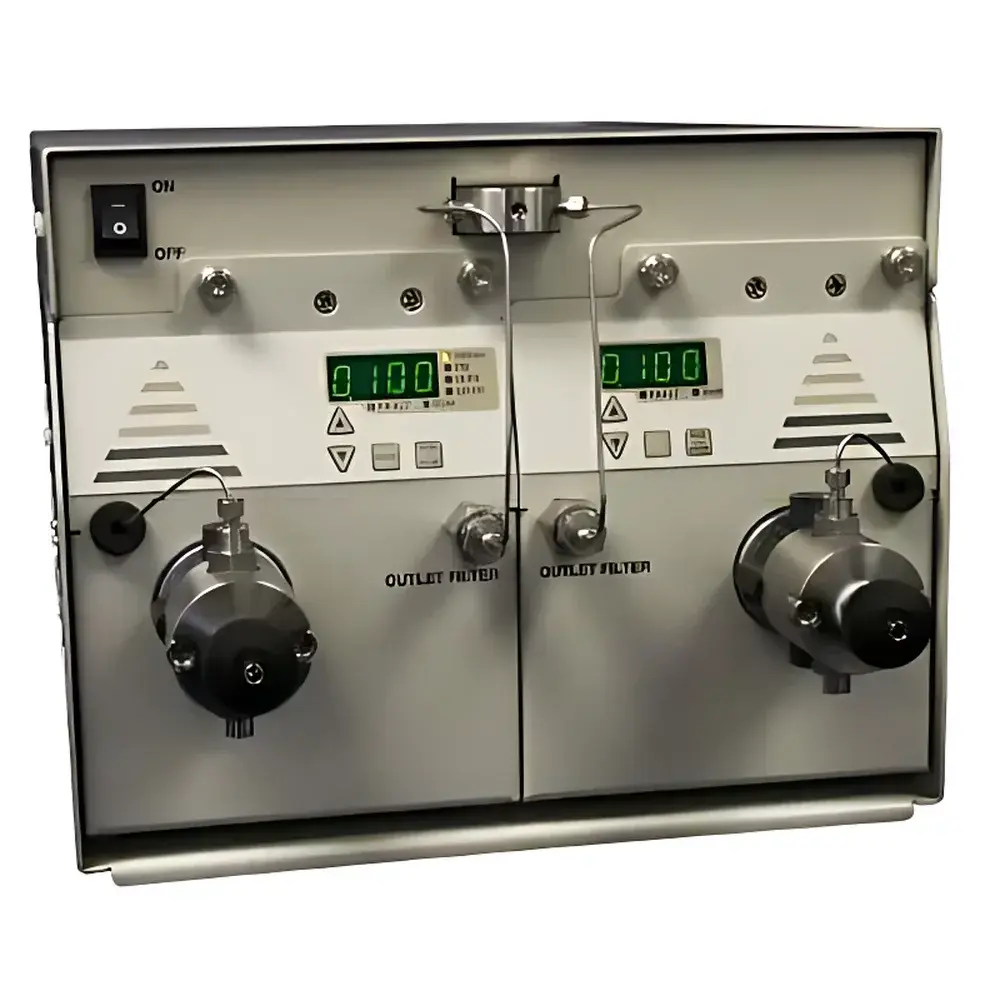
Laballiance B230 Binary High-Pressure Gradient Pump
| Brand | Laballiance |
|---|---|
| Origin | USA |
| Model | B230 |
| Flow Rate Range | 0.001–5.00 mL/min |
| Maximum Pressure | 6,000 psi (stainless steel pump heads), 5,000 psi (PEEK pump heads) |
| Pressure Accuracy | ±1% of full scale |
| Pressure Zero Drift | ±2 psi |
| Flow Accuracy | ±1% (at ≥0.2 mL/min) |
| Flow Precision | ≤0.075% RSD |
| Operating Temperature | 10–40 °C |
| Relative Humidity | 10–90% RH |
| Power Supply | 110/220 V, 50/60 Hz |
| Dimensions | 7" H × 10.5" W × 15.25" D |
| Weight | 24 lb (11 kg) |
| Interface | RS-232 |
| Compliance | Designed for GLP/GMP-aligned laboratory environments |
Overview
The Laballiance B230 Binary High-Pressure Gradient Pump is an engineered solution for precise, stable, and reproducible solvent delivery in high-performance liquid chromatography (HPLC) and ultra-high-performance liquid chromatography (UHPLC)-compatible systems. Based on dual independent reciprocating piston architecture with active pulse damping and real-time pressure monitoring, the B230 delivers gradient elution with minimal dwell volume and exceptional baseline stability. Its core design adheres to fundamental fluidic principles—positive displacement via dual synchronized stainless steel or PEEK pump heads, coupled with a diaphragm-type pulse dampener that attenuates pressure oscillations below 0.5% RSD across the full flow range. The integrated pressure transducer enables closed-loop pressure feedback control, ensuring consistent column backpressure during method development and routine QC analysis. As a binary system, it supports two mobile phase reservoirs, enabling linear, step, or multi-segment gradient profiles essential for method transfer and robustness testing.
Key Features
- Dual independent high-pressure pump heads with selectable wetted materials: 316 stainless steel for general-purpose applications or chemically inert PEEK for bio-compatible and aggressive solvent use (e.g., high-pH mobile phases, TFA-containing buffers)
- Patented self-cleaning pump head design: utilizes residual mobile phase flow behind the piston seal to continuously flush particulate and precipitate buildup—reducing seal wear and extending service intervals without manual disassembly
- Integrated diaphragm pulse dampener and fast-response pressure sensor (±2 psi zero drift) ensure <0.075% RSD flow precision at 1.0 mL/min, meeting USP and ICH Q2(R2) requirements for chromatographic system suitability
- Front-panel digital interface with LED display for real-time monitoring of flow rate, pressure, and system status; programmable upper/lower pressure limits with automatic shutdown to safeguard analytical columns and guard cartridges
- Microprocessor-controlled stepper motor drive eliminates flow drift due to temperature fluctuations or extended run times—critical for overnight unattended sequences in regulated laboratories
- RS-232 serial interface enables remote operation, method synchronization, and audit-trail-capable data logging when integrated with LIMS or chromatography data systems (CDS) compliant with FDA 21 CFR Part 11
Sample Compatibility & Compliance
The B230 accommodates a broad range of mobile phase chemistries—including aqueous buffers (pH 1–12), organic modifiers (acetonitrile, methanol, THF), and corrosive additives (TFA, HFBA)—when configured with PEEK fluidic path components. Stainless steel variants are validated for standard reversed-phase and normal-phase applications per ASTM D5281 (Standard Practice for Calibration of Liquid Chromatographic Systems). All configurations support IQ/OQ/PQ documentation packages aligned with ISO/IEC 17025 and GMP Annex 11 requirements. The pump’s self-cleaning function reduces carryover risk between injections, supporting compliance with ICH Q5C stability-indicating assay protocols. Ambient operating specifications (10–40 °C, 10–90% RH) meet typical laboratory HVAC standards per ISO 14644-1 Class 8 cleanroom auxiliary equipment guidelines.
Software & Data Management
While the B230 operates autonomously via its front-panel controls, its RS-232 port allows integration into third-party CDS platforms (e.g., Empower, Chromeleon, OpenLab) for centralized method deployment and electronic record retention. The pump firmware logs operational parameters—including total runtime, pressure excursions, and error codes—with timestamped entries suitable for GLP audit trails. No proprietary software installation is required; ASCII-based command sets enable direct scripting for automated system priming, gradient ramping, and diagnostic routines. Firmware updates are performed via terminal emulation, preserving configuration integrity during maintenance cycles.
Applications
- HPLC/UHPLC binary gradient separations in pharmaceutical QC labs—particularly for dissolution testing, assay quantitation, and impurity profiling per USP monographs
- Bioanalytical workflows involving peptide mapping, monoclonal antibody characterization, and oligonucleotide purity assessment where low metal leaching and pH stability are critical
- Academic research requiring method development flexibility—e.g., scouting gradients, solvent strength optimization, and column screening under variable backpressure conditions
- Environmental and food safety testing labs performing multiresidue pesticide analysis using EPA Method 8321B or AOAC 2012.01-compliant LC-MS/MS workflows
- Teaching laboratories emphasizing hands-on understanding of gradient formation kinetics, dwell volume effects, and pump mechanics in analytical chemistry curricula
FAQ
What mobile phase compatibility options does the B230 support?
Stainless steel pump heads are rated for solvents and buffers within pH 1–8; PEEK-configured units extend compatibility to pH 1–12 and aggressive organics including hexafluoroisopropanol and concentrated formic acid.
How often does the self-cleaning system require maintenance?
The onboard cleaning reservoir requires weekly replenishment with distilled water containing ≤5% methanol to inhibit microbial growth—no tools or downtime are needed for routine servicing.
Is the B230 compatible with modern CDS platforms for 21 CFR Part 11 compliance?
Yes—when connected via RS-232 to validated chromatography data systems, the B230 supports electronic signatures, audit trails, and user-access controls as defined in FDA guidance for computerized systems in regulated environments.
Can flow rate be calibrated in-house?
Yes—the instrument includes a built-in flow calibration mode accessible through the front panel; users may verify accuracy against gravimetrically measured effluent over a defined time interval per ISO 8655-4.
What is the maximum dwell volume of the B230 gradient mixer?
The internal low-volume mixer yields a system dwell volume of ≤500 µL when paired with standard 0.005″ ID PEEK tubing and a 10 µL injection loop—suitable for narrow-bore and microbore column applications.



