
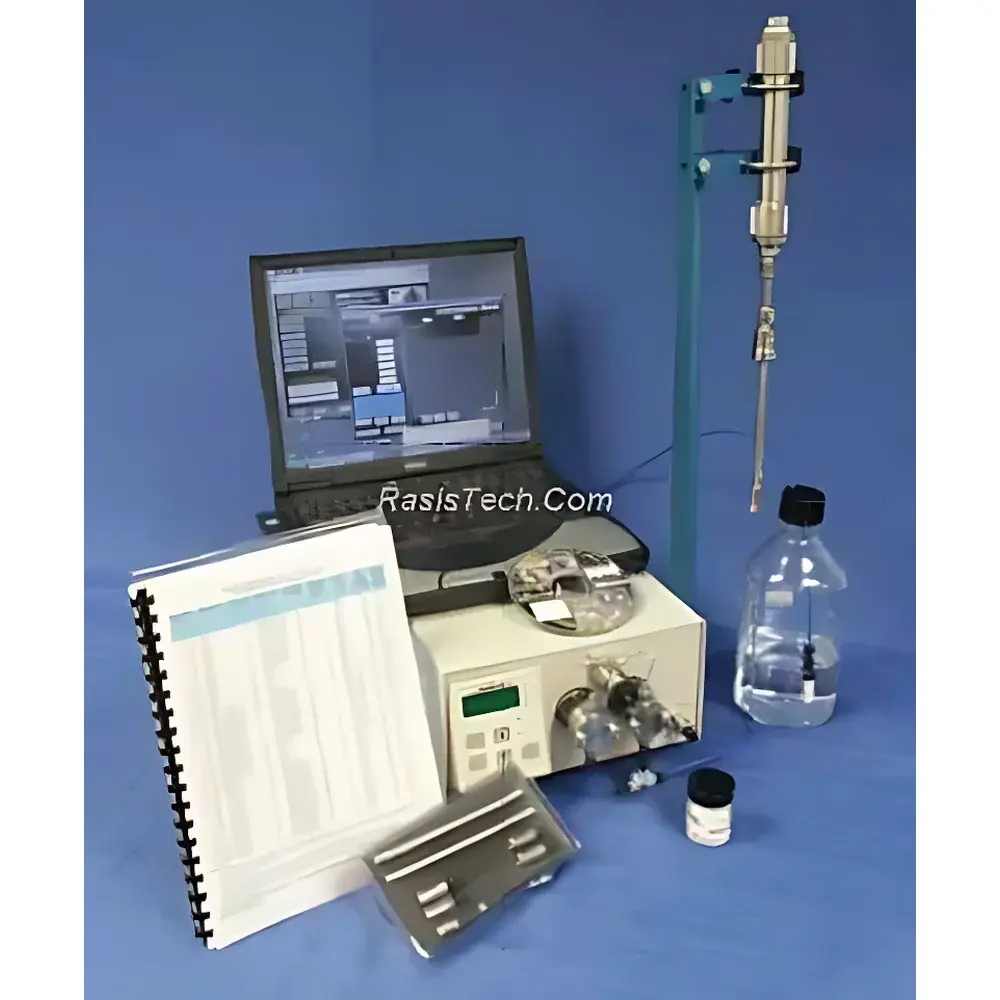
Laballiance Model CP High-Pressure Liquid Chromatography Column Packing System
| Brand | Laballiance |
|---|---|
| Origin | USA |
| Manufacturer Type | Authorized Distributor |
| Origin Category | Imported |
| Model | CP |
| Pricing | Available Upon Request |
| Pump Flow Range | 1–24 mL/min |
| Maximum Pressure | 10,000 or 18,000 psi |
| Pump Control Interface | RS-232 with pressure/flow sensors |
| Construction | Stainless Steel (SS) |
| Voltage | 110/220 V AC |
| Column Hardware Included | Two 4.6 × 150 mm stainless steel column assemblies (including endfittings, frits, and 2 µm stainless steel frits) |
| Slurry Vessel | 20 mL agitated slurry reservoir |
| Packing Accessories | Compression ferrules, metal bands, reducing adapters, O-rings, 1/16″ OD × 0.03″ ID stainless steel tubing |
| Stationary Phase | 10 g C18 silica-based packing material |
| Software | Quick-Set pump control software |
| Compliance | Designed for GLP-compliant column manufacturing environments |
Overview
The Laballiance Model CP High-Pressure Liquid Chromatography Column Packing System is an engineered solution for reproducible, high-integrity preparation of analytical- and semi-preparative-scale HPLC columns. It operates on the principle of controlled slurry packing under constant pressure—leveraging a precision-engineered dual-range piston pump to deliver stable, pulseless flow across a wide dynamic range (1–24 mL/min) while maintaining pressure stability within ±0.5% of setpoint. This architecture ensures uniform slurry delivery into stainless steel column hardware, minimizing void formation, bed disruption, and particle fracture—critical factors governing column efficiency (N), backpressure stability, and peak symmetry. The system supports both conventional slurry packing and density-matched “Neteal Density” techniques, enabling optimal packing density for sub-2 µm particles and high-retention-phase materials such as C18, phenyl-hexyl, and HILIC chemistries. Its modular design accommodates column inner diameters from 2.1 mm up to 10 mm, with scalable pressure and flow parameters aligned to ASTM D7913 and ISO 13877 guidance for chromatographic column validation.
Key Features
- High-stability constant-pressure pump with selectable maximum pressure ratings (10,000 psi or 18,000 psi) to match particle size and column geometry requirements
- Integrated RS-232 interface with real-time pressure and flow monitoring—enabling external logging and audit-ready data capture
- Stainless steel wetted path construction (316 SS) ensuring chemical compatibility with organic solvents (methanol, chloroform), aqueous buffers, and aggressive mobile phases
- Modular hardware kit including two complete 4.6 × 150 mm column assemblies with 2 µm sintered stainless steel frits, precision-machined endfittings, and leak-tight compression fittings
- Dedicated 20 mL agitated slurry vessel with magnetic stirring and inert gas purge port to maintain particle suspension homogeneity and prevent solvent evaporation
- Quick-Set pump control software supporting programmable ramp profiles, pressure hold sequences, and event-triggered data export in CSV format
- Full mechanical assembly kit—including reducing adapters, metal bands, ferrules, O-rings, and calibrated stainless steel tubing—for repeatable hardware configuration across lab personnel
Sample Compatibility & Compliance
The Model CP system is validated for use with silica-based, polymer-based, and hybrid organic-inorganic stationary phases, including but not limited to C18, C8, phenyl, amino, cyano, and zirconia-coated packings. It meets mechanical and procedural prerequisites outlined in USP , ICH Q5C, and FDA 21 CFR Part 11 when paired with compliant data acquisition workflows. All column hardware conforms to ASTM E260 and ISO 8573-1 for dimensional tolerances and surface finish. The system supports GMP-aligned column manufacturing protocols through traceable pressure/flow logs, user-access-controlled software permissions, and electronic signature-capable audit trails when integrated with validated LIMS or ELN platforms.
Software & Data Management
Quick-Set software provides deterministic control over packing sequences—including initial solvent equilibration, slurry introduction ramp, consolidation hold, and final pressure stabilization. Each run generates a timestamped metadata file containing operator ID, date/time, target pressure, actual pressure deviation, total volume delivered, and thermal drift compensation values. Exported data is natively compatible with JMP, MATLAB, and Python-based QC dashboards. Optional API integration enables automated reporting to enterprise quality systems. Software validation documentation (IQ/OQ/PQ templates) is available upon request for regulated laboratories operating under ISO/IEC 17025 or FDA 21 CFR Part 11 compliance frameworks.
Applications
- Development and scale-up of custom-packed reversed-phase, HILIC, and ion-exchange columns for method transfer and regulatory submission
- Repacking of degraded or contaminated columns in QC/QA laboratories to extend column lifetime without compromising resolution
- Research-grade column fabrication for novel stationary phases—including core-shell, monolithic, and chiral selectors—where batch-to-batch consistency is essential
- Training platform for chromatography core facilities teaching fundamental principles of bed compaction mechanics, slurry rheology, and frit integrity testing
- Supporting DOE-driven optimization studies correlating packing pressure, solvent composition, and slurry concentration with plate count (N), asymmetry factor (As), and pressure rise over time
FAQ
What column inner diameters does the Model CP support?
The system is optimized for columns ranging from 2.1 mm to 10 mm ID. For ≤3 mm ID columns, the CP12 variant is recommended; for ≥4.6 mm ID, the CP24 variant delivers superior flow linearity and pressure response.
Is the C18 packing material included sufficient for multiple columns?
The supplied 10 g quantity is calibrated for one standard 4.6 × 150 mm column at ~50% bed density. Additional material must be ordered separately for multi-column campaigns or larger geometries.
Can the system be used with non-silica-based packings such as polymeric resins or metal-organic frameworks (MOFs)?
Yes—provided slurry viscosity and compressibility fall within the pump’s operational envelope (dynamic viscosity < 25 cP, compressibility < 0.8%). Pre-packing rheological characterization is strongly advised.
Does Quick-Set software support 21 CFR Part 11 compliance out-of-the-box?
The base software includes electronic signature prompts and audit log generation. Full Part 11 compliance requires deployment on a validated Windows OS environment with domain-level access controls and periodic backup verification—documentation provided in the Validation Support Package.
What maintenance intervals are recommended for the pump and slurry vessel?
Piston seals should be inspected every 200 hours of operation; the agitator motor bearing requires lubrication every 12 months. A full calibration check using NIST-traceable pressure transducers is recommended annually or after any impact event.




