
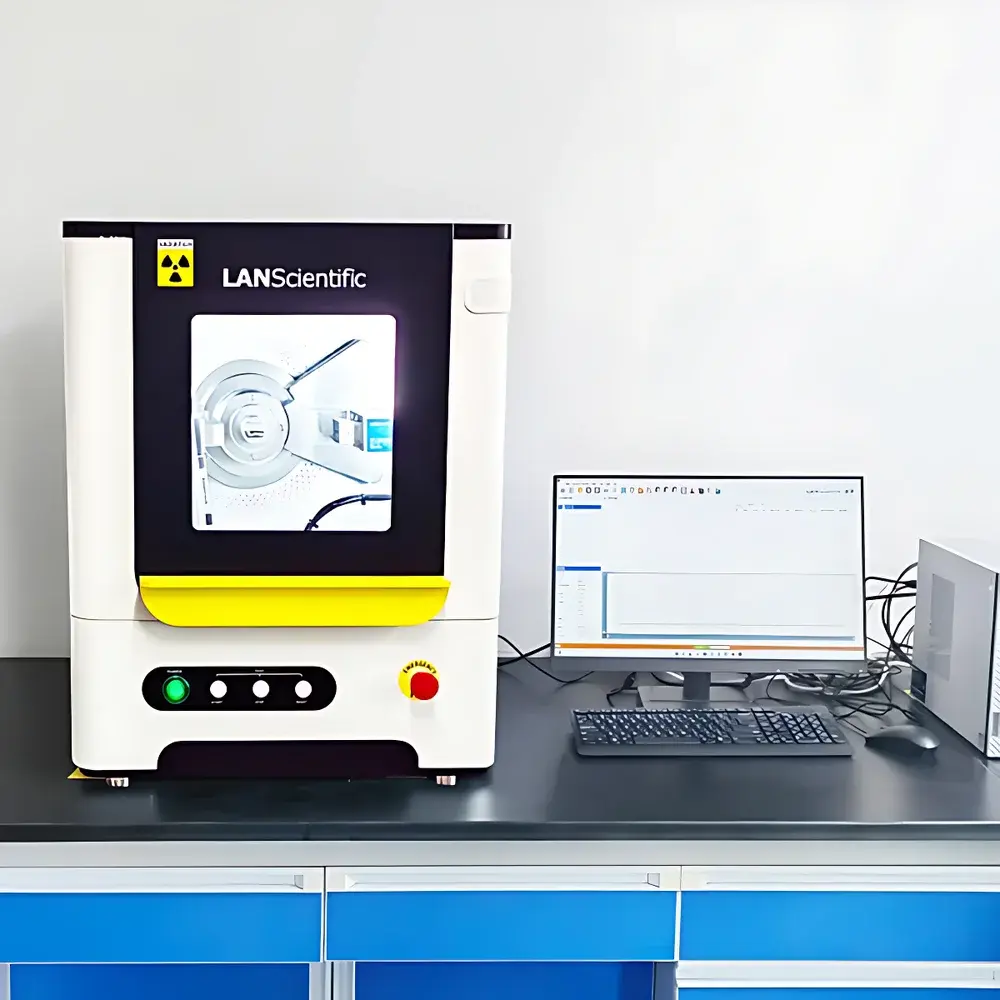
LANScientific FRINGE EV Desktop X-ray Diffractometer (XRD) with Integrated DPPC Detector
| Brand | LANScientific |
|---|---|
| Origin | Jiangsu, China |
| Manufacturer Type | Direct Manufacturer |
| Instrument Type | Powder X-ray Diffractometer |
| Geometry | Bragg–Brentano θ–2θ reflection mode |
| Power Supply | kW-class integrated X-ray source (exact rating per configuration) |
| Detector | Digital Pulse Processing Counter (DPPC), ≥1 × 10⁷ counts per second (CPS) |
| Sample Stage | Fixed-height goniometer with air-spring assisted large-window lift door |
| Software | CrystalX™ automated phase identification & quantification suite |
| Compliance | Designed for GLP-compliant labs |
Overview
The LANScientific FRINGE EV is a compact, benchtop-scale X-ray diffractometer engineered for high-fidelity powder X-ray diffraction (XRD) analysis in research, quality control, and routine materials characterization environments. It operates on the Bragg–Brentano θ–2θ reflection geometry, where a collimated Cu-Kα (or optional Mo/Co/Fe Kα) X-ray beam impinges upon a stationary or rotating sample stage positioned at the center of a precision goniometer. When the incident angle satisfies Bragg’s law (nλ = 2d sinθ), constructive interference generates characteristic diffraction peaks detected by the integrated Digital Pulse Processing Counter (DPPC) detector. Unlike conventional scintillation or Si(Li) detectors, the DPPC enables simultaneous acquisition of both angular-position-resolved diffraction intensity data and energy-dispersive X-ray spectral information—eliminating the need for secondary monochromators while preserving full spectral fidelity. The system’s kW-class sealed-tube X-ray source delivers stable, high-flux irradiation suitable for rapid data collection across diverse sample classes without compromising resolution or signal-to-noise ratio.
Key Features
- Compact benchtop architecture with air-spring-assisted large-window lift door—minimizes footprint and enables seamless integration into standard laboratory workspaces, including mobile or field-deployable platforms.
- Integrated DPPC detector with ≥1 × 10⁷ CPS throughput capacity, providing real-time pulse-height discrimination and enabling concurrent XRD pattern acquisition and elemental fingerprinting via energy-dispersive spectroscopy (EDS).
- Fixed-geometry Soller collimator assembly—no moving or adjustable optical components—enhances long-term mechanical stability and reduces calibration drift over extended operational cycles.
- Automated goniometer control with sub-arcminute angular reproducibility, supporting step-scanning and continuous scanning modes compliant with ISO 17873 and ASTM E975 standards.
- Full enclosure with interlocked safety door, automatic beam shutter activation during door opening, and real-time status feedback on the operator interface to ensure ALARA (As Low As Reasonably Achievable) radiation safety compliance.
Sample Compatibility & Compliance
The FRINGE EV accommodates a broad range of solid-state samples—including free-flowing powders, pressed pellets, bulk metal alloys, thin-film coatings, geological specimens, pharmaceutical tablets, and ceramic composites—without requiring specialized holders or vacuum environments. Its open-beam path design allows direct mounting of custom sample stages or environmental cells (e.g., heating/cooling stages, humidity chambers). All hardware and firmware comply with IEC 61010-1 for electrical safety and IEC 62495 for X-ray equipment classification. The CrystalX™ software platform supports 21 CFR Part 11-compliant electronic signatures, user-level access controls, and immutable audit trails required for GMP/GLP-regulated laboratories in pharmaceuticals, medical device manufacturing, and contract research organizations.
Software & Data Management
CrystalX™ is a purpose-built analytical suite that automates the entire XRD workflow—from instrument parameter setup and data acquisition to phase identification, Rietveld refinement, quantitative phase analysis (QPA), crystallinity assessment, and lattice parameter calculation. Leveraging the ICDD PDF-4+ database and built-in search-match algorithms, CrystalX™ performs real-time phase matching and reports weight fractions with uncertainty estimates based on internal standard methodology or reference intensity ratio (RIR) calibration. Raw data are stored in vendor-neutral .xy and .raw formats; processed results export to CSV, PDF, or CIF for archival or third-party analysis. Data integrity is enforced through timestamped metadata embedding, version-controlled processing scripts, and configurable backup protocols aligned with ISO/IEC 17025 documentation requirements.
Applications
This system serves as a primary analytical tool in academic materials science departments, national metrology institutes, cement and metallurgical QC labs, semiconductor process development centers, and pharmaceutical formulation units. Typical use cases include: identification of polymorphic forms in active pharmaceutical ingredients (APIs); quantification of amorphous content in lyophilized biologics; phase evolution monitoring during thermal annealing of battery cathode materials; residual stress mapping in additive-manufactured metal components; mineralogical composition analysis of soil and ore samples; and structural validation of MOFs and perovskite thin films. Its dual XRD/EDS capability further supports failure analysis workflows where crystallographic and compositional anomalies must be correlated spatially and statistically.
FAQ
Is the FRINGE EV suitable for regulatory submissions in pharmaceutical development?
Yes—the system meets critical requirements for method validation under USP , ICH Q5A, and FDA guidance on analytical procedure validation when operated with documented SOPs and calibrated traceable to NIST SRM standards.
Can the DPPC detector distinguish between overlapping diffraction peaks and fluorescence lines?
Yes—its pulse-height analysis engine separates characteristic X-ray fluorescence emissions from diffraction events based on photon energy, enabling selective background subtraction and improved peak deconvolution accuracy.
Does the instrument support external environmental cells?
Yes—standard flange interfaces accommodate commercially available heating, cooling, and gas-controlled stages; custom integration kits are available upon request.
What maintenance intervals are recommended for the X-ray tube?
Under typical usage (≤8 h/day), the sealed-tube source requires no scheduled maintenance for 12–18 months; anode wear monitoring is integrated into the diagnostic dashboard.
Is remote operation supported?
Yes—CrystalX™ includes secure TLS-encrypted remote desktop access and RESTful API endpoints for integration into LIMS and MES platforms.
Related Products




