
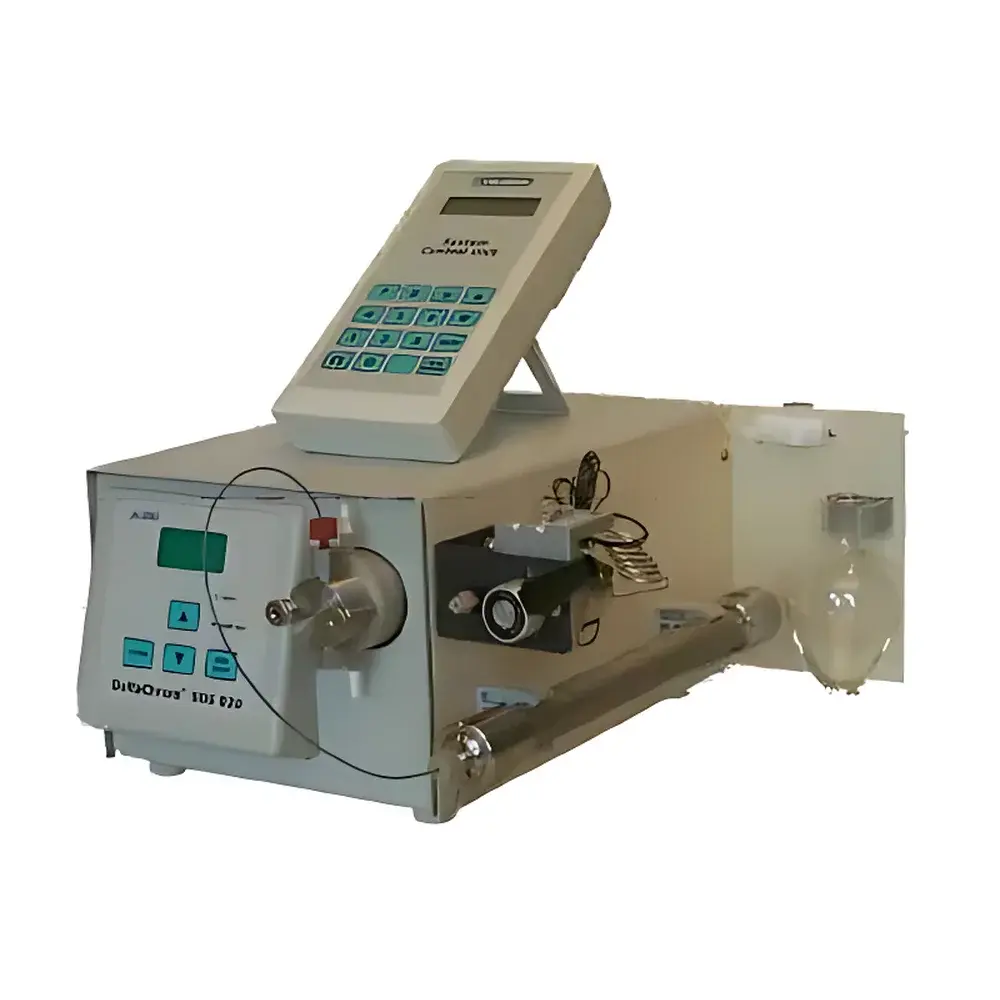
LabAlliance SCS-200 Gel Permeation Chromatography Sample Cleanup System
| Brand | LabAlliance |
|---|---|
| Origin | USA |
| Model | SCS-200 |
| Instrument Type | Ambient-Temperature GPC Cleanup System |
| Pump Flow Rate | 0.01–9.99 mL/min |
| Maximum Pressure | 2500 psi (pump), 1500 psi (column) |
| Flow Path Materials | 316 Stainless Steel, Ceramic, Inert Polymer |
| Injector | Adjustable 2 mL Manual Injector with Valve Position Sensing & Loop Interface |
| Column Dimensions | 250 × 16 mm (customizable) |
| Packing Material | PS-DVB Copolymer |
| Pore Size | 50 nm |
| Particle Size | 10 µm |
| Max Operating Temperature | 60 °C |
| Sample Load Capacity | 300 mg |
| Fraction Collector | Three-Position Electronic Solenoid Valve |
| Control Interface | Front-Panel SCU + RS-232 Serial Communication |
Overview
The LabAlliance SCS-200 Gel Permeation Chromatography (GPC) Sample Cleanup System is an ambient-temperature, fully integrated preparative chromatographic platform engineered for selective removal of high-molecular-weight interferences from complex environmental, food, and biological matrices prior to instrumental analysis. Based on the principle of size-exclusion chromatography (SEC), the system separates analytes by hydrodynamic volume in solution—retaining macromolecules such as lipids, pigments, polymers, and humic substances on the column while eluting low-molecular-weight target compounds (e.g., pesticides, PCBs, PAHs, mycotoxins, pharmaceutical residues) in early, well-defined fractions. Unlike high-temperature GPC systems, the SCS-200 operates at ambient conditions, eliminating thermal degradation risks for thermolabile analytes and simplifying method transfer across routine QC and regulatory laboratories. Its modular architecture supports reproducible, trace-level cleanup workflows required for GC, GC/MS, LC, and LC/MS analysis—particularly where matrix suppression, ionization interference, or column fouling compromises data integrity.
Key Features
- Constant-pressure, isocratic dual-piston reciprocating pump with flow accuracy ±0.5% RSD over 0.01–9.99 mL/min range and maximum pressure rating of 2500 psi—ensuring stable mobile phase delivery across diverse solvent systems (e.g., hexane/acetone, dichloromethane, ethyl acetate).
- Manually adjustable 2 mL injection loop with valve position sensing and standardized loop interface—enabling precise, repeatable sample introduction; optional custom loop volumes available upon request.
- Dedicated GPC column packed with 10 µm cross-linked polystyrene-divinylbenzene (PS-DVB) particles featuring uniform 50 nm pore diameter—optimized for molecular weight cutoff between ~500 Da and 10 kDa, balancing resolution and throughput.
- Three-port electronic fraction collector with solenoid-driven valve actuation—programmable via front-panel SCU or external PC to collect discrete fractions based on time, volume, or UV-triggered events (when coupled with optional detector).
- Chemically inert fluidic path constructed from 316 stainless steel, ceramic components, and fluoropolymer-lined tubing—resistant to chlorinated solvents, esters, and aliphatic hydrocarbons commonly used in GPC cleanup protocols.
- Comprehensive hardware diagnostics and real-time status monitoring via built-in SCU display—reducing operator dependency and supporting GLP-compliant documentation practices.
Sample Compatibility & Compliance
The SCS-200 accommodates a broad spectrum of sample types—including soil extracts, sediment homogenates, fish tissue lipid extracts, vegetable oil matrices, infant formula digests, and wastewater concentrates—provided they are pre-filtered (≤0.45 µm) and dissolved in compatible eluents. Its 300 mg nominal sample loading capacity enables robust cleanup of multi-residue extractions without column overloading. The system conforms to widely adopted regulatory methodologies, including EPA Method 3640A (GPC cleanup for organochlorine pesticides), AOAC Official Method 2007.01 (for mycotoxin analysis), and EN 15662:2018 (multi-residue pesticide analysis in food). All wetted materials meet USP Class VI biocompatibility standards, and the RS-232 interface supports audit-trail-capable data logging when integrated with validated LIMS or CDS software compliant with FDA 21 CFR Part 11 requirements.
Software & Data Management
While the SCS-200 operates autonomously via its embedded System Control Unit (SCU), it supports bidirectional serial communication through standard RS-232 protocol—enabling remote configuration, method upload/download, real-time status polling, and fraction event logging. When interfaced with third-party chromatography data systems (e.g., Thermo Chromeleon, Agilent OpenLAB, Waters Empower), the system can be synchronized for time-stamped fraction collection triggers and metadata embedding (e.g., sample ID, method name, operator initials). No proprietary software license is required; all control logic resides in firmware. Audit trails—including method changes, run start/stop timestamps, and valve actuation logs—are retained in non-volatile memory for minimum 12 months, facilitating internal quality audits and regulatory inspections under ISO/IEC 17025 or GLP frameworks.
Applications
- Removal of co-extracted triglycerides and sterols from animal tissue extracts prior to GC-ECD or GC-MS/MS quantification of persistent organic pollutants (POPs).
- Cleanup of plant-based food extracts to eliminate chlorophyll, carotenoids, and waxes before LC-MS/MS analysis of neonicotinoid insecticides.
- Depletion of polymeric interferents from polymer leachates or packaging migration studies targeting low-MW migrants (e.g., photoinitiators, antioxidants).
- Preparative isolation of <500 Da bioactive metabolites from fermentation broths or herbal extracts for structural elucidation by NMR or HRMS.
- Standardized fractionation of environmental sediment extracts for tiered toxicity testing (e.g., separating bioavailable vs. bound contaminant fractions).
FAQ
Can the SCS-200 be used with volatile organic solvents such as hexane or dichloromethane?
Yes—the entire fluidic path is rated for full compatibility with common GPC eluents including hexane, toluene, THF, dichloromethane, and acetone. Pressure and chemical resistance are validated per ASTM D4177 and ISO 8502-12 specifications.
Is column regeneration supported, and what is the recommended maintenance schedule?
PS-DVB columns are designed for ≥500 injections under typical cleanup conditions. Regeneration is performed using sequential 10-column-volume washes with methanol, THF, and chloroform. Routine maintenance includes monthly pump seal inspection and quarterly check of injector rotor seal integrity.
Does the system support integration with UV or fluorescence detectors?
The SCS-200 features standard 1/4″–28 UNF threaded ports and 1/16″ stainless steel tubing connections compatible with most commercial UV-Vis and fluorescence flow cells. Detector output signals may be used to trigger fraction collection via optional analog input module.
What validation documentation is provided with the instrument?
Each unit ships with Factory Acceptance Test (FAT) report, Certificate of Conformance (CoC), and IQ/OQ documentation templates aligned with ISO/IEC 17025 Annex A. Installation qualification kits include flow rate verification syringes and pressure calibration certificates traceable to NIST standards.
Is remote troubleshooting supported via network connectivity?
The native RS-232 interface does not support Ethernet or Wi-Fi; however, serial-to-Ethernet converters compliant with RFC 2217 may be deployed in validated IT environments to enable secure remote diagnostics under controlled change management procedures.
Related Products





