
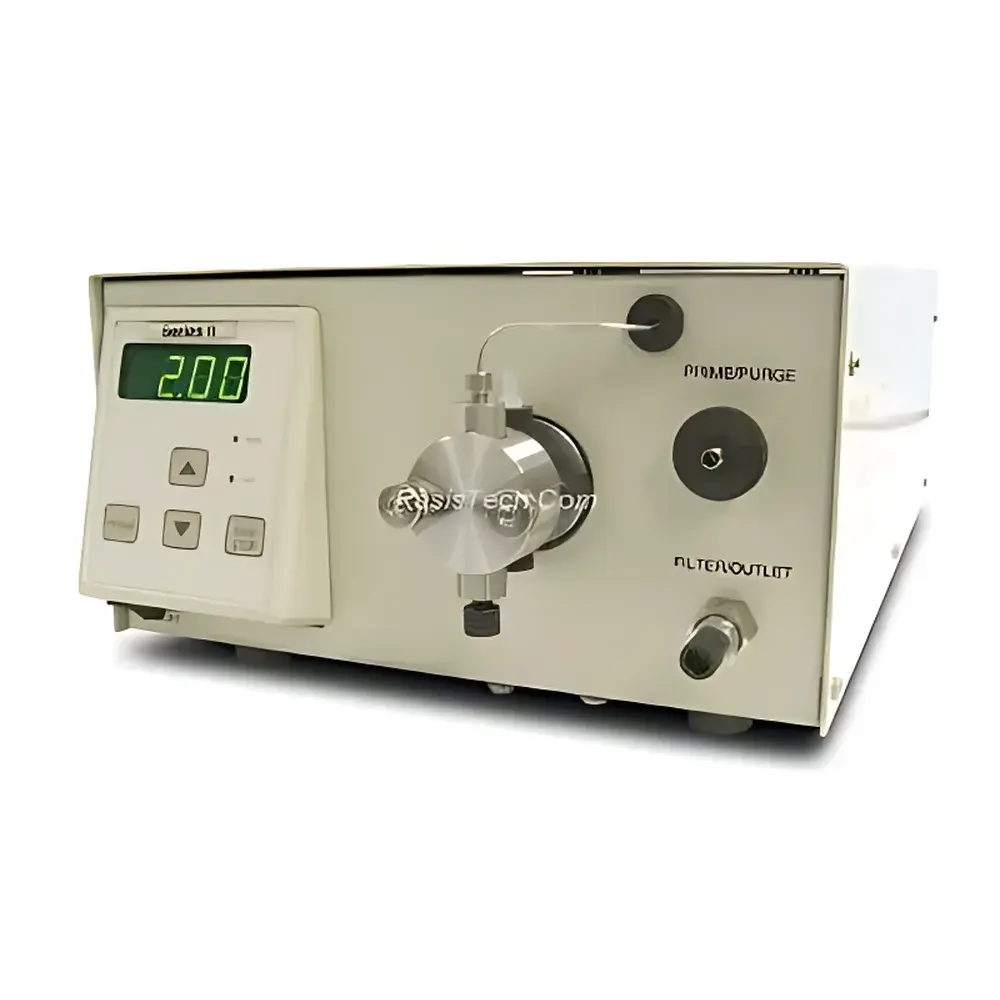
Laballiance Series II Digital Constant Flow Pump
| Brand | Laballiance |
|---|---|
| Origin | USA |
| Model | Series II |
| Flow Ranges | 0.001–5 mL/min, 0.01–10 mL/min, or 0.1–40 mL/min |
| Maximum Pressure | 6,000 psi (stainless steel heads, 5 & 10 mL), 5,000 psi (PEEK heads, 5 & 10 mL), 1,500 psi (40 mL head) |
| Flow Accuracy | ±1% |
| Flow Precision | ≤0.075% RSD |
| Dimensions | 5.5" H × 10.4" W × 17.5" D |
| Weight | 24 lb (11 kg) |
| Power | 220 V, 50/60 Hz |
| Features | Patented low-dead-volume pulse damper, integrated auto-cleaning system, stepper motor control, RS-232 interface, LED display, bypass valve |
Overview
The Laballiance Series II Digital Constant Flow Pump is a precision-engineered single-piston positive displacement pump designed for demanding liquid chromatography applications—including analytical and preparative HPLC, UHPLC-compatible workflows, and specialized detection systems requiring stable, pulse-free solvent delivery. Built upon a robust electromechanical architecture, it employs high-resolution digital stepper motor control to achieve exceptional flow stability and reproducibility across its three calibrated flow ranges. Its core innovation lies in the patented low-dead-volume pulse damper, which significantly attenuates pressure fluctuations inherent to reciprocating piston operation—enabling near-continuous flow profiles critical for baseline-sensitive detectors (e.g., UV-Vis, fluorescence, mass spectrometry). Unlike conventional pumps relying on passive damping or complex dual-piston synchronization, the Series II achieves pulse suppression through optimized fluidic geometry and real-time mechanical compliance, resulting in <0.075% RSD flow precision and ±1% absolute accuracy—performance validated per ISO 5725-2 and ASTM D3418 guidelines for volumetric flow instrumentation.
Key Features
- Patented low-dead-volume pulse damper delivering near-constant flow with minimal pressure ripple—optimized for low-noise detector operation.
- Integrated auto-cleaning mechanism positioned immediately downstream of the piston seal; utilizes mobile phase flow to flush particulate and precipitate buildup—reducing seal wear and extending service intervals.
- Tool-free piston seal replacement completed in under five minutes; no disassembly of pump head or recalibration required.
- Dual-material compatibility: 316 stainless steel pump heads for general-purpose and high-pressure applications; PEEK heads for metal-sensitive bioanalytical, pharmaceutical, and chelating mobile phases.
- One-touch solvent exchange protocol: automated purge-fill-degassing sequence or manual syringe-assisted priming—minimizing downtime during method development or gradient reconfiguration.
- RS-232 serial interface for remote control and integration into legacy or custom-built LC systems; LED front-panel display provides real-time flow rate, pressure status, and operational mode feedback.
Sample Compatibility & Compliance
The Series II accommodates a broad spectrum of mobile phase chemistries—including aqueous buffers, organic solvents (acetonitrile, methanol, THF), corrosive acids/bases (e.g., TFA, ammonium hydroxide), and viscous additives (e.g., ion-pairing reagents). Material compatibility is certified per USP Class VI and ISO 10993-5 for PEEK components, ensuring suitability for GMP-regulated biopharmaceutical QC environments. While the pump itself does not include an integrated pressure sensor, its mechanical design conforms to ANSI/AAMI/ISO 13485 manufacturing controls for medical device ancillaries. It supports GLP-compliant operation when paired with audit-trail-capable data acquisition software via RS-232 logging.
Software & Data Management
The Series II operates as a standalone instrument or integrates into host-controlled platforms via ASCII-based RS-232 command protocol (e.g., “FLOW=0.5”, “START”, “STOP”). Though no proprietary software is bundled, its command set is fully documented in the operator’s manual and compatible with third-party lab automation frameworks—including LabVIEW, Python (pySerial), and MATLAB. All parameter changes, run starts/stops, and error events are timestamped and loggable, supporting 21 CFR Part 11 compliance when deployed with validated electronic record systems. Firmware updates are performed via serial terminal; no cloud connectivity or firmware-as-a-service model is implemented—ensuring air-gapped deployment where required.
Applications
- Analytical-scale reversed-phase, HILIC, and ion-exchange chromatography requiring sub-mL/min flow stability.
- Preparative purification of peptides, oligonucleotides, and small-molecule APIs where consistent eluent delivery impacts fraction purity and yield.
- LC-MS coupling where pulse-induced signal noise degrades S/N ratio and quantitation linearity.
- Method transfer between laboratories using legacy HPLC infrastructure—direct drop-in replacement for discontinued or obsolete pump models without adapter kits or plumbing modifications.
- Teaching laboratories and QC facilities prioritizing operational transparency, serviceability, and long-term cost-of-ownership over proprietary ecosystem lock-in.
FAQ
Does the Series II pump include a built-in pressure sensor?
No. The Series II is engineered as a constant-flow actuator without integrated pressure monitoring. System pressure must be measured externally using a calibrated transducer installed in the flow path.
Can the pump operate with aggressive solvents such as concentrated HF or hot chlorinated hydrocarbons?
No. Neither stainless steel nor PEEK variants are rated for hydrofluoric acid, molten salts, or sustained exposure to >60°C chlorinated solvents. Consult the chemical compatibility chart in Section 4.2 of the technical manual before use.
Is the auto-cleaning solution consumable regulated under REACH or RoHS?
The recommended cleaning solution is deionized water—fully compliant with REACH Annex XIV and RoHS Directive 2011/65/EU. No hazardous additives are required or endorsed.
What maintenance schedule is recommended for routine operation?
Weekly replacement of the auto-cleaning reservoir fluid (DI water); quarterly inspection of piston seals and check valves; annual calibration verification using gravimetric flow measurement per ISO 4064-2.
How does the Series II comply with FDA 21 CFR Part 11 requirements?
The pump itself is not Part 11–certified, but its RS-232 output enables full electronic record generation when interfaced with validated software that implements audit trails, electronic signatures, and secure user access controls.



