
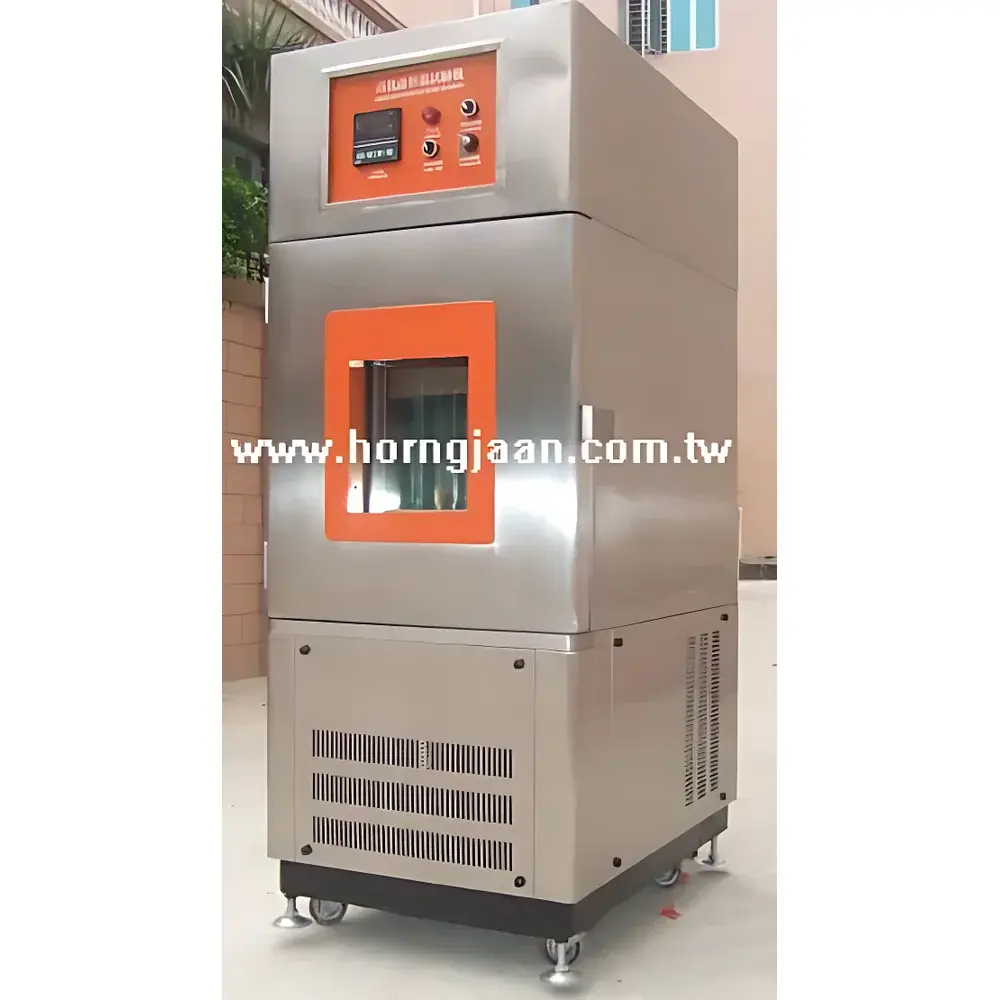
LabCompanion HC-120 Constant-Temperature High-Low Temperature Environmental Test Chamber
| Brand | LabCompanion |
|---|---|
| Model | HC-120 |
| Origin | Guangdong, China |
| Manufacturer Type | Direct Manufacturer |
| Country of Origin | China |
| Internal Chamber Dimensions | 500 × 600 × 400 mm (W × H × D) |
| Temperature Range | −70 °C to +150 °C |
| Temperature Uniformity | ±2 °C |
| Temperature Fluctuation | ±0.5 °C |
| Temperature Deviation | ±2 °C |
| Cooling Rate | 1.0–1.2 °C/min |
| Power Consumption | 3 kW |
| Supply Voltage | AC 380 V, 50 Hz |
| Construction | Stainless Steel Interior + Powder-Coated Cold-Rolled Steel Exterior |
| Safety Protections | Over-Temperature, Over-Pressure, and Phase-Failure Alarms |
Overview
The LabCompanion HC-120 Constant-Temperature High-Low Temperature Environmental Test Chamber is an engineered solution for precise, repeatable thermal stress evaluation of materials, components, and finished products under controlled static temperature conditions. Unlike programmable thermal cycling chambers, the HC-120 operates in constant-value (setpoint-hold) mode—maintaining a user-defined temperature with high stability over extended durations. Its core thermal architecture employs a cascade refrigeration system with dual-stage compressors and optimized heat exchanger geometry, enabling reliable operation across the full range of −70 °C to +150 °C. The chamber’s insulated double-wall construction—filled with high-density polyurethane foam (≥100 mm thickness)—minimizes thermal leakage and ensures low energy consumption during long-term stabilization. Designed for laboratory and industrial quality assurance environments, the HC-120 meets foundational mechanical and thermal performance expectations aligned with IEC 60068-2-1 (cold tests), IEC 60068-2-2 (dry heat), and ISO 16750-4 (road vehicles—environmental conditions). It serves as a primary tool for pre-compliance screening prior to formal qualification testing per MIL-STD-810 or AEC-Q200.
Key Features
- Stainless steel interior chamber (SUS304, 1.2 mm thick) with seamless welded corners and electropolished finish for corrosion resistance and easy decontamination.
- Double-layer insulated enclosure using CFC-free rigid polyurethane foam (thermal conductivity ≤0.022 W/m·K) for minimal ambient heat intrusion.
- Microprocessor-based digital temperature controller with PID algorithm, offering real-time setpoint adjustment, ramp/soak programming capability (in hold mode), and auto-tuning function.
- Dual independent safety circuits: mechanical over-temperature cut-off (bimetallic switch) and electronic monitoring with audible/visual alarm outputs for over-temperature, over-pressure, and phase-loss conditions.
- High-efficiency scroll-type refrigeration compressor (imported from Europe) with R404A/R23 mixed-refrigerant cascade configuration for deep-cold stability at −70 °C.
- Standard RS-485 interface supporting Modbus RTU protocol for integration into centralized lab monitoring systems or SCADA networks.
Sample Compatibility & Compliance
The HC-120 accommodates samples up to 50 kg (distributed load) within its 120 L internal volume (500 × 600 × 400 mm). Shelving is configurable with three adjustable stainless steel trays (load capacity: 15 kg per shelf), each featuring perforated surfaces to ensure uniform airflow distribution. The chamber supports non-hazardous solid and packaged specimens—including PCB assemblies, polymer housings, automotive sensors, and pharmaceutical packaging—provided they emit no volatile organic compounds above 1 ppmv at test temperatures. All electrical components comply with CE marking requirements (EMC Directive 2014/30/EU and Low Voltage Directive 2014/35/EU). While not certified to UL 1203 or IEC 60079 for explosive atmospheres, the HC-120 conforms to general-purpose industrial safety standards referenced in ISO/IEC 17025:2017 clause 6.4.3 for environmental condition control in accredited testing laboratories.
Software & Data Management
The HC-120 includes embedded data logging functionality storing up to 30 days of timestamped temperature readings (1-minute intervals) in non-volatile memory. Optional PC-based software (LabCompanion TempLog Pro v3.2) enables remote monitoring, real-time graphing, CSV export, and automated report generation compliant with GLP documentation requirements. Audit trail features include user login tracking, parameter change logs with timestamps, and electronic signature support for critical test records—facilitating alignment with FDA 21 CFR Part 11 when used in regulated pharmaceutical or medical device validation protocols. Data integrity safeguards include write-protection modes and checksum verification on exported files.
Applications
- Thermal aging studies of elastomers, adhesives, and composite laminates per ASTM D573 and ISO 188.
- Storage stability assessment of active pharmaceutical ingredients (APIs) and final drug products under ICH Q1A(R2) long-term and accelerated conditions.
- Pre-screening of electronic components for solder joint reliability and die attach integrity before HALT/HASS execution.
- Material coefficient of thermal expansion (CTE) estimation via dimensional metrology at stabilized temperature plateaus.
- Calibration verification of temperature-sensitive transducers and reference sensors in metrology labs.
FAQ
What is the difference between “constant-temperature” and “temperature cycling” operation in this chamber?
Constant-temperature (or “setpoint hold”) mode maintains a single, stable temperature for defined durations; it does not automatically transition between hot and cold extremes. Cycling requires optional firmware upgrade and external sequencing hardware.
Can the HC-120 be used for humidity-controlled testing?
No—the HC-120 is a dry-heat/cold chamber only. Humidity control requires the separate LabCompanion TH-120 series with integrated steam humidifier and desiccant drying system.
Is calibration certificate included with shipment?
A factory calibration report (traceable to NIM China) is provided. Full ISO/IEC 17025-accredited calibration must be arranged separately through authorized third-party labs.
What maintenance intervals are recommended for optimal performance?
Compressor oil and refrigerant levels should be verified annually; condenser coils require cleaning every 3 months in dusty environments; temperature sensor verification is advised quarterly using NIST-traceable reference probes.
Does the chamber support external trigger inputs for synchronized testing?
Yes—via TTL-level digital input (pin 2 on DB9 connector), enabling start/stop commands from external logic controllers or data acquisition systems.



