
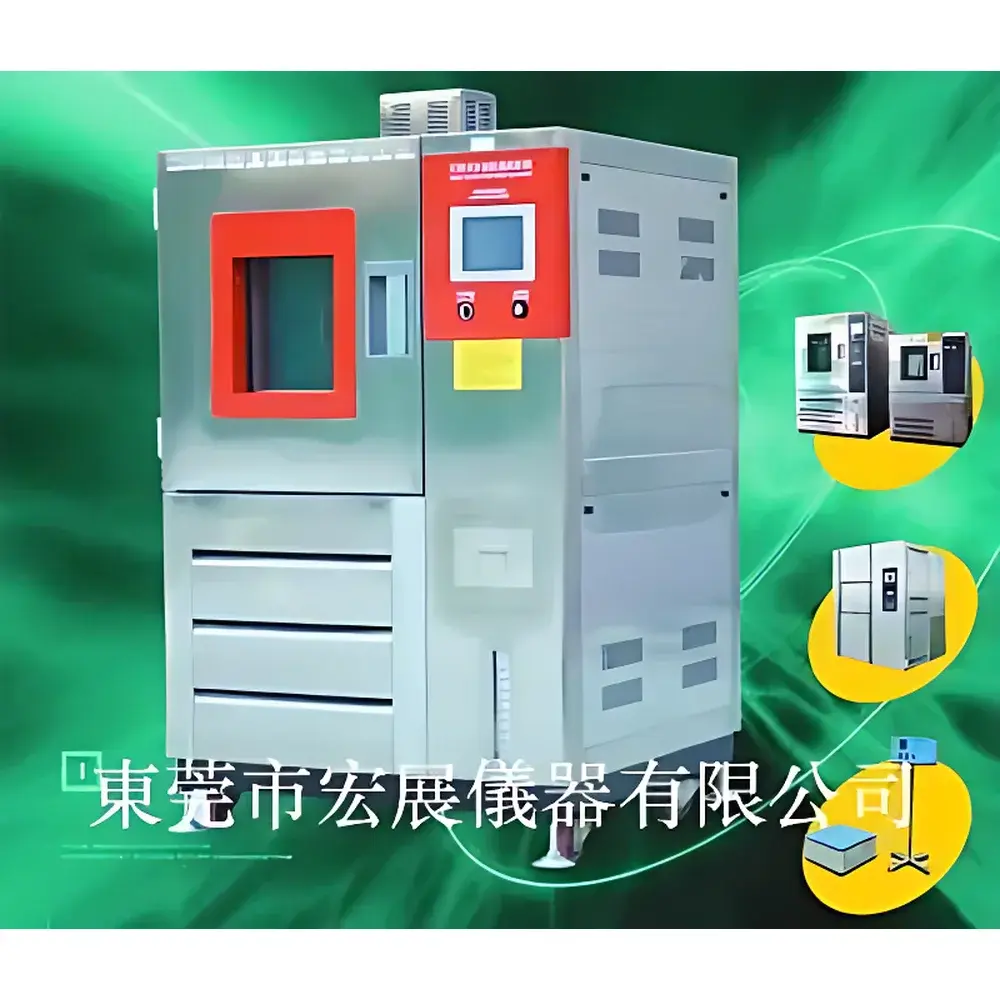
LabCompanion HC-225 High-Low Temperature Alternating Environmental Test Chamber
| Brand | LabCompanion |
|---|---|
| Origin | Guangdong, China |
| Manufacturer Type | Direct Manufacturer |
| Country of Origin | China |
| Model | HC-225 |
| Quotation | Upon Request |
| Internal Chamber Dimensions | 500 × 750 × 600 mm (W × H × D) |
| Temperature Range | −70 °C to +150 °C |
| Temperature Uniformity | ±2 °C |
| Temperature Fluctuation | ±0.5 °C |
| Temperature Deviation | ±2 °C |
| Cooling Rate | 1.0–1.2 °C/min |
| Power Supply | AC 380 V, 50 Hz |
| Total Power Consumption | 5 kW |
| Construction | Stainless steel interior chamber, cold-rolled steel exterior with powder coating |
| Safety Protections | Over-temperature, over-pressure, and phase-loss alarms |
Overview
The LabCompanion HC-225 High-Low Temperature Alternating Environmental Test Chamber is an engineered solution for evaluating the thermal resilience and functional stability of electronic components, precision instruments, automotive parts, aerospace hardware, and industrial materials under controlled, dynamically varying temperature conditions. Based on forced-air convection and dual-stage refrigeration architecture, the chamber delivers precise, repeatable thermal profiles across a wide operational range—from −70 °C to +150 °C—enabling both steady-state exposure and programmed cycling per international environmental stress testing protocols. Its design adheres to fundamental thermodynamic principles governing heat transfer, airflow distribution, and thermal inertia compensation, ensuring minimal spatial gradient deviation and high temporal reproducibility during extended test sequences.
Key Features
- Robust dual-stage cascade refrigeration system with imported hermetic compressors, optimized for rapid cooling response (1.0–1.2 °C/min) and long-term operational stability at extreme low temperatures.
- High-efficiency air circulation system featuring adjustable axial fans and strategically positioned ducting to maintain uniform temperature distribution (±2 °C) throughout the 500 × 750 × 600 mm working chamber.
- Stainless steel inner chamber (SUS304) with seamless welding and rounded corners for corrosion resistance, ease of cleaning, and compliance with cleanroom-compatible material handling requirements.
- Exterior housing constructed from cold-rolled steel with electrostatic powder coating, providing mechanical durability and resistance to environmental degradation in laboratory or production floor settings.
- Integrated safety architecture including independent over-temperature cutoff, high-pressure alarm for refrigerant circuits, and three-phase power monitoring with automatic shutdown upon phase loss or voltage anomaly.
- Intuitive digital controller with real-time logging capability, programmable ramp-soak cycles, and user-defined profile storage—designed for seamless integration into validated quality systems.
Sample Compatibility & Compliance
The HC-225 accommodates a broad spectrum of physical samples—including PCB assemblies, sensors, battery modules, optical enclosures, polymer housings, and mechanical fasteners—without requiring sample-specific fixtures or modifications. Its chamber geometry supports standard test specimen mounting via adjustable stainless steel shelves or custom fixture interfaces. The system complies with key national and international standards for environmental testing, including GB/T 10589–2008 (Low-Temperature Test Chambers), GB/T 10586–2006 (General Technical Conditions for Environmental Test Equipment), and GB/T 2423.1–2022 / GB/T 2423.2–2022 (Environmental Testing – Part 2: Tests). While not certified to IEC 60068-2 series by default, its performance envelope and control fidelity meet the technical prerequisites for equivalence assessment under ISO/IEC 17025-accredited laboratories conducting method-validated thermal stress tests.
Software & Data Management
The HC-225 operates via an embedded microprocessor-based controller with non-volatile memory for up to 100 user-defined test programs, each supporting up to 99 segments (ramp, soak, cycle). Real-time temperature data is recorded at configurable intervals (1–60 s) and stored internally for ≥30 days. Optional RS485/Modbus RTU or Ethernet TCP/IP interface enables connection to centralized SCADA or LIMS platforms. When integrated with LabCompanion’s optional PC-based software suite (v3.2+), users gain access to audit-trail-enabled operation logs, electronic signature support, PDF report generation, and export compatibility with CSV and Excel formats—facilitating alignment with GLP, GMP, and FDA 21 CFR Part 11 data integrity requirements where configured with appropriate validation documentation.
Applications
- Thermal cycling qualification of automotive ECUs per AEC-Q200 stress test schedules.
- Pre-shipping environmental screening of consumer electronics to detect latent solder joint or interconnect failures.
- Material coefficient-of-thermal-expansion (CTE) correlation studies for composite substrates used in semiconductor packaging.
- Accelerated aging validation of lithium-ion battery cells under alternating thermal loads simulating real-world charge-discharge duty cycles.
- Verification of hermetic seal integrity in medical device enclosures through thermal shock-induced leak detection protocols.
- Calibration stability verification of high-precision metrology instruments subjected to ambient temperature drift in calibration labs.
FAQ
What is the maximum allowable sample volume inside the HC-225 chamber without compromising temperature uniformity?
For guaranteed compliance with ±2 °C uniformity specification, total sample volume should not exceed 30% of the internal chamber volume (225 L), i.e., ≤67.5 L. Larger loads require empirical validation per IEC 60068-3-5.
Does the HC-225 support humidity control?
No—the HC-225 is a dry-temperature-only chamber. For combined temperature-humidity testing, consider the LabCompanion TH-225 series.
Can the controller be calibrated traceably to national standards?
Yes—internal Pt100 sensors are field-calibratable using external reference thermometers accredited to NIM or NIST-traceable standards; full calibration certificates are available upon request.
Is remote monitoring possible without proprietary software?
Yes—via Modbus RTU over RS485, third-party SCADA systems can read real-time setpoints, chamber temperature, compressor status, and alarm flags using standard register mapping.
What maintenance intervals are recommended for sustained performance?
Refrigerant circuit oil change every 36 months; condenser coil cleaning every 3 months in dusty environments; annual verification of door gasket compression and sensor linearity.



