
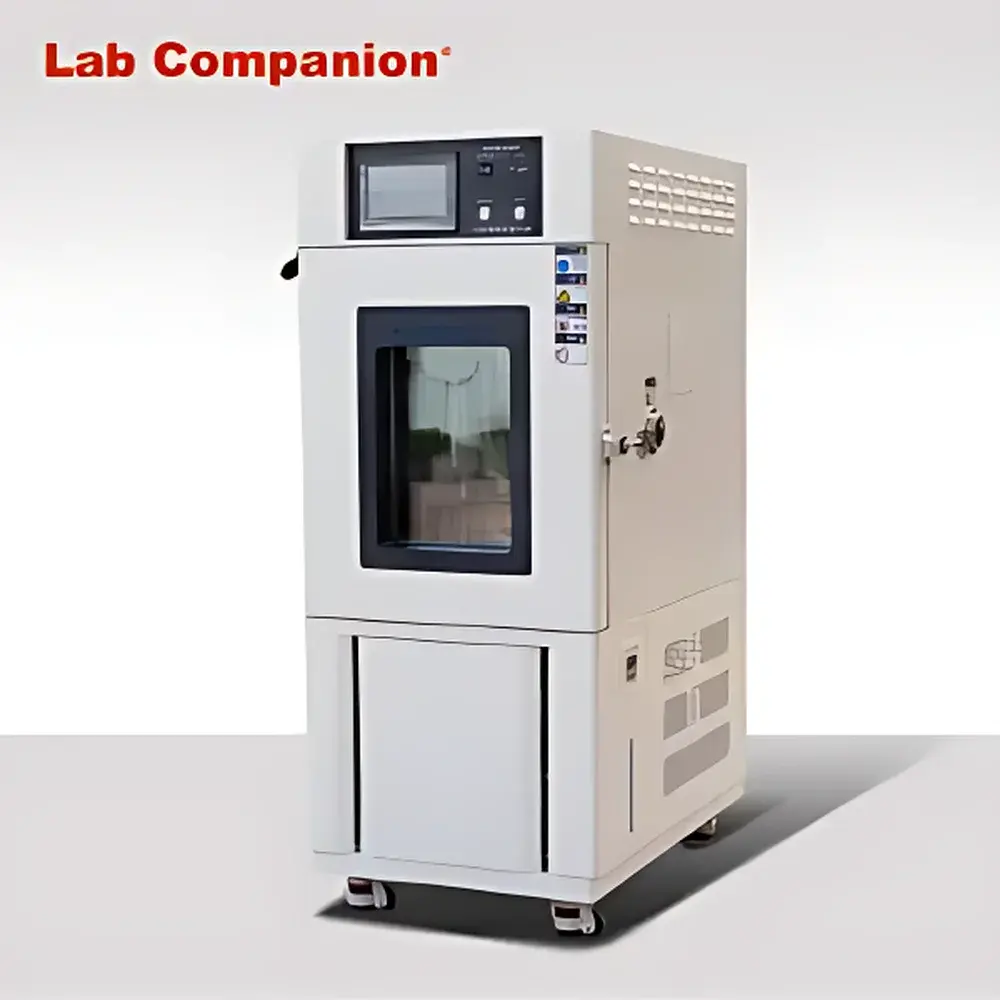
LabCompanion PS80 Photonic Device Thermal Cycling Chamber
| Brand | LabCompanion |
|---|---|
| Origin | Guangdong, China |
| Manufacturer | LabCompanion Co., Ltd. |
| Model | PS80 |
| Temperature Range | −70 °C to +150 °C |
| Cooling Method | Compressor-based Refrigeration |
| Explosion-Proof | Standard (Non-Explosion-Proof) |
| Temperature Fluctuation | ±0.5 °C |
| Temperature Uniformity | ±2.0 °C |
| Temperature Deviation | ±2.0 °C |
| Heating Rate | 1.0–3.0 °C/min |
| Cooling Rate | 1.2 °C/min |
| Internal Chamber Dimensions (W×D×H) | 400 × 500 × 400 mm |
| Viewing Window | Dual-side, 720 × 1520 mm, Anti-fog with Wiper |
| Humidity Range (optional configuration) | 20–98% RH |
| Controller | Japanese-made Color TFT LCD Touchscreen Microcomputer Controller (English/Chinese UI) |
| Communication Interfaces | RS-232 & RS-485 (independent, multi-unit daisy-chain capable) |
| Data Logging | Optional 256 MB CompactFlash Module with User-Configurable Sampling Interval |
| Safety Interlocks | Integrated Power Control for DUT + Chamber Safety Monitoring |
| Adjustable Interior Racks | Height- and Angle-adjustable (0°, 30°, 45°, 60°) for 10", 18", 20", 30" panel formats |
Overview
The LabCompanion PS80 Photonic Device Thermal Cycling Chamber is a purpose-engineered environmental test system designed specifically for reliability validation and qualification testing of optoelectronic components under controlled thermal stress. Built upon a robust compressor-based refrigeration architecture, the chamber delivers precise, repeatable temperature profiles across an extended operational range of −70 °C to +150 °C—critical for simulating real-world deployment conditions encountered by flat-panel displays, OLED emitters, TFT-LCD modules, backlight units, and low-temperature polycrystalline silicon (LTPS) substrates. Unlike generic temperature chambers, the PS80 integrates photonic industry–specific ergonomics: dual large-format anti-fog viewing windows (720 × 1520 mm), modular rack systems supporting variable panel sizes and tilt angles (0°–60°), and a microcomputer controller optimized for thermal ramp-and-soak protocols required in JEDEC JESD22-A104 (Temperature Cycling) and A119 (Thermal Shock) compliance testing. Its structural integrity, thermal stability (±0.5 °C fluctuation), and uniformity (±2.0 °C) meet the baseline metrological requirements for ISO/IEC 17025–accredited laboratories performing device-level environmental qualification.
Key Features
- Industrial-grade compressor refrigeration system enabling stable operation at −70 °C without liquid nitrogen dependency
- Dual large-area observation windows with integrated wiper and anti-fog coating for uninterrupted visual monitoring during extended thermal cycles
- Modular interior rack system with height-adjustable shelves and precision angle settings (0°, 30°, 45°, 60°) to accommodate TFT-LCD panels (10″–30″), OLED modules, and backlight assemblies
- Japanese-manufactured color TFT LCD touchscreen controller with bilingual (English/Chinese) interface, intuitive profile programming, and real-time graphical display of chamber status
- Dual independent communication ports (RS-232 and RS-485) supporting simultaneous PC connection and multi-chamber networked control via Modbus RTU or custom SCADA integration
- Comprehensive safety architecture including DUT power interlock, over-temperature cutoff, refrigerant pressure monitoring, and door-open alarm with automatic heater shutdown
- Optional 256 MB CompactFlash data logger with user-definable sampling intervals (1 s to 24 h), timestamped event logging, and CSV export capability for audit-ready traceability
Sample Compatibility & Compliance
The PS80 accommodates flat, rigid, and semi-flexible optoelectronic subassemblies up to 30 inches diagonally, with maximum sample depth of 400 mm and weight capacity of 30 kg per shelf. Its chamber geometry and airflow design minimize thermal gradients across active display surfaces—essential for detecting latent defects such as delamination, solder joint fatigue, or pixel degradation induced by repeated expansion/contraction. The system supports test execution per IEC 60068-2-14 (Test Nb: Change of Temperature), MIL-STD-810H Method 503.5 (Temperature Shock), and IPC-9701A (Performance Requirements for Lead-Free Solder Attachments). When equipped with humidity control (optional), it further complies with IEC 60068-2-78 (Damp Heat, Steady State) and JEDEC JESD22-A101 (Steady-State Temperature/Humidity Bias Life Test). All firmware and controller logs are structured to support GLP/GMP documentation workflows and FDA 21 CFR Part 11–compliant electronic record retention when paired with validated software configurations.
Software & Data Management
The embedded controller supports standalone operation with up to 100 programmable test profiles, each containing 99 segments (ramp, soak, hold). For centralized lab management, LabCompanion provides optional Windows-based PC software (ChamberLink Pro) that enables remote scheduling, real-time multi-chamber monitoring, automated report generation (PDF/Excel), and secure user role assignment (Operator, Engineer, Administrator). Logged data—including chamber setpoint, actual temperature, DUT power status, alarm events, and user actions—is stored with cryptographic time stamps and supports SHA-256 hash verification for integrity assurance. Audit trails comply with ISO 13485 and IATF 16949 requirements for medical and automotive electronics qualification labs.
Applications
- Qualification testing of OLED and microLED display modules under extreme thermal cycling (−40 °C ↔ +85 °C, 1000+ cycles)
- Reliability screening of TFT-LCD driver ICs and COG (Chip-on-Glass) assemblies prior to mass production
- Failure analysis correlation between thermal stress exposure and electro-optical parameter drift (luminance, chromaticity, response time)
- Process validation of encapsulation materials and adhesive bonds used in outdoor signage and automotive HUD displays
- Pre-compliance screening for AEC-Q200 stress tests targeting passive and active optoelectronic components
- Research into low-temperature performance limits of quantum dot color conversion films and perovskite-based light emitters
FAQ
What is the maximum sample volume the PS80 can accommodate?
The internal working chamber measures 400 × 500 × 400 mm (W × D × H), offering 80 L usable volume. With adjustable racks, it supports stacked configurations of up to four 20″ panels or two 30″ panels simultaneously.
Is the PS80 suitable for testing powered devices during thermal cycling?
Yes—the chamber includes dedicated DUT power feedthroughs (up to 250 VAC / 10 A) with interlocked control logic. Power delivery is automatically suspended if door is opened or safety thresholds are exceeded.
Can humidity functionality be retrofitted to a standard PS80 unit?
Humidity control (20–98% RH) is available only as a factory-configured option. Retrofitting is not supported due to structural, insulation, and condensate management requirements.
Does the controller support automated compliance reporting per JEDEC standards?
While the controller does not generate certified JEDEC reports natively, its logged data (time-stamped temperature, ramp rates, dwell durations) exports in CSV format compatible with third-party validation software used in accredited test labs for JEDEC JESD22-A104/A119 reporting.
What maintenance intervals are recommended for long-term operational reliability?
Compressor oil and refrigerant levels should be verified annually; air filters require cleaning every 3 months; calibration of the platinum RTD sensor is recommended every 12 months using NIST-traceable reference equipment.
Related Products



