
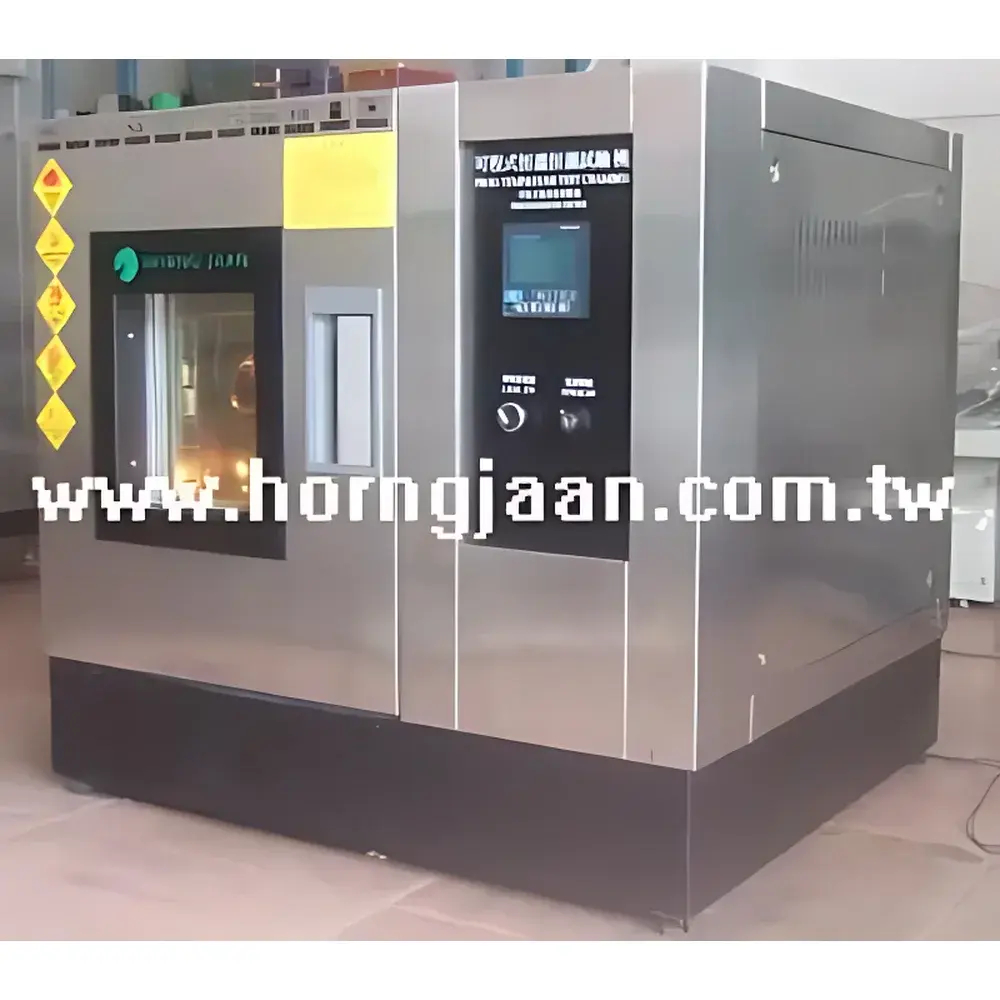
LabCompanion RZ-80 Compact High-Low Temperature Alternating Test Chamber
| Brand | LabCompanion |
|---|---|
| Model | RZ-80 |
| Temperature Range | -20 to 100°C |
| Humidity Range | 30–95% RH |
| Internal Dimensions (W×H×D) | 40×50×40 cm |
| External Dimensions (W×H×D) | 97×80×65 cm |
| Temperature Resolution | 0.1°C |
| Humidity Resolution | 0.1% RH |
| Temperature Control Accuracy | ±0.3°C |
| Humidity Control Accuracy | ±3% RH |
| Temperature Uniformity | ±1°C |
| Humidity Uniformity | ±3% RH |
| Heating Rate | ~30 min (30°C to 100°C) |
| Cooling Rate | ~40 min (40°C to 0°C), ~60 min (40°C to −20°C) |
| Safety Features | Comprehensive Over-Temp/Over-Humidity Protection, Power-Fail Memory, Interlock Switches |
Overview
The LabCompanion RZ-80 is a compact, benchtop high-low temperature alternating test chamber engineered for precision environmental simulation in research laboratories, quality control departments, and electronics reliability testing facilities. It operates on a forced-air convection principle with a dual-channel PID-controlled refrigeration and heating system, enabling stable and repeatable thermal cycling across a wide operational envelope. Unlike large walk-in chambers, the RZ-80 delivers laboratory-grade environmental control in a footprint optimized for limited bench space—making it ideal for small-batch validation, component-level stress screening, and accelerated aging studies where spatial constraints preclude conventional equipment. Its modular architecture supports vertical stacking without compromising airflow integrity or thermal stability, a design feature validated per IEC 60068-3-5 for stacked environmental test configurations.
Key Features
- Stackable mechanical design with integrated load-bearing support frames and interlocking ventilation ducts—enables up to three units to be vertically aligned without performance degradation or safety compromise.
- Dual independent PID controllers for temperature and humidity, each with adaptive tuning algorithms to maintain setpoint stability under dynamic load conditions.
- Optimized air distribution system featuring tangential centrifugal blowers and perforated baffle plates, achieving ≤±1°C temperature uniformity and ≤±3% RH uniformity across the full working volume (per ISO 16750-4 Annex C verification protocol).
- Comprehensive safety architecture including over-temperature cutoff (mechanical and electronic), high-humidity shutoff, door interlock switches, refrigerant pressure monitoring, and non-volatile power-fail memory that retains all active profiles and runtime logs after unexpected shutdown.
- Standard dry-contact timing outputs (Form-C relays) synchronized to chamber state transitions—enabling seamless integration with external data acquisition systems, vibration tables, or automated optical inspection platforms.
- Expandable I/O interface supporting optional BIAS (Built-in Analog Signal) modules for analog voltage/current input/output, facilitating real-time correlation of environmental parameters with device-under-test (DUT) electrical responses.
Sample Compatibility & Compliance
The RZ-80 accommodates a broad range of sample types—including PCB assemblies, polymer components, medical device packaging, lithium-ion battery cells, and pharmaceutical primary containers—within its 80 L internal volume. Its stainless-steel interior (SUS304), non-contaminating insulation (CFC-free polyurethane foam), and condensate management system meet material compatibility requirements for ISO 10993-12 and USP applications. The chamber conforms to key international standards including IEC 60068-2-1 (cold), IEC 60068-2-2 (dry heat), IEC 60068-2-30 (damp heat cyclic), and ASTM D4332 for conditioning of plastic specimens prior to mechanical testing. All control firmware and data logging functions comply with GLP/GMP documentation requirements, including audit-trail enabled event logging and user-access level management.
Software & Data Management
The RZ-80 integrates with LabCompanion’s optional ETS-Link™ software suite (Windows-based), providing full remote operation, multi-chamber synchronization, and automated compliance reporting. The software supports 21 CFR Part 11-compliant electronic signatures, role-based access control, and encrypted data export in CSV, PDF, and XML formats. Real-time trending, deviation alerts, and statistical process control (SPC) charts are generated directly from raw sensor streams sampled at 1 Hz. All configuration changes, alarm events, and calibration entries are time-stamped and archived with SHA-256 hash integrity verification—ensuring full traceability for FDA, ISO 17025, or ISO 9001 audits.
Applications
- Thermal cycling qualification of automotive ECUs per AEC-Q200 Rev D specifications.
- Stability testing of active pharmaceutical ingredients (APIs) and finished dosage forms under ICH Q1A(R3) long-term and accelerated storage conditions.
- Reliability screening of consumer electronics using JEDEC JESD22-A104E temperature cycling profiles.
- Material property evaluation—including coefficient of thermal expansion (CTE), glass transition temperature (Tg), and moisture absorption kinetics—in polymer composites and adhesives.
- Pre-conditioning of sensors and MEMS devices prior to functional testing in climatic chambers or probe stations.
- Environmental stress screening (ESS) of avionics subassemblies per MIL-STD-810H Method 502.7.
FAQ
What is the maximum allowable sample mass inside the RZ-80 without compromising thermal uniformity?
The chamber maintains specified uniformity with up to 15 kg of thermally inert mass placed centrally on the standard shelf; heavier or high-thermal-mass loads require empirical validation using Class II platinum RTDs per ISO 16750-4 Annex D.
Does the RZ-80 support ramp-and-soak profiles with variable rates?
Yes—up to 99 programmable segments with independent ramp rates (0.1–10.0°C/min) and dwell times (0.1–9999.9 min), configurable via front-panel keypad or ETS-Link™ software.
Is third-party calibration certification available?
Factory calibration includes NIST-traceable certificates for temperature and humidity sensors; optional UKAS-accredited calibration (ISO/IEC 17025) is available upon request with documented uncertainty budgets.
Can the RZ-80 operate continuously at −20°C with 95% RH?
No—simultaneous extreme low temperature and high humidity exceeds condensation management capacity; the operational envelope is bounded by the psychrometric limit curve defined in IEC 60068-3-4, with maximum RH at −20°C limited to 60% RH.
What maintenance intervals are recommended for refrigeration system integrity?
Compressor oil and filter-drier replacement every 24 months under continuous operation; annual leak-check verification using helium mass spectrometry per ASHRAE Standard 15.



