
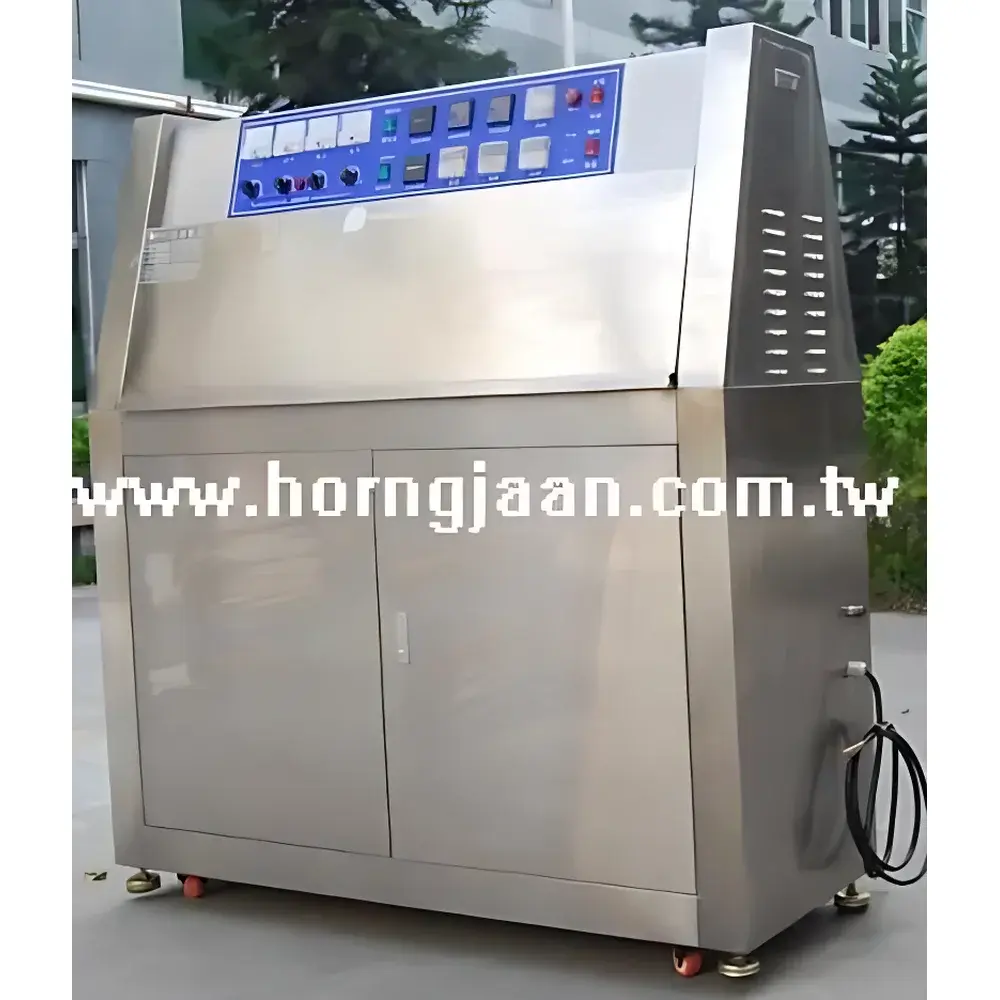
LabCompanion UV3 Advanced UV Aging Test Chamber
| Brand | LabCompanion |
|---|---|
| Origin | Guangdong, China |
| Manufacturer Type | OEM/ODM Producer |
| Origin Category | Domestic (China) |
| Model | UV3 |
| Pricing | Upon Request |
| Temperature Range | RT+10°C to 70°C |
| Humidity Range | ≥90% RH |
| Sample-to-Lamp Distance | 50 ± 2 mm |
| Lamp Center-to-Center Spacing | 70 mm |
| Irradiance | UVA-340 @ 0.68 W/m² (295–360 nm), UVB-313 @ 0.60 W/m² (280–315 nm) |
| Interior Dimensions | 1170 × 450 × 500 mm (W×D×H) |
| Exterior Dimensions | 1300 × 550 × 1380 mm (W×D×H) |
| Light Source | Fluorescent UV Lamps (UVA-340 and/or UVB-313) |
| Exposure Mechanism | Condensation Cycle (Humid Hot Air + Backside Cooling) |
| Compliance Standards | GB/T 16422.3–1997, ASTM G53–88, GB/T 14522–93 |
| Safety Protections | Overload/short-circuit protection, Ground fault protection, Overtemperature cutoff, Low-water level shutdown, Compressor overpressure/overload protection |
Overview
The LabCompanion UV3 Advanced UV Aging Test Chamber is an engineered environmental test system designed for accelerated photochemical degradation assessment of polymeric, coating, and elastomeric materials under controlled ultraviolet (UV) irradiation, thermal stress, and condensation cycles. Unlike full-spectrum solar simulators, the UV3 leverages fluorescent UV lamp technology—specifically UVA-340 and UVB-313 lamps—to replicate the most photoreactive portion of terrestrial sunlight (280–360 nm), where quantum efficiency for polymer bond scission, chromophore degradation, and oxidative crosslinking is highest. This spectral selectivity enables high-fidelity simulation of outdoor weathering mechanisms—including chalking, gloss loss, color shift, microcracking, blistering, and embrittlement—without requiring broadband irradiance or complex optical filtering. The chamber operates on a cyclic exposure protocol: UV irradiation at elevated temperature and humidity is followed by non-irradiative condensation phases, mimicking diurnal dew formation through controlled vapor saturation and differential surface cooling. This dual-phase methodology aligns with internationally recognized accelerated aging protocols for durability validation in R&D, quality control, and regulatory submission workflows.
Key Features
- Stainless steel interior and exterior construction ensures long-term corrosion resistance and compliance with ISO 9001 cleanroom-compatible fabrication standards.
- Dual-lamp compatibility: Interchangeable UVA-340 (peak 340 nm, solar-spectrum matched) and UVB-313 (peak 313 nm, high-acceleration) lamp configurations support both realistic simulation and rapid screening applications.
- Precision digital PID controller with AI-based adaptive tuning, integrated thermocouple compensation, and real-time deviation correction for stable temperature maintenance within ±0.5°C.
- Condensation exposure system utilizes saturated humid air (≥90% RH) combined with asymmetric thermal gradient—front surface heated, rear surface ambient-cooled—to generate reproducible dew-point condensation without external water spray or misting mechanisms.
- Standard sample rack features aluminum frame with spring-tensioned mounting and adjustable orientation (0°–20° tilt) to ensure uniform irradiance distribution across specimens per ASTM G53 Annex A2.
- Optional UV irradiance sensor (calibrated traceable to NIST standards) enables closed-loop irradiance control, automatic lamp-output compensation, and audit-ready irradiance logging compliant with FDA 21 CFR Part 11 requirements when paired with validated software.
Sample Compatibility & Compliance
The UV3 accommodates flat-panel specimens up to 110 mm × 230 mm (standard ASTM G154 format), with optional multi-tier racks supporting up to 48 samples per cycle. Compatible substrate classes include thermoplastics (PP, PE, PC, ABS), thermosets (epoxies, polyurethanes), organic coatings (acrylics, alkyds, fluoropolymers), elastomers (EPDM, SBR, silicone), and fiber-reinforced composites. All operational parameters adhere to test method validity criteria defined in ASTM G53–88 (Standard Practice for Operating Fluorescent Ultraviolet (UV) and Condensation Exposure Apparatus for Nonmetallic Materials), GB/T 16422.3–1997 (Plastics—Methods of Exposure to Laboratory Light Sources—Part 3: Fluorescent UV Lamps), and GB/T 14522–93 (Artificial Climate Accelerated Testing Methods for Plastics, Coatings and Rubber Used in Mechanical Industry). The system supports GLP-compliant documentation when used with validated data acquisition modules and electronic signature-enabled software packages.
Software & Data Management
Control firmware includes embedded data logging (1 Hz sampling rate) for temperature, relative humidity, UV irradiance (if equipped), and cycle phase status. Exportable CSV files support post-test statistical analysis of degradation kinetics (e.g., ΔE* color change, gloss retention %, tensile strength decay). Optional LabCompanion UV-Link™ software provides remote monitoring via Ethernet/Wi-Fi, automated report generation (PDF/Excel), user-access-level management (admin/operator/viewer), and full audit trail functionality—including operator ID, timestamped parameter changes, alarm history, and calibration event records—meeting requirements for ISO/IEC 17025 and 21 CFR Part 11 compliance in regulated laboratories.
Applications
- Formulation optimization of UV stabilizers, HALS additives, and pigment systems in automotive clearcoats and architectural coatings.
- Comparative lifetime prediction of polymer blends used in outdoor signage, agricultural films, and photovoltaic encapsulants.
- Qualification testing of medical device housing materials per ISO 10993–12 (biological evaluation of medical devices—sample preparation and reference materials).
- Pre-certification validation for IEC 61215 (photovoltaic module qualification) and UL 746C (polymeric materials for electrical equipment) UV resistance requirements.
- Root-cause analysis of field failures linked to photooxidative degradation pathways in consumer electronics enclosures and infrastructure components.
FAQ
What is the difference between UVA-340 and UVB-313 lamp spectra, and how do I select the appropriate one?
UVA-340 lamps emit primarily within 295–360 nm, closely matching the short-wavelength edge of terrestrial sunlight; they are recommended for correlation studies with real-world outdoor exposure. UVB-313 lamps emit down to 280 nm, producing higher photon energy and faster degradation rates—ideal for rapid screening or failure-mode acceleration where absolute correlation is secondary to comparative ranking.
Does the UV3 support irradiance calibration traceable to national standards?
Yes—the optional UV irradiance sensor is factory-calibrated against NIST-traceable reference detectors and includes certificate of calibration valid for 12 months. Field recalibration services are available through LabCompanion’s global service network.
Can the UV3 be integrated into an existing LIMS or MES environment?
Yes—via Modbus TCP or OPC UA protocol interfaces, the UV3 controller supports bidirectional communication with laboratory information management systems (LIMS) and manufacturing execution systems (MES) for automated test initiation, parameter synchronization, and result ingestion.
Is condensation cycle timing programmable independently of UV exposure duration?
Yes—each phase (UV-on, UV-off/condensation, dark soak) can be individually configured with duration, temperature setpoint, and humidity target, enabling custom cycling profiles beyond standard ASTM or ISO defaults.
What maintenance intervals are recommended for UV lamp replacement and sensor verification?
Lamps should be replaced after 1,600 hours of cumulative operation (per ASTM G154 Section 6.2.3); irradiance sensors require annual verification using a portable reference meter. Preventive maintenance logs are auto-generated and exportable for internal QA audits.



