
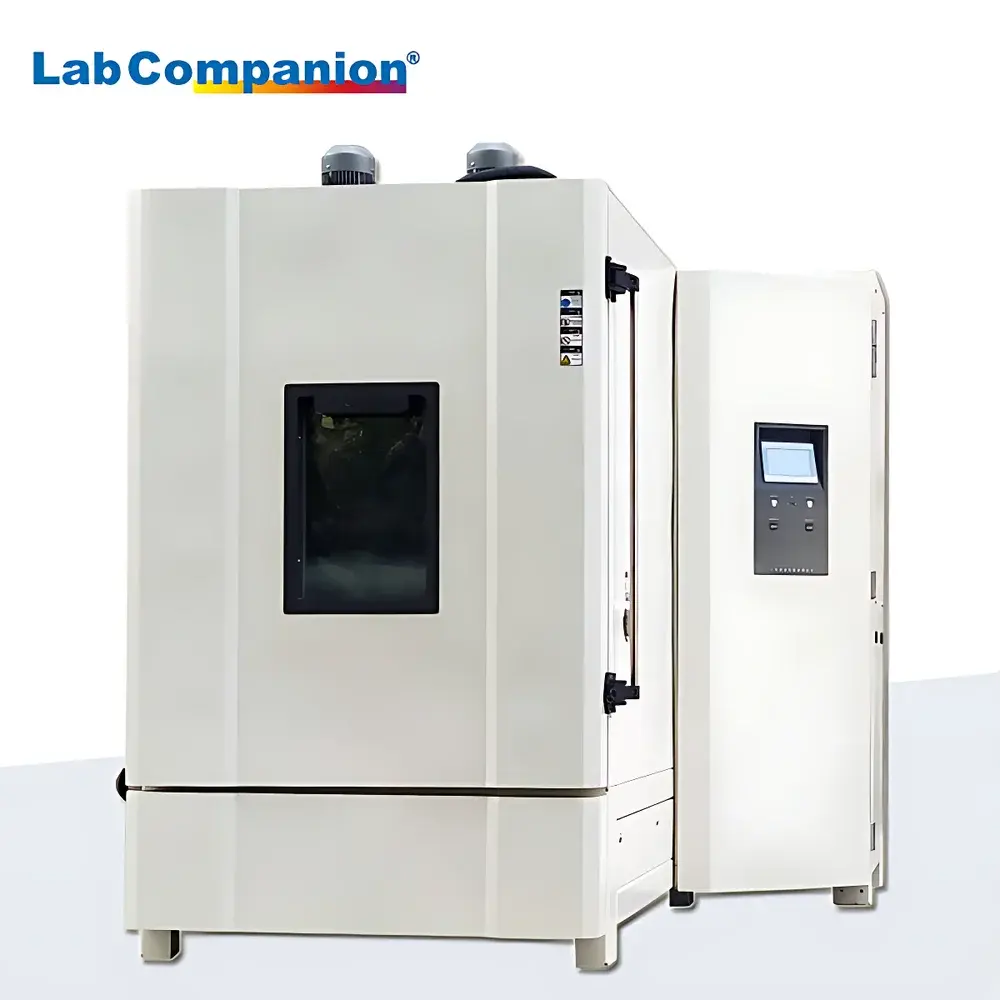
LabCompanion TC-1000 Rapid Temperature Transition Chamber
| Brand | LabCompanion |
|---|---|
| Origin | Guangdong, China |
| Manufacturer Type | Direct Manufacturer |
| Model | TC-1000-5 |
| Temperature Range | −70 °C to +150 °C |
| Temperature Deviation | ±2.0 °C |
| Ramp Rates | 5–25 °C/min (linear or non-linear) |
| Optional LN₂-assisted cooling | up to 30 °C/min |
| Internal Dimensions (W×H×D) | 1000 × 1000 × 1000 mm |
| Compliance | GB/T 5170.2–2008 |
Overview
The LabCompanion TC-1000 Rapid Temperature Transition Chamber is an engineered environmental test system designed for high-fidelity thermal stress evaluation of electronic components, automotive modules, aerospace assemblies, and advanced packaging materials. It operates on a dual-refrigeration architecture—combining mechanical compression cooling with optional liquid nitrogen (LN₂) injection—to achieve precisely controlled, repeatable temperature transitions across the full operational range of −70 °C to +150 °C. Unlike standard thermal cycling chambers, the TC-1000 is specifically calibrated for rapid ramp rates (5–25 °C/min, configurable as linear or non-linear profiles), enabling accelerated life testing (ALT), HALT (Highly Accelerated Life Testing), and qualification per IEC 60068-2-14, MIL-STD-810H Method 503.5, and JEDEC JESD22-A104. Its chamber core features insulated stainless-steel construction, PID-controlled forced-air circulation, and real-time thermal mapping capability via integrated sensor arrays.
Key Features
- Programmable ramp rate selection: 5, 10, 15, 20, and 25 °C/min—each independently validated under no-load conditions at 25 °C ambient and 25 °C coolant inlet temperature
- Optional LN₂ auxiliary cooling module enables peak cooling rates up to 30 °C/min within the −55 °C to +125 °C operational envelope
- Internal chamber volume: 1.0 m³ (1000 mm W × 1000 mm H × 1000 mm D), optimized for large-format PCBs, EV battery modules, and multi-unit test fixtures
- Temperature uniformity ≤ ±1.5 °C (measured per GB/T 5170.2–2008 at steady state); temperature stability (fluctuation) ≤ ±0.5 °C
- Robust control architecture with dual-stage safety interlocks, over-temperature/over-pressure cut-off, and emergency power-down logic compliant with IEC 61000-6-2/6-4 EMC requirements
- Touchscreen HMI with embedded data logging (10,000-point buffer), USB export, and optional Ethernet/IP interface for SCADA integration
Sample Compatibility & Compliance
The TC-1000 accommodates samples up to 80 kg with unrestricted airflow pathways, supporting standardized test fixtures per ASTM E1545 and IPC-TM-650 2.6.22. It meets national verification standards GB/T 5170.2–2008 for temperature performance validation and is compatible with GLP/GMP documentation workflows when paired with optional audit-trail-enabled software. While the base TC-series model is dry-cycle only (no humidity control), its structural platform allows field-upgrade to TH-series configurations (20–98% RH) where hygrothermal stress testing is required. All thermal profiles are traceable to NIST-traceable reference sensors calibrated annually per ISO/IEC 17025-accredited procedures.
Software & Data Management
The chamber ships with LabCompanion TestSuite v4.2—a Windows-based control and analysis application supporting multi-segment profile programming, real-time deviation alarms, and automatic report generation in PDF/CSV formats. The software implements role-based user access control (operator, engineer, administrator), full electronic signature support, and 21 CFR Part 11-compliant audit trail functionality—including timestamped event logs for setpoint changes, alarm triggers, and calibration interventions. Data export supports OPC UA and Modbus TCP protocols for seamless integration into enterprise MES/QMS platforms such as Siemens Opcenter, ETQ Reliance, or Qualio.
Applications
- Thermal shock screening of solder joints and die-attach interfaces in semiconductor packages
- Validation of thermal expansion coefficient (CTE) mismatch in multi-material assemblies (e.g., SiC MOSFET modules)
- Environmental stress screening (ESS) of avionics control units per DO-160 Section 4.3
- Reliability qualification of lithium-ion battery cells and packs under dynamic thermal load cycles
- Material compatibility testing of adhesives, conformal coatings, and encapsulants per IPC-CC-830B
- Pre-compliance thermal cycling per AEC-Q200 Rev D for passive and active automotive components
FAQ
What is the standard temperature calibration method used for the TC-1000?
The TC-1000 is calibrated using three NIST-traceable PT100 sensors placed at geometric center and opposing corners of the working volume, following GB/T 5170.2–2008 spatial averaging methodology.
Can the TC-1000 be integrated into an automated test cell with PLC-level control?
Yes—the chamber provides native Modbus RTU (RS-485) and optional EtherNet/IP communication ports, enabling direct handshake with Allen-Bradley, Siemens S7, or Beckhoff controllers.
Is LN₂ consumption data provided for the auxiliary cooling option?
Yes—typical LN₂ usage is 1.2–1.8 L/min during sustained 30 °C/min ramps from +25 °C to −55 °C; consumption scales linearly with ramp duration and mass load.
Does the TC-1000 support custom thermal profiles with dwell, ramp, and hold segments?
Yes—up to 99 programmable segments per test cycle, including conditional branching based on real-time sensor feedback (e.g., “hold until internal sensor T1 reaches −40 °C ±0.3 °C”).
What maintenance intervals are recommended for long-term reliability?
Compressor oil and filter replacement every 3,000 operating hours; LN₂ solenoid valve inspection every 6 months; annual full-system metrological verification by authorized service partner.



