
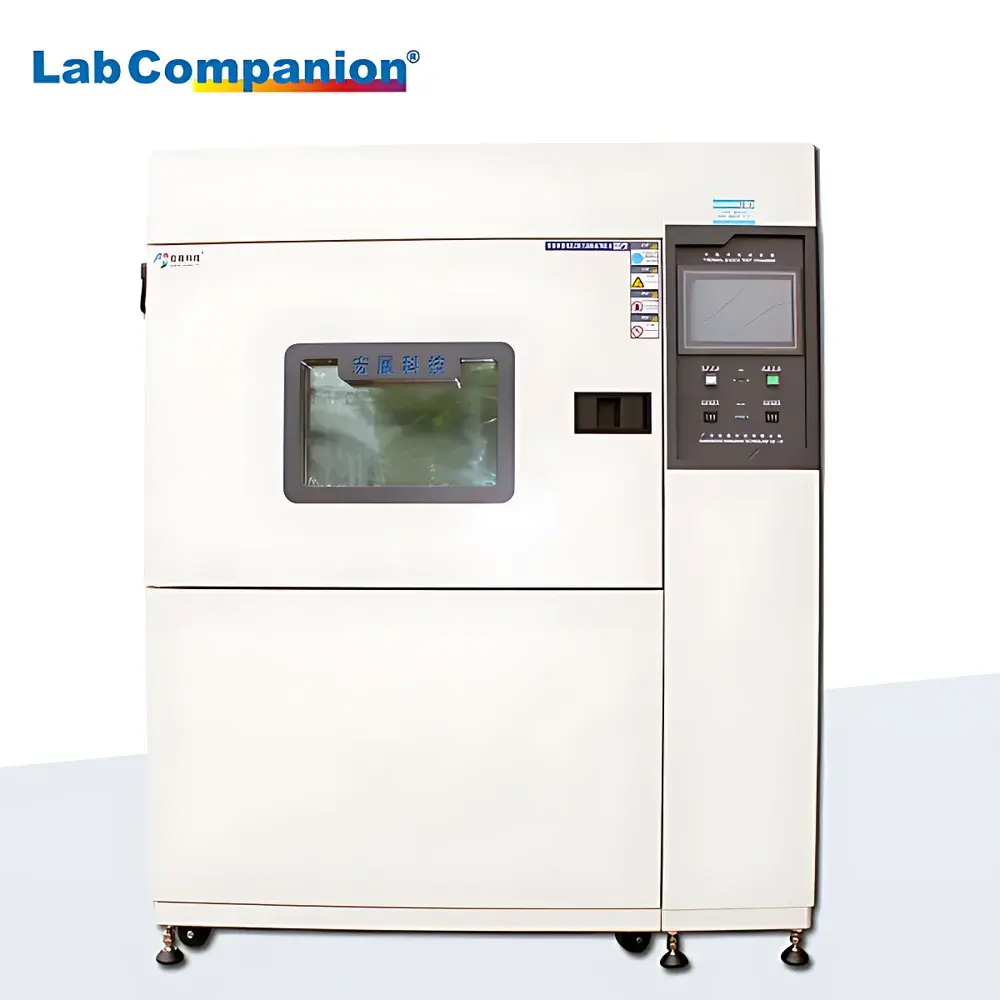
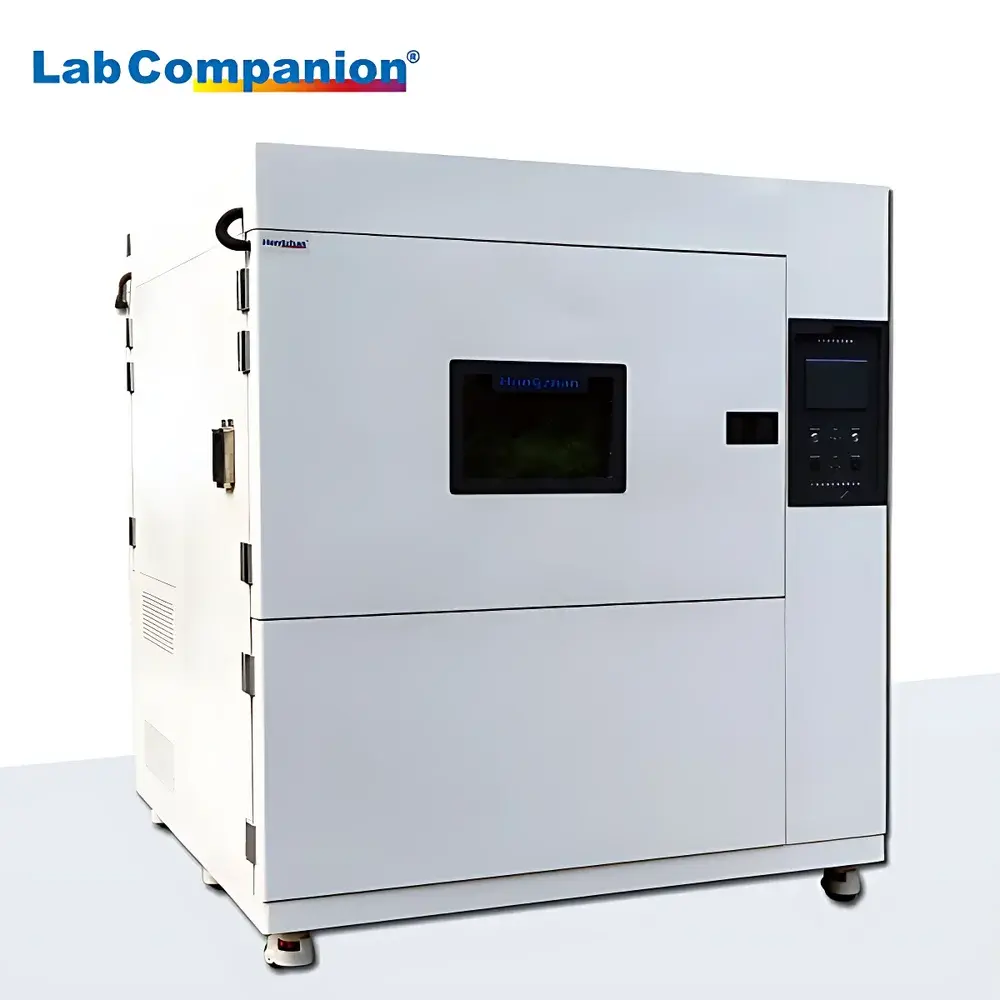
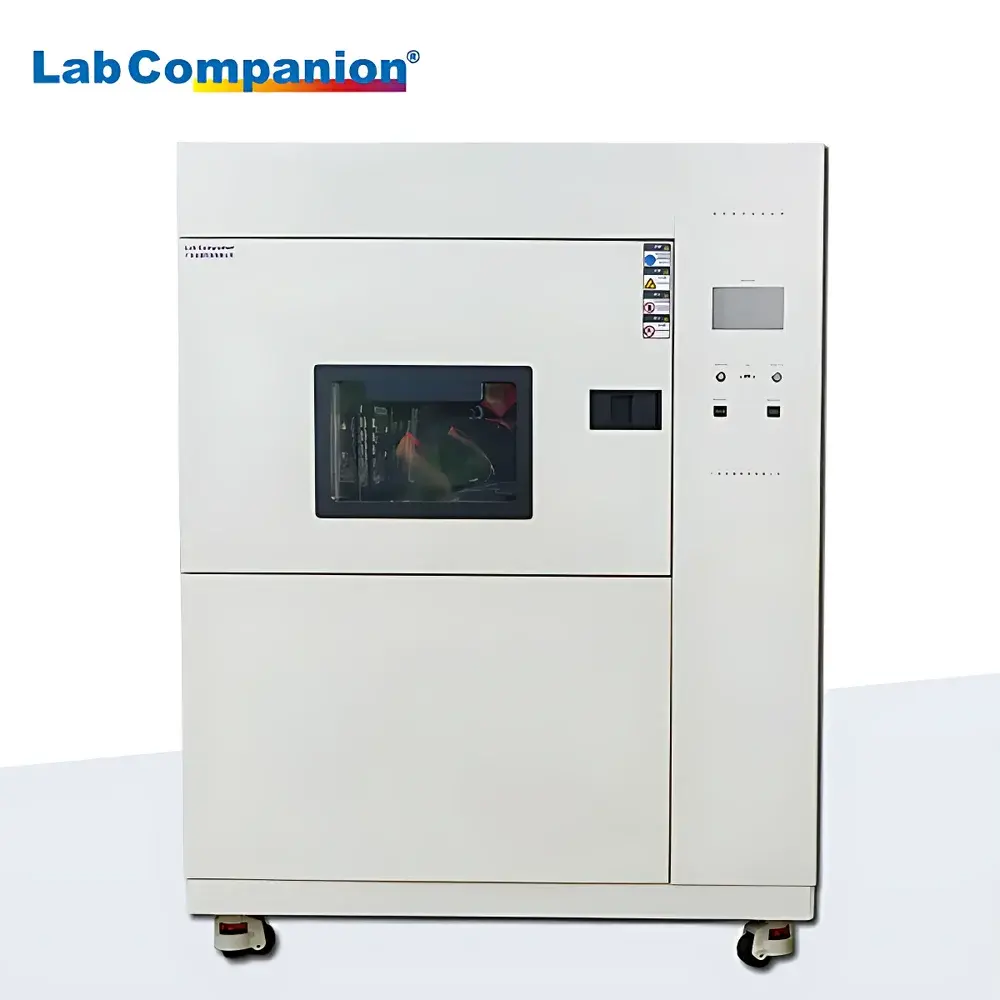
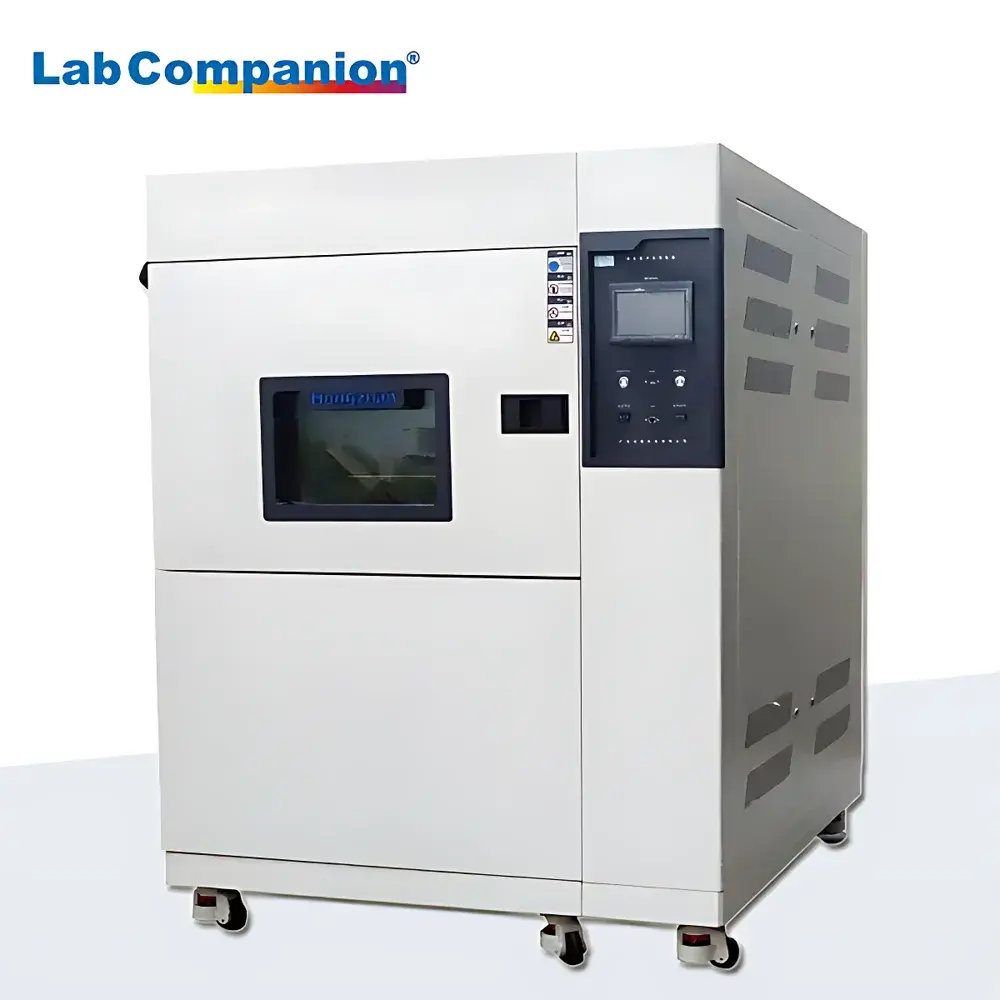
LabCompanion TSU-225A Three-Zone Thermal Shock Test Chamber
| Brand | LabCompanion |
|---|---|
| Origin | Guangdong, China |
| Manufacturer Type | Direct Manufacturer |
| Model | TSU-225A |
| High-Temperature Range | +60 °C to +200 °C |
| Low-Temperature Range | −78 °C to 0 °C |
| Thermal Shock Range | −55 °C to +150 °C |
| Temperature Stability | ±2 °C |
| Heating Rate | +60 °C to +200 °C ≤ 20 min |
| Cooling Rate | +20 °C to −75 °C ≤ 60 min |
Overview
The LabCompanion TSU-225A is a precision-engineered three-zone thermal shock test chamber designed for accelerated reliability evaluation of electronic components, aerospace materials, automotive modules, and packaging systems under extreme temperature transitions. Unlike dual-chamber (hot/cold) configurations, the TSU-225A employs a true three-compartment architecture—comprising independent high-temperature, low-temperature, and test zones—enabling rapid, repeatable, and contamination-free thermal cycling without mechanical sample transfer. Its operational principle relies on pneumatically actuated isolation doors that sequentially expose test specimens to pre-conditioned environments, minimizing thermal lag and ensuring strict adherence to standardized shock profiles defined in MIL-STD-810H Method 503.7, IEC 60068-2-14, and JESD22-A104E. The chamber’s robust stainless-steel construction, insulated with high-density polyurethane foam (≥100 mm thickness), ensures long-term thermal integrity and energy efficiency across continuous duty cycles.
Key Features
- Three-zone segregated design: Independent hot zone (+60 °C to +200 °C), cold zone (−78 °C to 0 °C), and ambient test zone—eliminating cross-contamination and enabling precise dwell-time control per phase.
- Pneumatic air-door switching mechanism with <1.5 s actuation time and position feedback verification, ensuring reproducible thermal transition timing critical for qualification testing.
- Temperature stability maintained within ±2 °C across the entire usable working volume (W750 × H500 × D600 mm), validated per ASTM E742 and ISO 16750-4 calibration protocols.
- Controlled heating rate of ≤20 minutes for +60 °C → +200 °C ramp; controlled cooling rate of ≤60 minutes for +20 °C → −75 °C ramp—both measured under no-load conditions per IEC 60068-3-5.
- Integrated over-temperature, over-pressure, and refrigerant leak detection with automatic shutdown and audible/visual alarms compliant with EN 61000-6-2 EMC requirements.
- Touchscreen HMI with programmable multi-step profiles, real-time data logging (1 Hz resolution), and USB export capability for audit-ready traceability.
Sample Compatibility & Compliance
The TSU-225A accommodates specimens up to 10 kg mass and 30 kg static load on its adjustable stainless-steel test shelf. Compatible with JEDEC-standard plastic-encapsulated microcircuits (e.g., QFP, BGA, SOIC), PCB assemblies, solder joints, conformal-coated sensors, and polymer-based enclosures. All thermal shock profiles meet the environmental stress screening (ESS) requirements outlined in IPC-J-STD-002, IPC-J-STD-020, and NASA-HDBK-7120. The system supports GLP/GMP-aligned operation through optional password-protected user roles, electronic signature support, and 21 CFR Part 11–compliant audit trail generation when paired with LabCompanion’s optional DataVault software module.
Software & Data Management
Equipped with LabCompanion’s ThermControl™ v4.2 firmware, the TSU-225A provides intuitive profile programming—including ramp-hold-soak sequences, conditional branching, and failure-triggered abort logic. Raw sensor data (PT100 class A accuracy) is timestamped and stored internally for ≥30 days at 1 Hz sampling. Export formats include CSV, PDF test reports (with header metadata: operator ID, chamber ID, calibration due date), and XML for LIMS integration. Optional cloud synchronization enables remote monitoring via secure TLS 1.2 API endpoints, supporting centralized fleet management across multi-site R&D and QA laboratories.
Applications
- Qualification testing of avionics hardware per DO-160 Section 4 (Temperature Variation).
- Solder joint fatigue assessment in automotive ECUs subjected to thermal cycling per ISO 16750-4.
- Accelerated aging studies of battery electrolyte membranes and solid-state electrolytes.
- Validation of hermetic seal integrity in MEMS devices and optoelectronic packages.
- Process window definition for reflow soldering and underfill curing processes.
- Material coefficient-of-thermal-expansion (CTE) mismatch analysis in heterogeneous laminates.
FAQ
What standards does the TSU-225A comply with for thermal shock testing?
It meets IEC 60068-2-14, MIL-STD-810H Method 503.7, JESD22-A104E, and supports validation against ASTM E742 and ISO 16750-4 for chamber performance verification.
Can the chamber operate continuously for extended qualification runs?
Yes—the refrigeration system uses dual-stage cascade compressors with oil-level monitoring and automatic defrost cycles, enabling uninterrupted 72+ hour operation under specified load conditions.
Is remote diagnostics supported?
Standard Ethernet interface enables SNMP-based network health monitoring; optional remote desktop access (via secure VPN) allows OEM-level troubleshooting and firmware updates.
How is temperature uniformity verified during installation?
Factory-installed 9-point NIST-traceable PT100 sensor array enables on-site mapping per IEC 60068-3-5 Annex B, with full report generation included in commissioning documentation.
Does the system support custom alarm escalation protocols?
Yes—up to 8 configurable alarm levels with relay outputs, email/SMS notifications (via SMTP gateway), and integration into building management systems (BACnet/IP or Modbus TCP).
Related Products



