
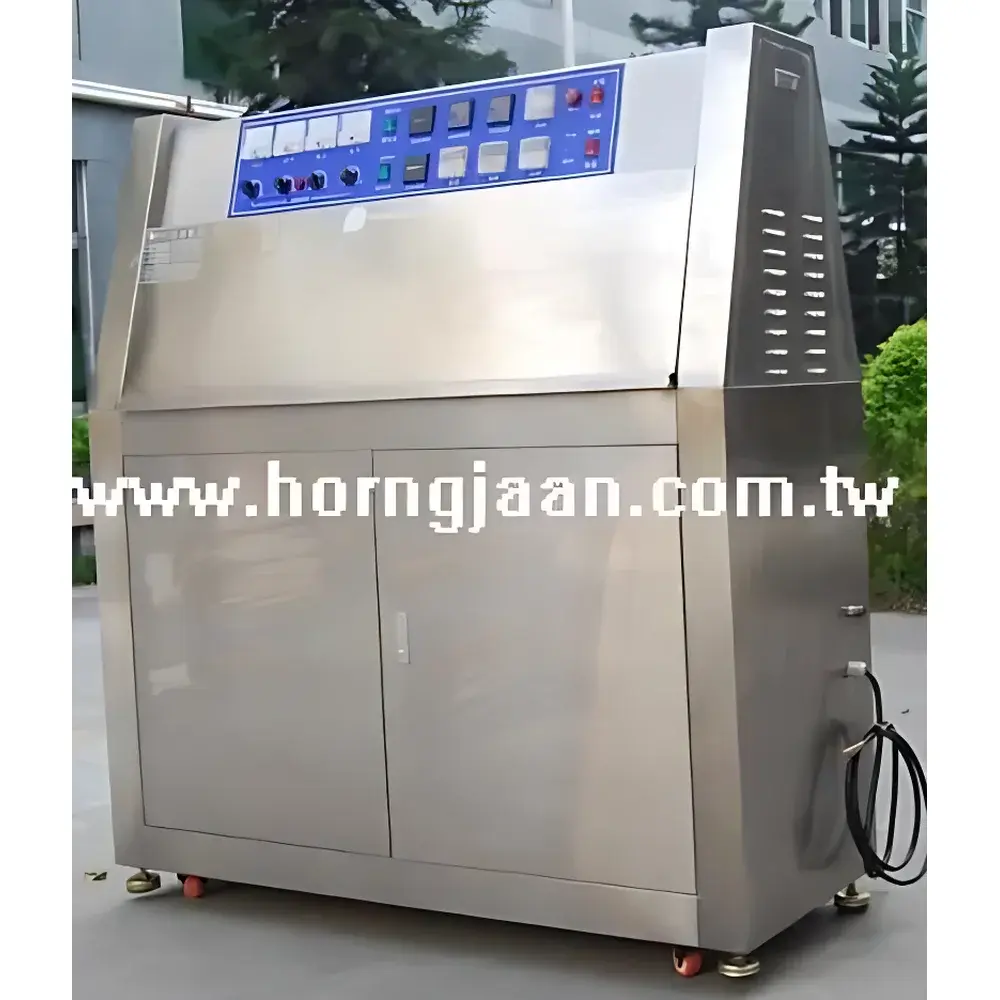
LabCompanion UV Accelerated Weathering Test Chamber UV Series
| Brand | LabCompanion |
|---|---|
| Origin | Guangdong, China |
| Manufacturer Type | Direct Manufacturer |
| Model | UV1/UV2/UV3 |
| Temperature Range | RT+10–70 °C |
| Humidity Range | ≥90% RH |
| Sample-to-Lamp Distance | 50 ± 2 mm |
| Lamp Center-to-Center Spacing | 70 mm |
| Irradiance | UVA-340 @ 0.68 W/m² (295–360 nm), UVB-313 @ 0.60 W/m² (280–315 nm) |
| Interior Dimensions | 1170 × 450 × 500 mm (W×D×H) |
| Exterior Dimensions | 1300 × 550 × 1380 mm (W×D×H) |
| Construction | Stainless Steel Interior & Exterior |
| Control System | Intelligent Digital Controller with AI-PID Regulation |
| Condensation Mechanism | Steam-Based Cold-Condensation Cycle |
| Compliance Standards | GB/T 16422.3–1997, ASTM G53–88, GB/T 14522–93 |
Overview
The LabCompanion UV Accelerated Weathering Test Chamber (UV Series) is an engineered environmental test system designed to simulate the photochemical degradation effects of solar ultraviolet radiation under controlled laboratory conditions. Unlike full-spectrum xenon arc or carbon arc exposure systems, this chamber employs fluorescent UV lamps—specifically UVA-340 and UVB-313—to replicate the most damaging short-wavelength UV component of natural sunlight (280–360 nm), which accounts for the majority of polymer photodegradation despite comprising only ~5% of total solar irradiance. The device implements a cyclic exposure protocol combining controlled UV irradiation with condensation-driven moisture exposure, mimicking diurnal dew formation and thermal-hygrometric stress encountered in real-world outdoor service environments. This approach enables accelerated assessment of material performance metrics including color shift, gloss loss, chalking, cracking, embrittlement, surface oxidation, and delamination—critical parameters for R&D validation, quality control, and regulatory compliance in plastics, coatings, elastomers, and composite materials.
Key Features
- Two standardized UV lamp options: UVA-340 lamps (peak emission at 340 nm, spectral match to terrestrial solar UV down to 295 nm) for realistic outdoor simulation; UVB-313 lamps (peak at 313 nm, extended short-wave output) for aggressive acceleration testing.
- Steam-based condensation cycle replicates nocturnal dew formation without external water spray—ensuring uniform, reproducible moisture exposure on specimen surfaces.
- Dual-zone temperature control maintains precise black-panel or specimen surface temperature during irradiation and condensation phases, supporting ISO 4892-3 and ASTM G154 alignment.
- Stainless steel construction (interior and exterior) ensures long-term corrosion resistance and cleanroom-compatible operation.
- Intelligent digital controller with AI-PID algorithm delivers stable setpoint regulation, programmable multi-step cycles, and real-time data logging of temperature, humidity, and irradiance (when optional UV sensor is installed).
- Integrated safety architecture includes overtemperature cutoff, dry-run protection, ground fault interruption, power overload tripping, and automatic system shutdown upon fault detection—all compliant with IEC 61000-6-2/6-4 EMC requirements.
Sample Compatibility & Compliance
The UV Series accommodates flat, rigid, or semi-flexible specimens up to 150 mm × 75 mm × 20 mm per slot, mounted on an aluminum frame with spring-loaded clamping. It supports standard specimen holders conforming to ASTM D7869 and ISO 4892-3 geometries. The chamber is validated against internationally recognized standards including ASTM G53–88 (Standard Practice for Operating Fluorescent Ultraviolet (UV) and Condensation Exposure Apparatus for Polymer Testing), GB/T 16422.3–1997 (Plastics—Methods of Exposure to Laboratory Light Sources—Part 3: Fluorescent UV Lamps), and GB/T 14522–93 (Artificial Climate Accelerated Aging Test Methods for Plastics, Paints and Rubber Used in Mechanical Industry Products). Its operational envelope meets GLP-relevant traceability requirements when paired with calibrated UV radiometers and audit-trail-enabled controllers.
Software & Data Management
While the base model features a standalone microprocessor controller with LED display and keypad interface, optional PC connectivity (RS-485 or Ethernet) enables remote monitoring and data export via LabCompanion’s proprietary WinUV software. This platform supports CSV-formatted time-series logging of irradiance (W/m²), chamber air temperature (°C), black-panel temperature (°C), and relative humidity (%RH), with timestamped event markers for cycle transitions and alarm triggers. For regulated environments, optional 21 CFR Part 11-compliant firmware upgrade provides electronic signatures, role-based access control, and immutable audit trails—facilitating FDA, ISO 17025, or ICH Q5C-aligned qualification documentation.
Applications
This test chamber serves laboratories engaged in formulation development, supplier qualification, and product lifetime prediction across multiple sectors: automotive interior trim and exterior coatings; architectural sealants and façade materials; agricultural films and greenhouse covers; medical device polymer housings; aerospace composites; and consumer electronics enclosures. It is routinely deployed to support failure mode analysis (FMEA), comparative benchmarking of UV stabilizers (e.g., HALS, benzotriazoles), and verification of weathering resistance claims under contractual warranty specifications.
FAQ
What is the difference between UVA-340 and UVB-313 lamp configurations?
UVA-340 lamps closely replicate the solar UV spectrum down to 295 nm and are recommended for realistic outdoor durability assessment. UVB-313 lamps emit more energetic short-wave UV (down to 280 nm) and are used where rapid screening or extreme acceleration is required—though results may not correlate directly with field exposure.
Is irradiance calibration traceable to NIST or other national standards?
Yes—optional UV radiometers supplied with the system are factory-calibrated against NIST-traceable reference detectors. Annual recalibration services are available through LabCompanion’s certified metrology lab.
Can the chamber operate continuously without operator intervention?
Yes—the controller supports unattended execution of multi-day test sequences with automatic cycling between UV exposure and condensation phases. All safety interlocks remain active during autonomous operation.
Does the system comply with FDA 21 CFR Part 11 requirements?
Out-of-the-box, it meets basic data integrity requirements. Full Part 11 compliance—including electronic signatures and audit trail generation—requires installation of the optional validated software module and associated procedural controls.
What maintenance intervals are recommended for UV lamps and sensors?
UV lamps should be replaced after 1600–2000 hours of cumulative operation. Radiometer sensors require annual verification; quartz viewing windows must be cleaned weekly with isopropyl alcohol to prevent transmission loss.



