
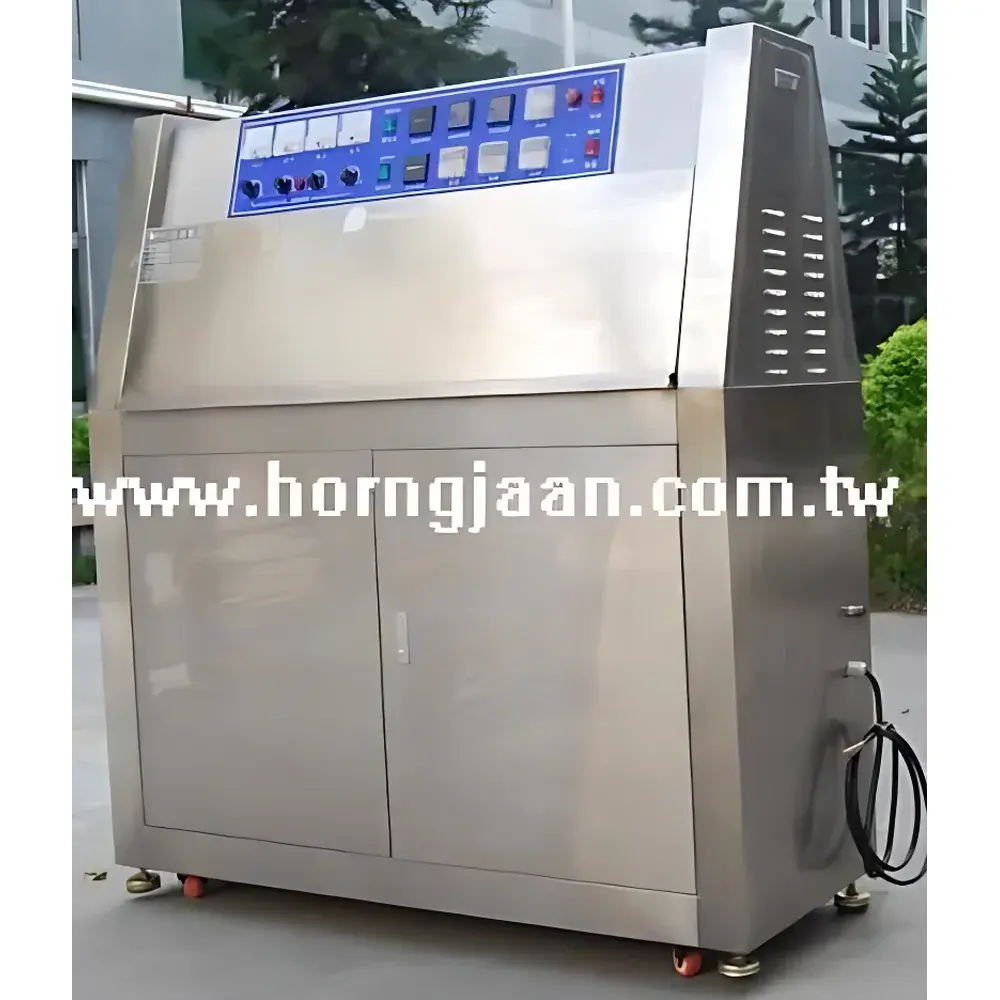
LabCompanion UV1 UV Aging Test Chamber
| Brand | LabCompanion |
|---|---|
| Origin | Guangdong, China |
| Manufacturer Type | OEM/ODM Manufacturer |
| Country of Origin | China |
| Model | UV1 |
| Pricing | Upon Request |
| Temperature Range | RT+10°C to 70°C |
| Humidity Range | ≥90% RH |
| Sample-to-Lamp Distance | 50 ± 2 mm |
| Lamp Center-to-Center Spacing | 70 mm |
| Irradiance | UVA-340 @ 0.68 W/m² (295–360 nm), UVB-313 @ 0.60 W/m² (280–315 nm) |
| Internal Chamber Dimensions | 1170 × 450 × 500 mm (W×D×H) |
| External Dimensions | 1300 × 550 × 1380 mm (W×D×H) |
| Light Source | Fluorescent UV Lamps (UVA-340 or UVB-313 selectable) |
| Exposure Mechanism | Condensation Cycle (Humid Hot Air + Backside Cooling) |
| Compliance Standards | GB/T 16422.3–1997, ASTM G53–88, GB/T 14522–93 |
| Safety Protections | Overcurrent, Ground Fault, Overtemperature, Low-Water, Compressor Overpressure, Auto Power Cut-off with Audible Alert |
Overview
The LabCompanion UV1 UV Aging Test Chamber is an engineered environmental test system designed for accelerated photochemical degradation assessment of polymeric and organic materials under controlled ultraviolet (UV) irradiation, humidity, and thermal cycling. It operates on the principle of fluorescent UV lamp exposure—leveraging the high photon energy of short-wavelength UV radiation (280–360 nm) to replicate the dominant photo-oxidative stress mechanisms observed in natural outdoor weathering. Unlike full-spectrum solar simulation, the UV1 focuses specifically on the most damaging spectral region: UV-B (280–315 nm) and UV-A (315–400 nm), where quantum yield for bond scission and radical generation is significantly elevated. This targeted approach enables reproducible, high-throughput evaluation of surface degradation phenomena—including color shift (ΔE), gloss loss, chalking, microcracking, delamination, and embrittlement—without requiring complex optical filtering or xenon arc infrastructure.
Key Features
- Stainless steel chamber construction (interior and exterior) with corrosion-resistant finish and seamless welded joints for long-term exposure integrity
- Intelligent digital controller with AI-based PID temperature/humidity regulation, real-time data logging, and dual-mode operation (irradiation + condensation)
- Dual-lamp compatibility: Interchangeable UVA-340 (peak at 340 nm, simulating terrestrial solar UV-A) and UVB-313 (peak at 313 nm, delivering aggressive, super-solar UV-B intensity) lamp arrays
- Precision sample mounting frame fabricated from anodized aluminum alloy, ensuring dimensional stability and uniform thermal expansion during cyclic testing
- Condensation exposure cycle: Saturated humid air (≥90% RH) at elevated temperature induces dew formation on specimen surfaces—mimicking nocturnal dew deposition critical to hydrolytic degradation pathways
- Integrated safety architecture: Comprehensive protection suite including overtemperature cutoff, ground-fault interruption, low-water level detection, compressor overload monitoring, and automatic mains disconnection upon fault detection
- Optional UV irradiance sensor with closed-loop feedback control—enables dynamic lamp power compensation to maintain target irradiance despite lamp aging or voltage fluctuation
Sample Compatibility & Compliance
The UV1 accommodates flat-panel specimens up to 1170 mm × 450 mm × 50 mm (L×W×T), with standardized rack spacing optimized for ASTM G53–88 and ISO 4892–3 alignment. It supports rigid and semi-flexible substrates including thermoplastics (PP, ABS, PC), coatings (automotive clearcoats, architectural paints), elastomers (EPDM, silicone), and fiber-reinforced composites. All operational protocols adhere to internationally recognized material aging standards: GB/T 16422.3–1997 (equivalent to ISO 4892–3), ASTM G53–88 (Standard Practice for Operating Fluorescent Ultraviolet (UV) and Condensation Exposure Apparatus), and GB/T 14522–93 (Mechanical Industry Standard for Artificial Climate Accelerated Testing of Plastics, Paints, and Rubbers). The chamber’s design permits traceable calibration against NIST-traceable UV radiometers and satisfies prerequisite conditions for GLP-compliant test documentation when paired with validated software.
Software & Data Management
While the base UV1 model employs a standalone microprocessor controller with LED display and manual parameter entry, optional PC-integrated software (LabCompanion UV-Link Suite) provides enhanced functionality: time-stamped irradiance history, multi-channel temperature/humidity trending, alarm event logging with timestamp and cause code, and export-ready CSV reports compliant with FDA 21 CFR Part 11 audit trail requirements. All data points are stored internally with non-volatile memory retention (>10 years), and user-defined test profiles (e.g., “ISO 4892–3 Cycle 1: 4 h UV @ 60°C / 4 h Condensation @ 50°C”) can be recalled and duplicated across units for inter-laboratory correlation studies.
Applications
- Formulation screening of UV stabilizers (HALS, benzotriazoles, triazines) in polymer masterbatches
- Qualification of automotive interior trim materials per OEM specifications (e.g., GMW14124, Ford CETP)
- Accelerated lifetime prediction of photovoltaic encapsulants (EVA, POE) and backsheet films
- Regulatory compliance testing for medical device packaging (ISO 11607–2) and pharmaceutical secondary packaging (ICH Q1B)
- Quality assurance of architectural cladding systems exposed to subtropical climates
- Research into synergistic effects of UV + moisture on hydrophilic polymer degradation kinetics
FAQ
What is the difference between UVA-340 and UVB-313 lamp spectra?
UVA-340 lamps emit primarily within 295–360 nm, closely matching the solar UV spectrum reaching Earth’s surface; they are recommended for realistic outdoor durability assessment. UVB-313 lamps emit strongly below 315 nm—including wavelengths not present in natural sunlight—and are used for highly accelerated, comparative screening where absolute correlation to field performance is secondary to relative ranking.
Can the UV1 perform cyclic testing with dark/cool periods?
Yes—the standard condensation cycle inherently includes a non-irradiated phase where saturated humid air maintains elevated surface temperature while specimen backs cool convectively, inducing dew formation. Additional dark cycles (e.g., 10 h dark at 25°C) can be programmed via optional software.
Is calibration of UV irradiance traceable to national standards?
When equipped with the optional UV irradiance sensor, calibration is performed using a NIST-traceable reference radiometer (e.g., Optronic OL754) prior to shipment; annual recalibration is recommended per ISO/IEC 17025 guidelines.
Does the UV1 meet requirements for ISO/IEC 17025-accredited laboratories?
Yes—when operated with documented SOPs, calibrated sensors, maintenance logs, and version-controlled software, the UV1 supports technical validity for accredited testing under clauses 6.4 (Equipment) and 7.7 (Ensuring Validity of Results) of ISO/IEC 17025:2017.
What maintenance intervals are recommended for UV lamp replacement?
UVA-340 lamps require replacement every 1,600–2,000 hours of operation; UVB-313 lamps every 1,200–1,500 hours. Actual service life depends on operating temperature, duty cycle, and power regulation stability—monitoring via irradiance sensor extends usable lifespan through adaptive output compensation.
Related Products



