
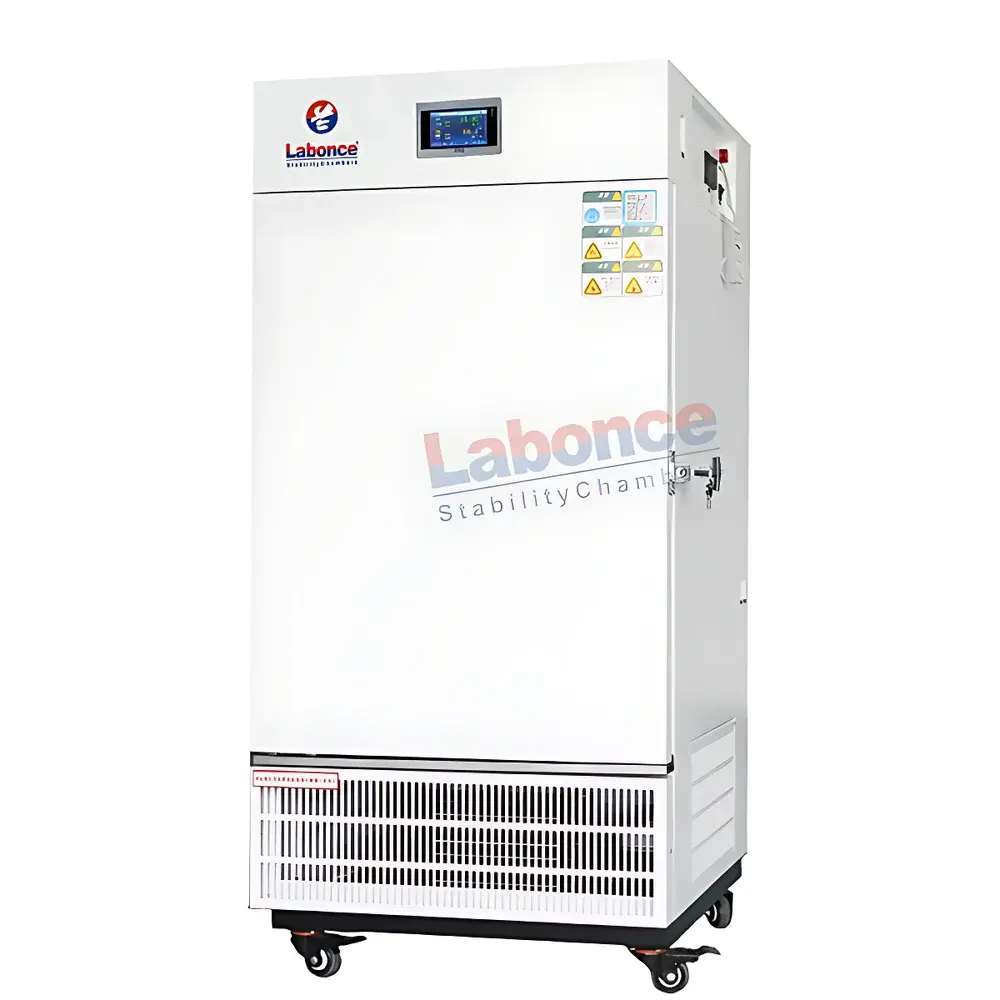
Labonce Labonce-250CT Drug Stability Testing Chamber
| Brand | Labonce |
|---|---|
| Origin | Beijing, China |
| Manufacturer Type | Direct Manufacturer |
| Product Origin | Domestic (China) |
| Model | Labonce-250CT |
| Pricing | Available Upon Request |
| Temperature Range | 0–85 °C |
| Chamber Volume | 250 L |
| Internal Dimensions (W×D×H) | 600×500×830 mm |
| External Dimensions (W×D×H) | 780×880×1650 mm |
| Power Consumption | 1.5 kW |
| Standard Shelves | 3 shelves (7 total positions) |
| Temperature Uniformity | ≤2.0 °C |
| Temperature Fluctuation | <±0.5 °C |
| Temperature Deviation | <±1.0 °C |
| Compliance | GB/T 10586–2006 |
| Control System | Programmable Color Touchscreen Controller with 3-Tier User Permissions & Audit Trail |
| Data Storage | Internal Electronic Logging + USB Export |
| Cooling System | Imported Inverter Compressor (≥50% Energy Savings) |
| Safety | Independent Over-Temperature Protection Circuit |
| Door Design | Dual-door — outer solid insulated door + inner tempered glass door |
| Construction | Exterior: Powder-coated steel |
| Interior | Stainless steel chamber with built-in glass observation window |
| Optional Accessory | Pin-type micro printer |
Overview
The Labonce Labonce-250CT Drug Stability Testing Chamber is an ICH-compliant environmental simulation system engineered for long-term and accelerated stability studies of pharmaceutical products, packaging materials, and excipients under controlled temperature conditions. Designed in accordance with the technical requirements of GB/T 10586–2006 (Equivalent to ISO 16750-4 and ASTM E145–22 for thermal performance validation), this chamber employs a precision air-circulation architecture to maintain thermally stable, reproducible environments essential for regulatory submissions under ICH Q1A(R3), Q5C, and WHO TRS 1010 Annex 9. Its core operating principle relies on forced-air convection with dynamically balanced airflow distribution—ensuring minimal thermal stratification across the entire 250 L working volume. The chamber supports continuous operation at setpoints from 0 °C to 85 °C, making it suitable for thermal stress testing, excipient compatibility screening, and primary/secondary packaging integrity evaluation per USP and Ph. Eur. 5.1.3.
Key Features
- High-fidelity thermal control: Achieves temperature fluctuation <±0.5 °C and deviation <±1.0 °C (per GB/T 10586–2006 verification protocol), with uniformity ≤2.0 °C across all shelf positions.
- Dual-door configuration: Outer insulated solid door minimizes heat exchange and light ingress; inner tempered glass door enables non-intrusive visual monitoring without compromising chamber stability—critical for minimizing thermal disturbance during routine inspections.
- Inverter-driven refrigeration: Equipped with an imported variable-frequency compressor delivering ≥50% energy reduction versus fixed-speed alternatives, while maintaining consistent cooling capacity across ambient temperature ranges (15–35 °C).
- Regulatory-grade controller: Full-color programmable touchscreen interface with three-tier user authentication (Operator / Supervisor / Administrator), electronic audit trail (21 CFR Part 11 compliant logging), and real-time parameter lockout functionality.
- Robust mechanical construction: Seamless stainless-steel interior (AISI 304), powder-coated carbon steel exterior, and reinforced structural frame ensure long-term corrosion resistance and mechanical durability in GLP/GMP laboratory environments.
- Redundant safety architecture: Independent over-temperature protection circuit (hardware-based, non-software dependent) safeguards both samples and instrumentation under fault conditions.
Sample Compatibility & Compliance
The Labonce-250CT accommodates standard pharmaceutical stability protocols including ICH Q1A(R3) long-term (25 °C/60% RH, 30 °C/65% RH), intermediate (30 °C/65% RH), and accelerated conditions (40 °C/75% RH when paired with optional humidity module). While the CT-series model is temperature-only, its chamber geometry (600×500×830 mm internal) supports up to seven adjustable stainless-steel shelves—enabling simultaneous placement of multiple ICH-compliant trays, vials, blister packs, or sachets. All materials in contact with test specimens comply with USP Class VI biocompatibility requirements. The unit is validated per IQ/OQ protocols and supports calibration traceability to NIST-traceable reference standards. Documentation packages include Factory Acceptance Test (FAT) reports and full compliance matrices mapping hardware/software features to FDA 21 CFR Part 11, EU Annex 11, and PIC/S PI 007–1 requirements.
Software & Data Management
Data integrity is enforced through embedded firmware that records time-stamped temperature readings at user-defined intervals (1–60 min), stores ≥12 months of continuous data internally (non-volatile memory), and exports CSV-formatted logs via USB 2.0 port—preserving metadata including operator ID, event timestamps, alarm history, and parameter modification logs. The audit trail captures all critical actions: setpoint changes, program starts/stops, user logins, and system alerts—with immutable hash-protected entries. Optional integration with Labonce’s centralized LabManager™ software enables remote monitoring, multi-chamber fleet management, automated report generation (PDF/Excel), and electronic signature workflows aligned with ALCOA+ principles.
Applications
- ICH-guided stability testing of APIs, finished dosage forms (tablets, capsules, injectables), and biologics intermediates.
- Thermal aging studies of polymer-based primary packaging (e.g., HDPE bottles, aluminum blisters, child-resistant closures).
- Excipient compatibility assessment under elevated temperature stress (e.g., Maillard reaction screening, hydrolysis kinetics).
- Validation of cold-chain interruption resilience for temperature-sensitive formulations.
- Material qualification per ASTM D3045 (heat aging of plastics) and ISO 4892–2 (laboratory light exposure—when combined with optional UV module).
- Supporting GMP batch release testing where thermal preconditioning precedes analytical assay (e.g., dissolution, HPLC).
FAQ
Is the Labonce-250CT certified for GMP/GLP compliance?
Yes—the controller’s audit trail, user permission hierarchy, and electronic signature readiness meet baseline requirements for GLP (OECD Principles) and GMP (FDA 21 CFR Part 11, EU Annex 11). Full qualification documentation (IQ/OQ/PQ templates) is provided upon request.
Can humidity be added to this model?
The Labonce-250CT is a temperature-only chamber. Humidity capability is available in the parallel Labonce-250CH series; retrofitting is not supported due to fundamental differences in chamber sealing, sensor layout, and condensate management.
What is the validation support package?
Labonce supplies pre-validated IQ/OQ protocols, calibration certificates for integrated PT100 sensors (±0.15 °C accuracy), and a temperature mapping template compliant with ISO 14644–3 and ASTM E2297–22.
Does the unit support remote monitoring via Ethernet or Wi-Fi?
Standard configuration includes RS485 Modbus RTU for PLC integration. Ethernet/Wi-Fi connectivity is available as a factory-installed option with TLS 1.2–secured API endpoints.
How frequently must the system be recalibrated?
Annual calibration is recommended per ISO/IEC 17025 and internal quality procedures; however, the dual-sensor redundancy (working + reference) enables in-house drift verification between formal calibrations.




