
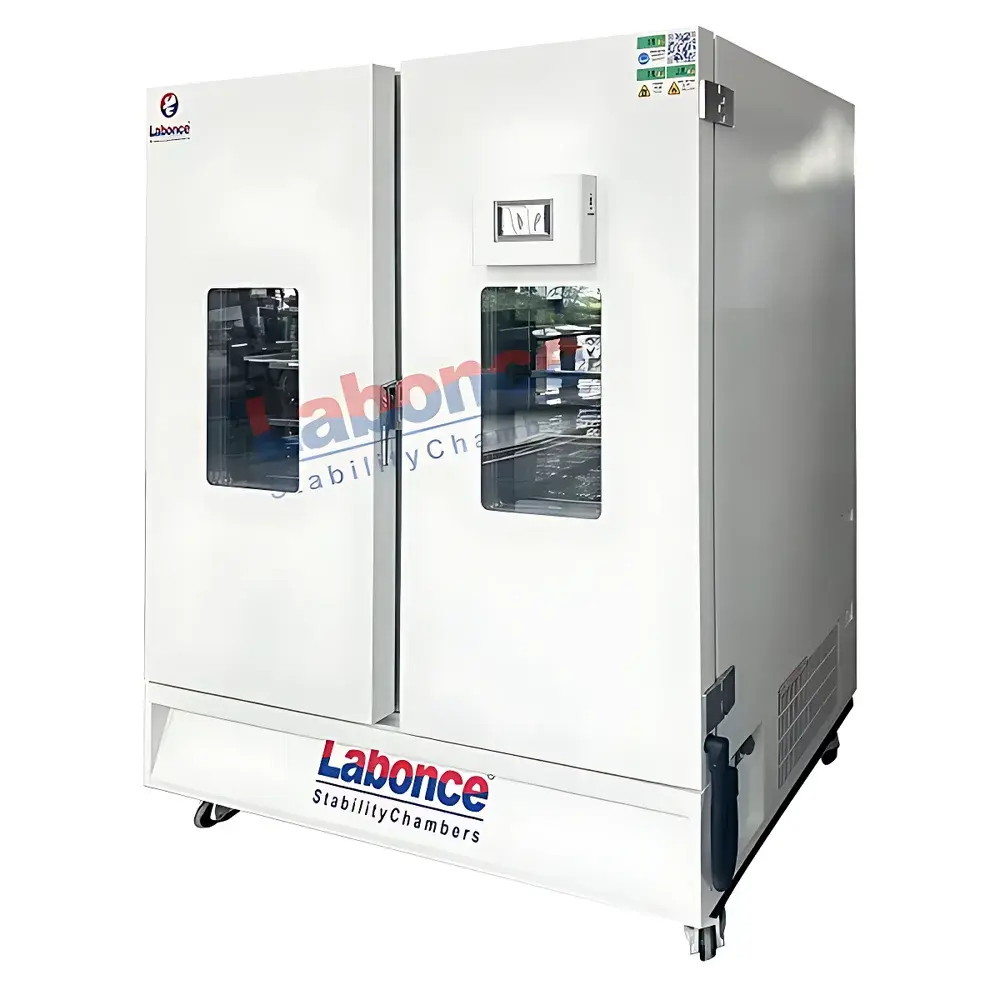
Labonce Labonce-800BC Pharmaceutical Stability & Storage Chamber
| Brand | Labonce |
|---|---|
| Origin | Beijing, China |
| Manufacturer Type | Direct Manufacturer |
| Model | Labonce-800BC |
| Temperature Range | 2–14 °C |
| Internal Volume | 800 L |
| Internal Dimensions (W×D×H) | 1200×490×1360 mm |
| External Dimensions (W×D×H) | 1390×900×1970 mm |
| Power Consumption | 1.2 kW |
| Temperature Uniformity | ≤2.0 °C |
| Temperature Fluctuation | <±1.0 °C |
| Temperature Deviation | <±2.0 °C |
| Ambient Operating Temperature | +5 to +30 °C |
| Power Supply | AC 220 V ±10%, 50 Hz |
| Standard Shelves | 4 pcs |
| Compliance | YY/T 0086–2020 |
Overview
The Labonce Labonce-800BC Pharmaceutical Stability & Storage Chamber is an ISO-compliant, GxP-aligned environmental test chamber engineered for long-term, uninterrupted storage and stability testing of temperature-sensitive pharmaceutical products—including APIs, reference standards, clinical trial materials, and finished dosage forms. Designed in strict accordance with YY/T 0086–2020 (Chinese national standard for medical refrigerated cabinets), the chamber maintains a precisely controlled temperature range of 2–14 °C—optimized for the ICH Q5C-recommended “refrigerated” storage condition (5 ± 2 °C). Its thermodynamic architecture employs forced-air convection with a proprietary air-distribution duct system, ensuring uniform thermal distribution across the full 800 L working volume without reliance on passive diffusion or localized cooling zones. The chamber’s operational integrity is validated under continuous 24/7 duty cycles, supporting GLP- and GDP-compliant storage workflows in QC laboratories, central pharmacies, biobanks, and regulatory submission-support facilities.
Key Features
- High-efficiency refrigeration system featuring a hermetically sealed industrial-grade compressor (imported origin), delivering stable cooling performance with acoustic noise 15,000 operating hours)
- Advanced airflow management: Multi-directional duct design with rear-mounted centrifugal blower ensures ≤2.0 °C temperature uniformity (measured per ISO 14644-3 mapping protocol at 9-point grid)
- Thermal insulation: 100 mm thick high-density polyurethane foam (density ≥42 kg/m³, closed-cell content >95%), minimizing heat ingress and humidity drift during ambient fluctuations
- Dual-layer chamber construction: Exterior powder-coated cold-rolled steel; interior liner fabricated from electropolished AISI 304 stainless steel (Ra ≤0.6 µm), non-porous and compliant with USP extractables requirements
- Intelligent controller: 7-inch full-color TFT touchscreen with programmable ramp-soak profiles, real-time trend logging, and triple-tier user authentication (Operator / Supervisor / Administrator)
- Integrated safety redundancy: Dual-stage compressor protection (thermal overload + high-pressure cutout), independent mechanical thermostat backup, and door-open duration monitoring
- Alarm infrastructure: Local audible alarm (85 dB), visual status LED, and optional GSM-enabled remote alerting for temperature excursions, power failure, or door ajar events
Sample Compatibility & Compliance
The Labonce-800BC accommodates diverse pharmaceutical packaging formats—including vials, syringes, blister packs, secondary cartons, and stability batches in open trays—without compromising thermal homogeneity. Its interior layout supports standardized ICH Q1A(R2) storage configurations (e.g., 30 cm clearance from walls, shelf loading ≤75% capacity). All materials contacting the storage environment meet USP Class VI biocompatibility criteria and are free of silicone, phthalates, and volatile organic compounds (VOCs). The chamber is pre-validated for compliance with YY/T 0086–2020 (Medical Refrigerated Cabinets), and its data integrity framework aligns with FDA 21 CFR Part 11 requirements when paired with optional audit-trail-enabled firmware (v3.2+). It supports IQ/OQ documentation packages per ASTM E2500 and ISO 13485 Annex A guidelines.
Software & Data Management
The embedded controller records temperature at 1-minute intervals with automatic timestamping and stores ≥12 months of raw data internally (non-volatile flash memory). Data export is supported via USB 2.0 (CSV format) or optional Ethernet/Wi-Fi module for integration into LIMS or electronic lab notebooks (ELN). Audit trail functionality logs all user actions—including setpoint changes, calibration adjustments, and alarm acknowledgments—with immutable timestamps and operator ID linkage. Optional RS-485 Modbus RTU interface enables centralized monitoring across multi-chamber installations. Firmware updates are performed via signed digital packages to ensure cryptographic integrity.
Applications
- ICH Q5C-compliant long-term and accelerated stability studies for drug substances and products
- Reference standard storage under WHO TRS 992 Annex 5 and EU GMP Annex 15 conditions
- Clinical supply chain cold chain validation (pre-shipment qualification and in-transit simulation)
- QC sample holding prior to assay—ensuring no thermal degradation between receipt and analysis
- GDP-compliant storage of investigational medicinal products (IMPs) in clinical trial depots
- Biological reagent preservation (e.g., monoclonal antibodies, ELISA kits, PCR master mixes)
FAQ
What is the temperature recovery time after a 30-second door opening event?
Typically ≤12 minutes to return within ±0.5 °C of setpoint (tested at 5 °C, 50% RH, ambient 25 °C), verified per ISO 14644-3 Annex B.
Does the chamber support 21 CFR Part 11-compliant electronic signatures?
Yes—when configured with administrator-level firmware and external PKI certificate integration, it meets electronic signature and audit trail requirements.
Can the internal shelves be repositioned during operation?
Yes—shelves are adjustable on fixed rails without tools; load capacity per shelf is 35 kg (uniformly distributed).
Is validation support documentation provided with shipment?
Yes—factory-issued IQ/OQ templates, sensor calibration certificates (NIST-traceable Pt100 probes), and temperature mapping reports are included.
What maintenance intervals are recommended for optimal performance?
Compressor oil inspection every 24 months; condenser coil cleaning every 6 months; annual verification of temperature sensors and alarm thresholds per ISO/IEC 17025 protocols.



