
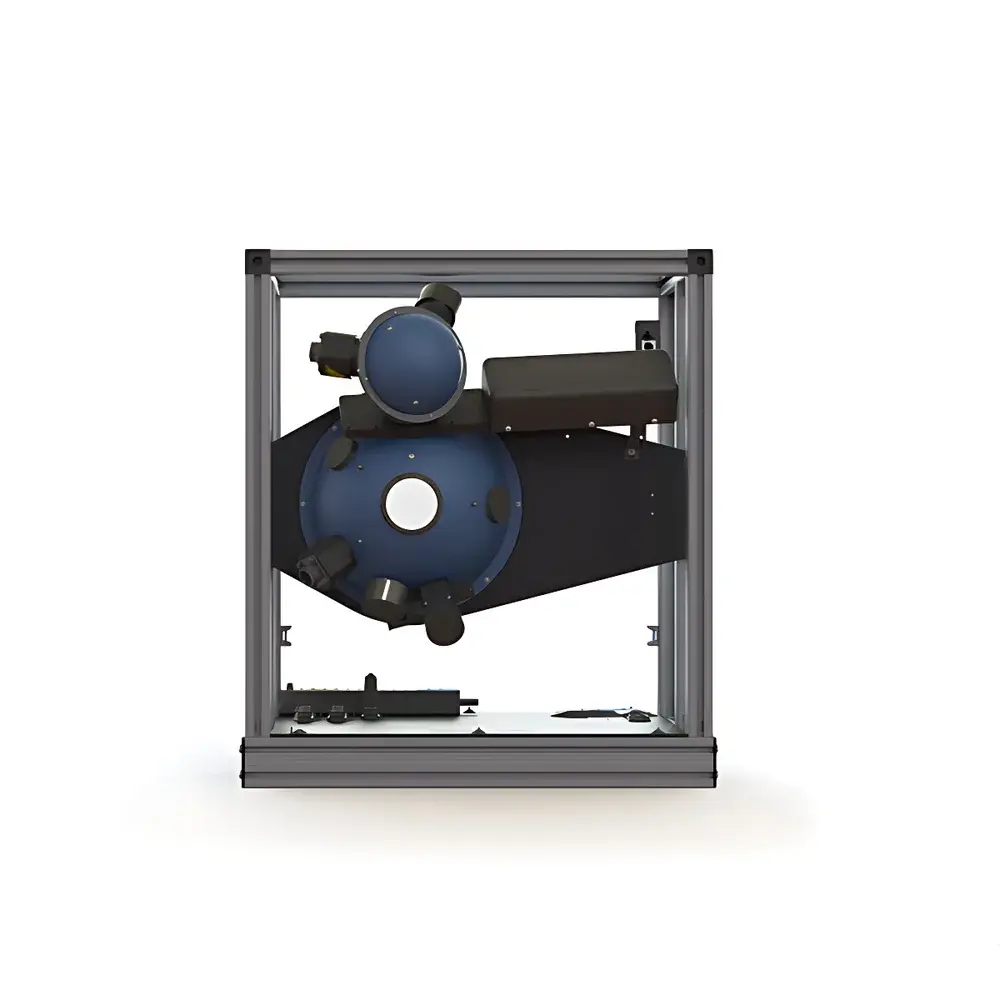
Labsphere Helios-LL Series Low-Luminance Integrating Sphere Uniform Light Source
| Brand | Labsphere |
|---|---|
| Origin | USA |
| Model | Helios-LL Series |
| Light Source Type | Tungsten-Halogen |
| CCT | 2856 K ±50 K |
| Spectral Distribution | Blackbody-like |
| Integrating Sphere Coating | Spectraflect or Spectralon |
| Output Port Diameter | 2–8 in (0.05–0.2 m) |
| Sphere Diameter | 7.5–20 in (0.19–0.5 m) |
| Max Luminance | 1,600–9,500 cd/m² |
| Illuminance at Port | 5,000–30,000 lux |
| Dynamic Range | 4.00E+09 to 1.00E+10 (31–32 bits, 196–199 dB) |
| Angular Uniformity (FOV ±35°) | ±2.0% |
| Attenuation System | Advanced Variable Attenuator (VAA), 6.00E+06 to 8.80E+06 steps |
| Detector Configuration | Dual Silicon Detectors (SD-S1 & SD-L1) |
| Software Interface | HELIOSense GUI with LSAPI support |
| Compliance | MIL-STD-810G, ISO/IEC 17025 traceable calibration options available |
Overview
The Labsphere Helios-LL Series is a precision-engineered low-luminance integrating sphere uniform light source designed for radiometric and photometric characterization of night vision imaging systems, low-light surveillance cameras, and electro-optical sensors operating near the signal-to-noise ratio (SNR) limit. Based on calibrated tungsten-halogen lamps emitting a stable blackbody-like spectral distribution centered at 2856 K ±50 K, the Helios-LL delivers spectrally continuous, spatially uniform output across its full field-of-view (±35°), enabling repeatable, traceable testing under controlled darkroom conditions. Its core architecture integrates a high-stability thermal source, dual silicon photodetectors (SD-S1 and SD-L1), and a motorized variable attenuator (VAA) to achieve an extended dynamic range exceeding 1010 — critical for validating sensor linearity, dynamic range, and noise floor performance across illumination levels ranging from daylight-equivalent intensities down to sub-millilux regimes.
Key Features
- Ultra-low luminance capability: Configurable output from <1 cd/m² up to 9,500 cd/m², supporting MIL-spec NVG (night vision goggle) and EO/IR sensor validation.
- Dual-detector feedback loop: SD-S1 (broad-range stability) and SD-L1 (optimized for ultra-low-light sensitivity) enable real-time luminance monitoring and closed-loop intensity control.
- Advanced Variable Attenuator (VAA): Precision motorized neutral-density filter wheel with >6 million discrete attenuation steps ensures smooth, reproducible dimming without spectral shift.
- High spatial uniformity: ±2.0% angular uniformity over ±35° full field-of-view, verified per ISO 9050 and ASTM E308 methodologies.
- Thermally stable Spectraflect® or Spectralon® sphere coatings: Minimize spectral dependence and enhance long-term radiometric repeatability.
- Modular scalability: Five standard configurations (USLR-L08F/L, L12F/L, L20F) differ in sphere diameter (7.5–20 in), port size (2–8 in), and maximum output — allowing system optimization for resolution, throughput, or sensitivity requirements.
Sample Compatibility & Compliance
The Helios-LL series supports direct coupling to imaging sensors, lens assemblies, and optical test benches via standardized flange-mount ports. It is routinely deployed in laboratories accredited to ISO/IEC 17025 for photometric calibration, and its output stability and traceability align with MIL-STD-810G environmental testing protocols for electro-optical equipment. While not inherently FDA-regulated, its radiometric integrity supports GLP-compliant validation of medical low-light endoscopes and scientific CMOS/CCD detectors. Custom NIST-traceable calibrations — including spectral irradiance, luminance, and uniformity maps — are available for applications requiring uncertainty budgets below ±1.5% (k=2). All configurations comply with IEC 61000-4 electromagnetic compatibility standards and operate within Class I laser safety guidelines when used as intended.
Software & Data Management
HELIOSense GUI serves as the unified control and analysis platform for the Helios-LL system. Built on Labsphere’s LSAPI (Labsphere Software Application Programming Interface), it natively recognizes all integrated hardware components — VAA, dual detectors, optional spectroradiometers, and shutter controllers — enabling synchronized automation. The software supports scripted test sequences (Python-based), responsive “Hunt & Seek” feedback loops for adaptive exposure optimization, and automated generation of compliance reports compliant with 21 CFR Part 11 audit trail requirements. Raw detector data, attenuation positions, and timestamped luminance values are logged in HDF5 format for post-processing in MATLAB, Python, or third-party metrology suites. Calibration coefficients are embedded and digitally signed to prevent tampering, ensuring data integrity during regulatory audits.
Applications
- Characterization of night vision device (NVD) modulation transfer function (MTF) and minimum resolvable temperature difference (MRTD) under low-luminance conditions.
- Dynamic range validation of security cameras, automotive ADAS sensors, and astronomical CCDs operating at sub-10−3 lux.
- Calibration of radiometric reference standards used in national metrology institutes and OEM production test lines.
- Development and verification of automatic exposure control (AEC) algorithms in low-light imaging pipelines.
- Testing of lens flare, veiling glare, and ghosting artifacts using controlled, spatially uniform stimuli.
- Validation of sensor response linearity per ISO 15739 and EMVA 1288 standards across multi-decade intensity spans.
FAQ
What spectral range does the Helios-LL cover?
The tungsten-halogen source emits continuously from 350 nm to 2500 nm, with peak output near 1000 nm — ideal for silicon-based sensors and legacy NVG phosphor response curves.
Can the system be integrated with external spectroradiometers?
Yes. HELIOSense supports bidirectional communication with industry-standard spectroradiometers (e.g., Ocean Insight, Konica Minolta) via USB or Ethernet, enabling real-time spectral correction and CCT drift compensation.
Is factory calibration included with purchase?
Each system ships with a base luminance calibration certificate traceable to NIST. Optional expanded calibrations — including spatial uniformity mapping, spectral irradiance, and angular dependency characterization — are available upon request.
How is thermal drift managed during extended low-light measurements?
The halogen lamp operates in constant-power mode with active thermal stabilization; combined with SD-L1’s low-drift amplifier design and dual-detector differential referencing, long-term stability remains within ±0.15% over 8-hour sessions.
Does the Helios-LL support automated pass/fail testing per MIL-STD-3009?
Yes. Predefined test templates for MIL-STD-3009 Annex D (NVG performance) are available in HELIOSense, including auto-thresholding, statistical outlier rejection, and PDF report generation with digital signature.




