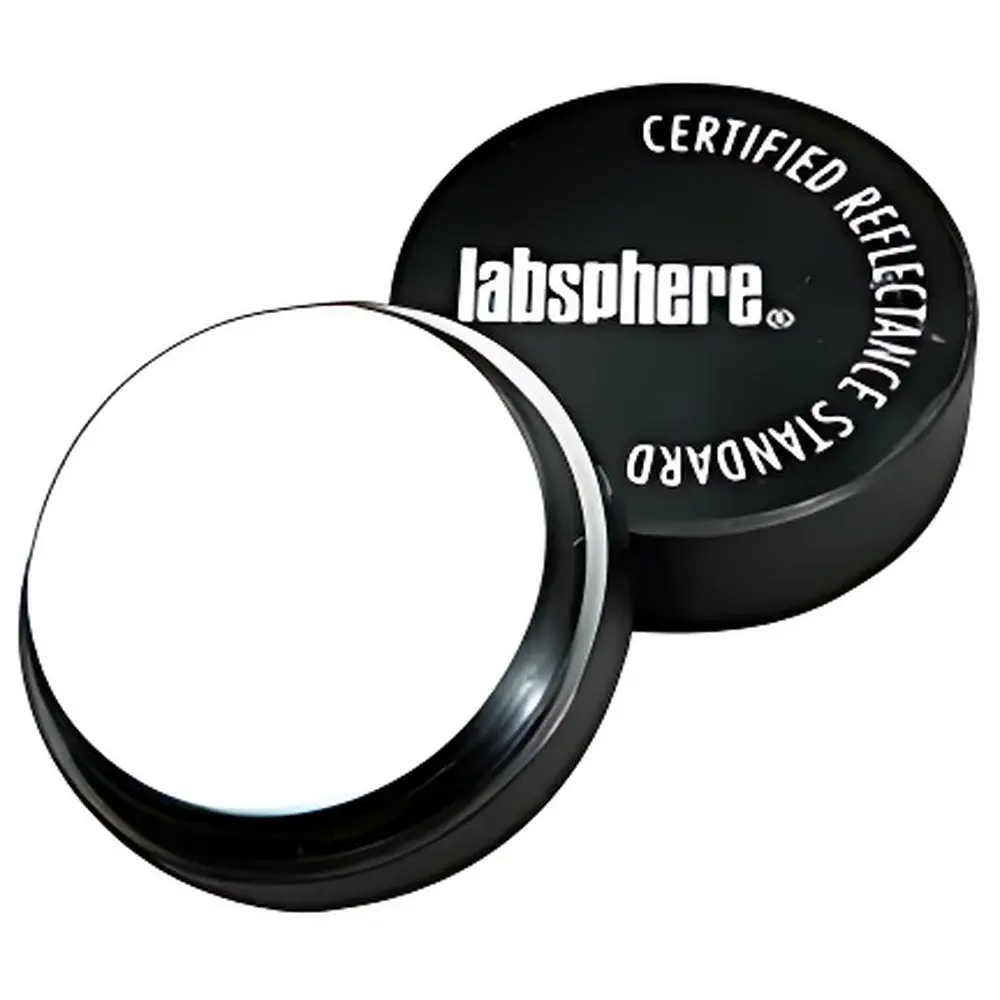
Labsphere WS-1 Standard Diffuse Reflectance Reference Whiteboard
| Brand | Labsphere |
|---|---|
| Origin | USA |
| Model | WS-1 |
| Component Type | Optical Reference Standard |
| Spectral Range | 250–2000 nm |
| Diffuse Reflectance | >98% (400–1500 nm), >95% (250–2000 nm) |
| Substrate Material | PTFE (Polytetrafluoroethylene) |
| Housing | Anodized Aluminum |
| Diameter (with housing) | 38 mm |
| Thickness | 10 mm |
| Weight | 30 g |
| Compliance | NIST-traceable calibration available (optional) |
Overview
The Labsphere WS-1 Standard Diffuse Reflectance Reference Whiteboard is a precision-engineered optical calibration standard designed for high-accuracy reflectance measurements in spectrophotometry, colorimetry, and remote sensing applications. It utilizes sintered polytetrafluoroethylene (PTFE) as the reflective surface — a material renowned for its near-perfect Lambertian scattering behavior, exceptional spectral neutrality, and long-term photostability. The WS-1 operates on the principle of diffuse reflectance standardization: by providing a known, highly stable, and spatially uniform reflectance baseline across ultraviolet, visible, and near-infrared (UV-VIS-NIR) wavelengths (250–2000 nm), it enables traceable correction of instrument response functions, stray light effects, and detector nonlinearity. Its engineered microstructure ensures minimal angular dependence and negligible polarization sensitivity — critical attributes for compliance with ASTM E308, ISO/CIE 11664, and USP optical measurement protocols.
Key Features
- Ultra-high diffuse reflectance: >98% between 400–1500 nm; >95% from 250–2000 nm — validated via NIST-traceable spectrophotometric characterization
- Lambertian surface geometry with <±0.3% spatial uniformity across active aperture (Ø32 mm)
- Chemically inert PTFE substrate — resistant to moisture, oxidation, and common laboratory solvents
- Anodized aluminum housing with precision-machined recess for secure mounting and edge protection
- Thermally stable performance: no measurable reflectance drift after thermal cycling from −20 °C to +60 °C
- Compatible with industry-standard holders including Labsphere RPH-1 and STAN-Holder for contamination-free handling and alignment
Sample Compatibility & Compliance
The WS-1 is optimized for use with integrating sphere-based spectrophotometers (e.g., PerkinElmer Lambda, Agilent Cary, Shimadzu UV-3600i), hyperspectral imagers, and bidirectional reflectance distribution function (BRDF) goniometers. Its spectral response meets the requirements of ISO 2768-1 (general tolerances), ASTM E259 (standard practice for preparation of reflectance standards), and supports GLP/GMP-compliant workflows when paired with NIST-traceable calibration certificates (available upon request). The PTFE surface conforms to FDA-recommended material safety guidelines for non-contact optical metrology in regulated environments. No outgassing or particulate shedding has been observed under vacuum conditions up to 1×10⁻⁵ Torr, making it suitable for aerospace-grade optical testing.
Software & Data Management
While the WS-1 itself is a passive reference standard, its integration into modern optical measurement systems leverages built-in software calibration routines in platforms such as Labsphere’s SpectraSuite, Ocean Insight’s OceanView, and Thermo Fisher’s OMNIC. These tools support automated reference acquisition, spectral deviation mapping, and time-stamped calibration logging — essential for audit readiness under 21 CFR Part 11. When used with instruments featuring spectral correction algorithms (e.g., stray-light compensation or detector linearity correction), the WS-1 serves as the foundational input for generating instrument-specific correction matrices. All calibration data generated using the WS-1 may be exported in CSV, XML, or HDF5 formats for third-party analysis and LIMS integration.
Applications
- Baseline correction and wavelength validation in UV-VIS-NIR spectrophotometers
- Calibration of hyperspectral sensors in agricultural monitoring, mineralogy, and environmental remote sensing
- Reference standard for reflectance factor (R%) determination per CIE Publication 15:2018
- Validation of BRDF models in optical coating development and solar absorber characterization
- Stability verification for accelerated aging studies of optical materials and coatings
- Supporting ASTM D2244 (color difference calculation) and ISO 11664-4 (colorimetric observers) protocols
FAQ
Is the WS-1 suitable for UV-C (190–280 nm) measurements?
The WS-1 exhibits measurable degradation below 250 nm due to PTFE photolysis; for deep-UV applications, Labsphere recommends the WS-1-SL variant with enhanced UV stability.
Can the WS-1 be cleaned if contaminated?
Yes — gentle rinsing with deionized water followed by nitrogen blow-drying is acceptable; avoid abrasive wiping or organic solvents which may alter surface morphology.
Does the aluminum housing affect spectral measurements?
No — the housing is fully recessed and optically masked; only the PTFE surface contributes to measured reflectance.
How often should the WS-1 be recalibrated?
Under controlled lab conditions (no mechanical abrasion or UV exposure beyond specification), annual verification against a NIST-traceable transfer standard is recommended per ISO/IEC 17025.
Is there a version with certified uncertainty values?
Yes — the optional NIST-traceable calibration certificate (NIST SRM 2036-equivalent) provides expanded uncertainty (k=2) of ±0.15% reflectance across 400–1500 nm.