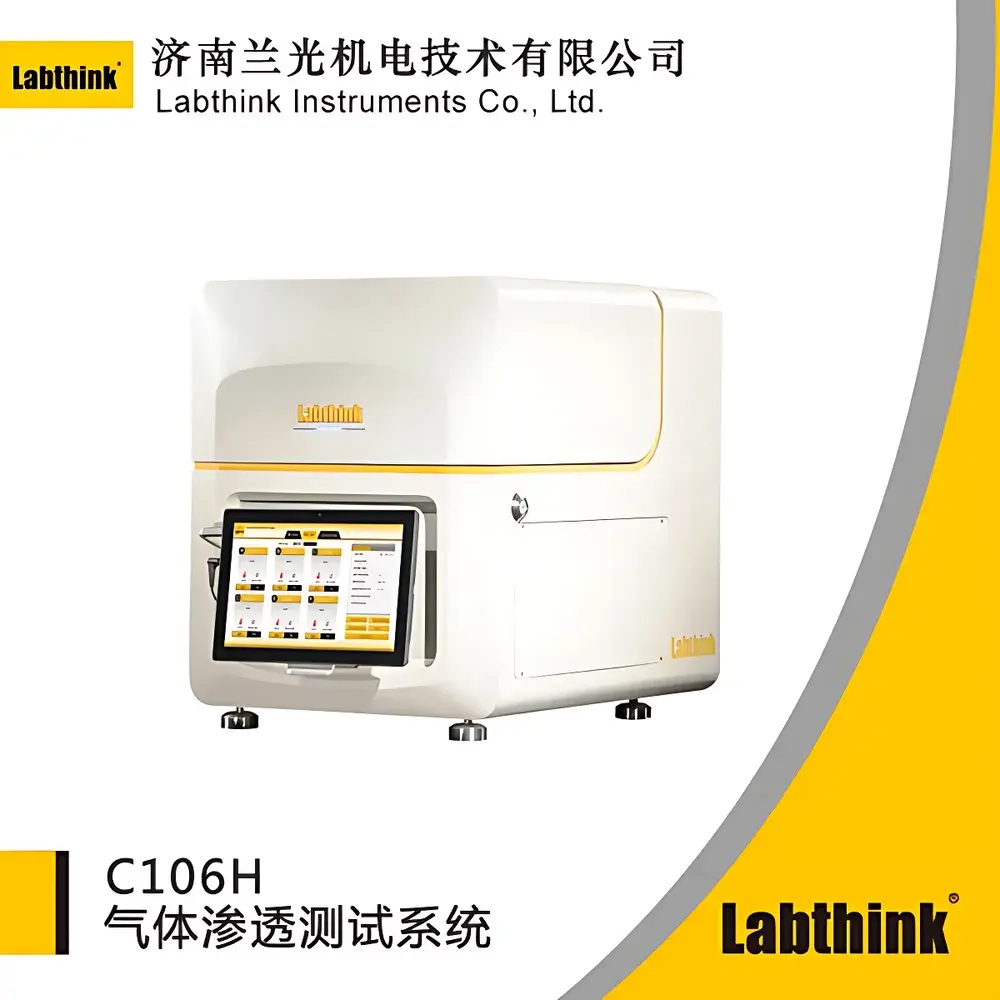
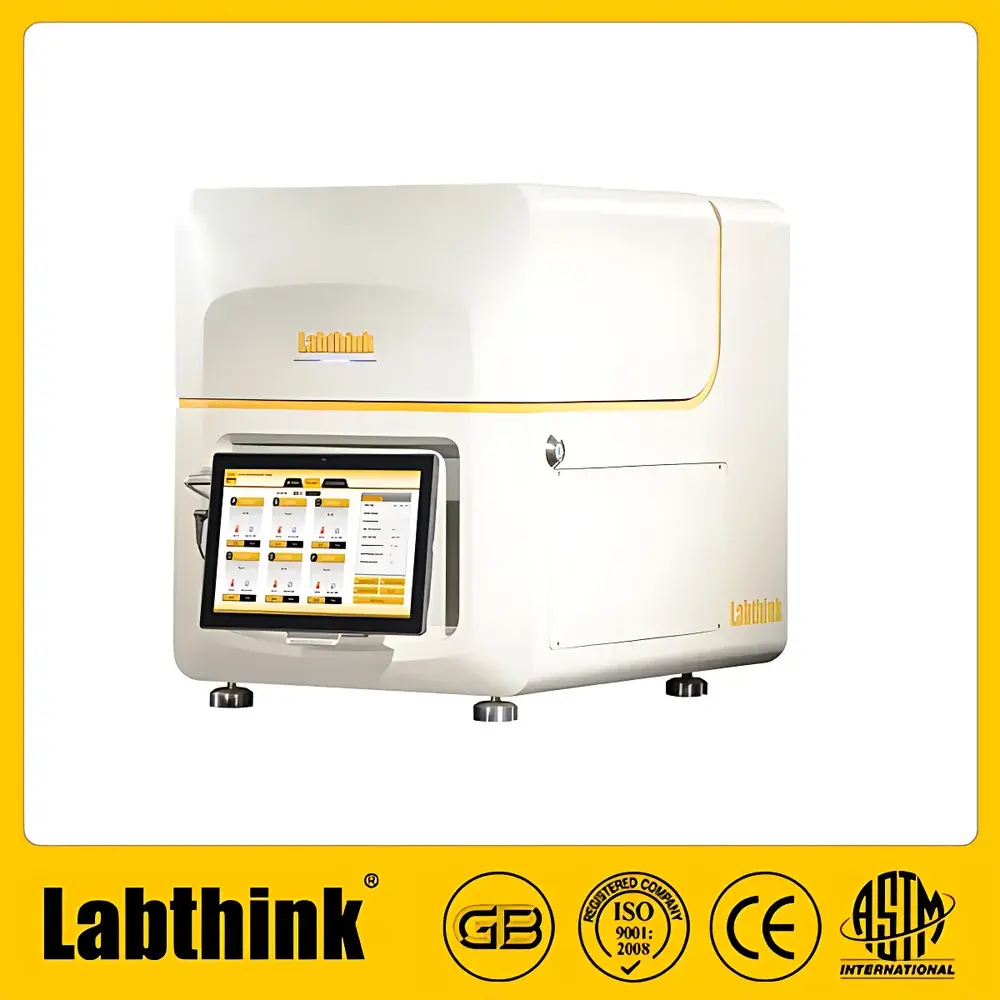
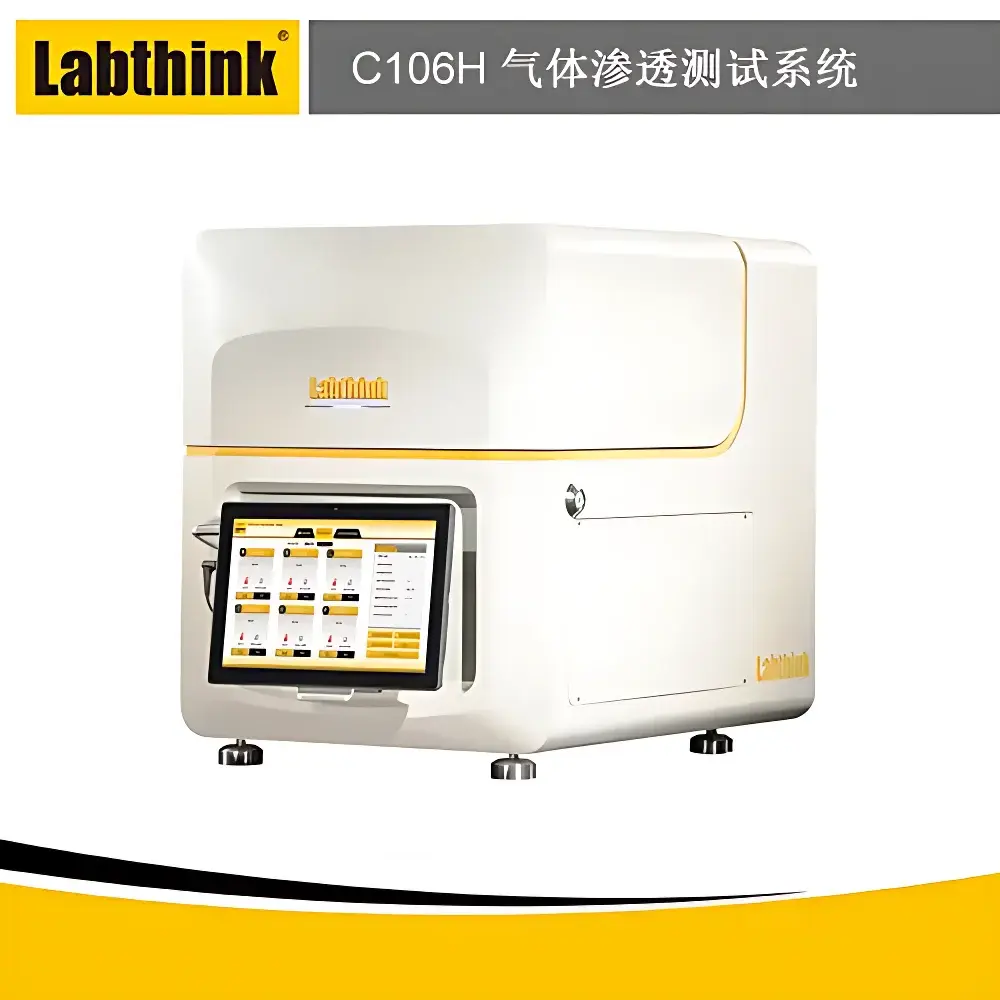
Labthink C106H Gas Permeability Tester for Infusion Bags, IV Membranes, and Multilayer Packaging Films
| Brand | Labthink |
|---|---|
| Origin | Shandong, China |
| Manufacturer Type | OEM/ODM Manufacturer |
| Country of Origin | China |
| Model | C106H |
| Price Range | USD 14,000 – 115,000 |
| Test Principle | Differential Pressure (Manometric) Method |
| Standards Compliance | ISO 15105-1, ISO 2556, GB/T 1038-2000, ASTM D1434, JIS K7126-1, YBB 00082003 |
| Test Gases | O₂, N₂, CO₂ (user-supplied) |
| Temperature Range | 15–50 °C (standard), 5–60 °C (optional) |
| Humidity Range | 0% RH (dry), 5–90% ±2% RH (optional) |
| Vacuum Resolution | 0.01 Pa |
| Vacuum Accuracy | ±0.2% of reading (1–100% of sensor span) |
| Test Chamber Vacuum Level | ≤10 Pa |
| Test Area | 38.48 cm² per chamber |
| Sample Size | 11.2 cm × 11.2 cm |
| Max Sample Thickness | 3 mm |
| Test Pressure Range | 10–150 kPa (adjustable) |
| Pressure Stability | ±0.2 kPa |
| Gas Transmission Rate (GTR) Range | 0.01–50,000 cm³/m²·24h·0.1MPa |
| GTR Resolution | 0.001 cm³/m²·24h·0.1MPa |
| Temperature Uniformity | ±0.15 °C |
| Chamber Configuration | 6 independent test chambers |
| Data Output | Permeability Coefficient (P), Diffusion Coefficient (D), Solubility Coefficient (S), GTR curves, P vs. T plots, real-time pressure/temperature logging |
| Software Features | CFR 21 Part 11 compliance package (optional), audit trail, user permission levels, electronic signatures, raw data export (CSV, PDF, XML) |
| Control Interface | 12-inch Windows-based touch tablet |
| Automation | Auto-clamping, auto-vacuum control, auto-pressure compensation, motorized lid actuation with audio-visual alert |
| Vacuum Pump | Imported high-vacuum pump, ultimate vacuum ≤0.2 Pa |
| Pneumatic System | Imported solenoid valves & actuators, MTBF >100,000 cycles |
| Thermal Management | 360° circumferential air-circulation heating, PID-controlled uniformity |
| Power Supply | 120 VAC ±10%, 60 Hz OR 220 VAC ±10%, 50 Hz (selectable) |
| Net Weight | 100 kg |
| Dimensions | 600 × 490 × 660 mm (W × D × H) |
Overview
The Labthink C106H Gas Permeability Tester is a high-precision, six-chamber differential pressure (manometric) system engineered for quantitative determination of gas transmission rate (GTR), permeability coefficient (P), diffusion coefficient (D), and solubility coefficient (S) in flexible packaging materials used across pharmaceutical, medical device, food, and specialty chemical industries. Designed specifically to meet the stringent barrier validation requirements for intravenous (IV) infusion bags, sterile barrier systems, and multilayer laminates, the instrument operates on the fundamental principle of Fick’s first law of diffusion under controlled transmembrane pressure gradients. A preconditioned specimen is sealed between two isolated chambers; the lower (vacuum) chamber is evacuated to ≤10 Pa, while the upper chamber is pressurized with test gas (e.g., O₂, N₂, or CO₂) at user-defined pressures from 10–150 kPa. The resulting gas flux through the film is monitored via high-stability vacuum transducers, enabling calculation of all primary permeation parameters with traceable metrological integrity. Its architecture supports both routine QC screening and advanced R&D characterization—particularly critical for ultra-high-barrier materials where GTR values fall below 0.1 cm³/m²·24h·0.1MPa.
Key Features
- Six independent test chambers—triple the throughput of conventional single- or dual-chamber instruments—enabling parallel analysis of identical or heterogeneous samples under identical environmental conditions.
- 360° circumferential air-circulation thermal system ensures ±0.15 °C temperature stability across all chambers, eliminating edge-to-center thermal gradients that compromise measurement reproducibility.
- Imported high-resolution vacuum sensors (0.01 Pa resolution, ±0.2% accuracy) and ultra-low-leakage pneumatic circuitry guarantee reliable quantification of ultra-low-permeability films—including AlOx-coated PET, SiOx-deposited PP, and EVOH-based laminates.
- Automated pressure-compensation algorithm maintains high-side pressure within ±0.2 kPa during extended tests, minimizing drift-induced error in low-flux measurements.
- Motorized, acousto-optically signaled sample clamp mechanism delivers repeatable sealing force (±2% variation), eliminating operator-dependent variability in leak-path formation.
- Integrated 12-inch Windows-based touchscreen interface enables full test configuration, real-time monitoring, and post-run curve analysis without external PC dependency.
- Modular vacuum pump subsystem (ultimate vacuum ≤0.2 Pa) features automatic start/stop logic synchronized with test phase transitions—reducing energy consumption and mechanical wear.
Sample Compatibility & Compliance
The C106H accommodates flat, non-porous specimens up to 3 mm thick and 11.2 cm × 11.2 cm in dimension—including plastic films (LDPE, HDPE, PP, PET, PA), metallized substrates (Al-coated PET, foil-laminates), coextrusions (EVOH/PA/PP), pharmaceutical-grade IV bag films (PVC, TPE, polyolefin blends), and rigid sheets (PVC, PVDC, silicone rubber). All testing protocols align with internationally recognized standards: ISO 15105-1 (plastics—determination of gas transmission rate—part 1: differential pressure method), ISO 2556 (gas transmission rate of plastics—manometric method), ASTM D1434 (standard test method for determining gas permeability characteristics), GB/T 1038-2000 (Chinese national standard for plastic film gas permeability), JIS K7126-1, and YBB 00082003 (Chinese pharmaceutical packaging standard for infusion containers). Optional configurations support GLP/GMP-aligned operation, including CFR 21 Part 11-compliant software modules with electronic signatures, role-based access control, and immutable audit trails.
Software & Data Management
The embedded Labthink PermeaSoft™ v4.2 platform provides intuitive workflow navigation, multi-level user authentication, and comprehensive data governance. Real-time visualization includes dynamic GTR vs. time plots, permeability coefficient temperature-dependence curves (Arrhenius analysis), and pressure/temperature overlay graphs. Raw data files are stored in timestamped, encrypted binary format with metadata tagging (operator ID, calibration status, environmental logs). Export options include CSV (for statistical analysis in JMP or Minitab), PDF reports (with embedded digital signatures), and XML (for LIMS integration). When configured with the DataShield™ module, the system enforces ALCOA+ principles—ensuring data attribution, legibility, contemporaneous recording, originality, accuracy, completeness, consistency, endurance, and availability per FDA and EMA expectations.
Applications
- Pharmaceutical packaging validation: Quantifying O₂ ingress into IV bags to ensure drug stability and shelf-life prediction per ICH Q5C guidelines.
- Medical device pouch qualification: Measuring CO₂ transmission through Tyvek®/PET laminates used in sterilization packaging.
- Food packaging development: Benchmarking N₂ barrier performance of snack pouches containing oxygen-sensitive lipids.
- Material R&D: Correlating polymer crystallinity (via DSC) with O₂ diffusion coefficients in novel bio-based films.
- Regulatory submission support: Generating auditable datasets compliant with USP , EP 3.2.1, and ISO 11607-1 Annex A for packaging integrity dossiers.
- Supplier qualification: Cross-lot comparison of barrier performance across resin batches or extrusion lines.
FAQ
What gases can be tested with the C106H?
Standard configurations support O₂, N₂, and CO₂ using user-supplied gas cylinders. Custom variants accommodate H₂ and CH₄ with modified safety interlocks and explosion-proof components.
Is humidity control available?
Yes—relative humidity can be regulated from 0% to 90% ±2% RH within the test chamber when equipped with the optional humidification module.
How does the six-chamber design improve efficiency?
It allows simultaneous measurement of six replicates or six different materials under identical thermal and pressure conditions—reducing total qualification time by up to 83% versus sequential single-chamber testing.
Can the system comply with 21 CFR Part 11?
Yes—when ordered with the CFR 21 Part 11 software package, it provides full electronic record and signature functionality, including audit trail generation, user permissions, and data encryption.
What maintenance is required for long-term accuracy?
Annual recalibration of vacuum sensors and temperature probes is recommended; vacuum pump oil replacement every 2,000 operating hours; and routine inspection of O-rings and clamping surfaces per Labthink’s Preventive Maintenance Schedule.