
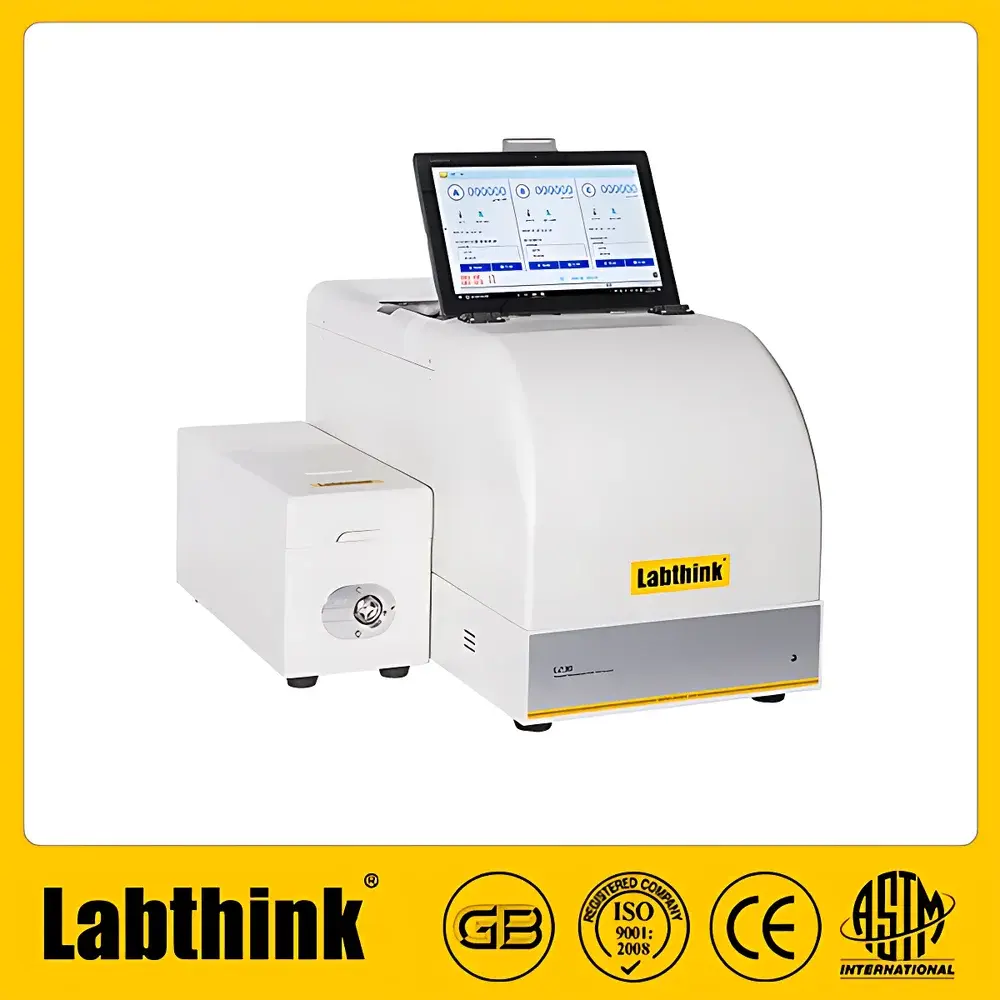
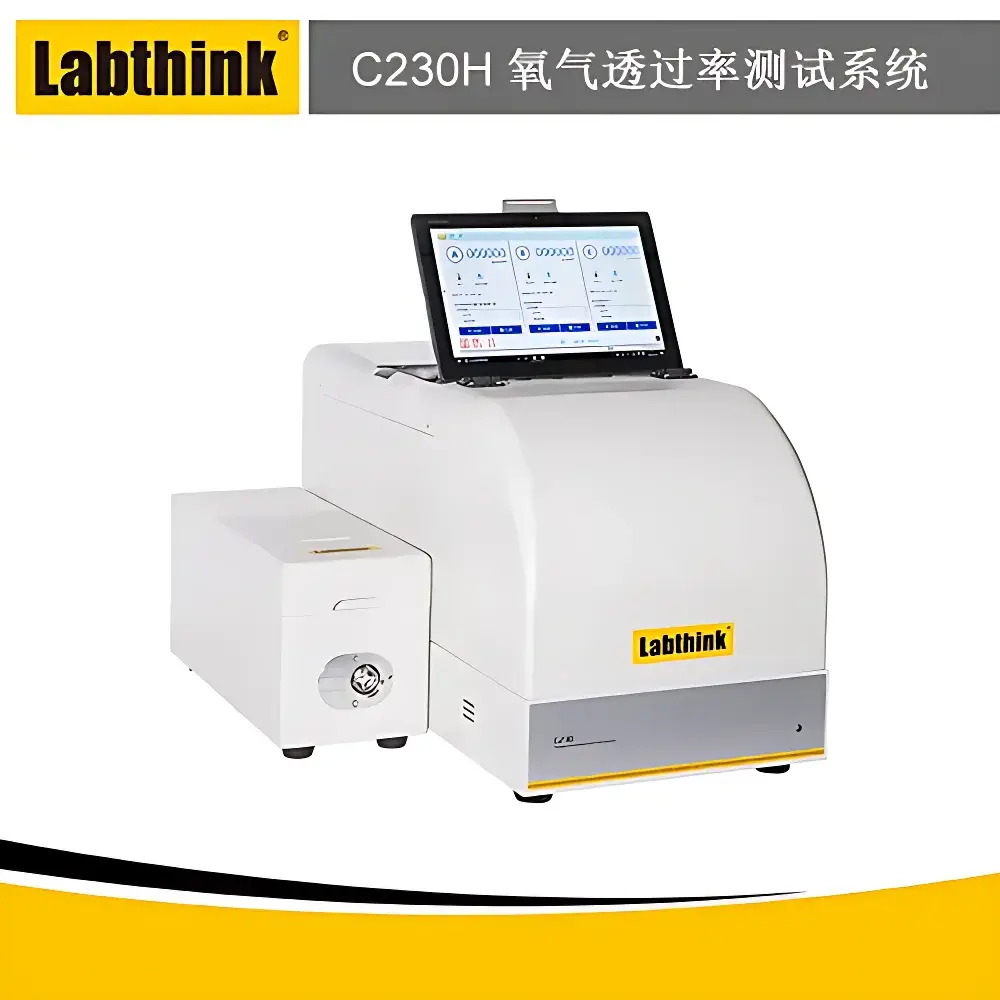
Labthink C230H Oxygen Transmission Rate (OTR) Tester for Food Containers and Rigid Packaging
| Brand | Labthink |
|---|---|
| Model | C230H |
| Origin | Shandong, China |
| Manufacturer Type | OEM/ODM Producer |
| Country of Origin | China |
| Price Range | USD 14,000 – 85,000 |
| Test Principle | Isobaric Method with Coulometric Oxygen Sensor |
| Standards Compliance | ASTM D3985, ASTM F1307, ASTM F1927 (optional), GB/T 19789, GB/T 31354, DIN 53380-3, JIS K7126-2-B, YBB 00082003-2015 |
| Test Range | 0.01–200 cm³/(m²·day) [film] |
| Resolution | 0.001 cm³/(m²·day) |
| Repeatability | ±0.01 cm³/(m²·day) or ±2%, whichever is greater |
| Temperature Control | 10–55 °C (±0.2 °C) |
| Humidity Control | 0–90% RH (±1% RH), 100% RH (optional) |
| Test Chambers | 3 independent chambers |
| Sample Area | 50 cm² (standard) |
| Max. Sample Size | 108 mm × 108 mm |
| Max. Thickness | ≤3 mm |
| Package Testing Capacity | up to 3 L |
| Carrier Gas | ≥99.999% high-purity N₂ |
| Inlet Pressure | ≥0.28 MPa (40.6 psi) |
| Gas Interface | 1/8″ stainless steel tubing |
| Optional Features | DataShield™ Data Integrity System, CFR 21 Part 11 Compliance Module, GMP Computer System Validation Support, Package Testing Mode |
Overview
The Labthink C230H Oxygen Transmission Rate (OTR) Tester is an isobaric, coulometric-sensor-based instrumentation platform engineered for precise, reproducible, and regulatory-compliant oxygen permeability assessment of flexible films, rigid packaging, and formed containers—including plastic bowls used for ambient-stable food products such as eight-treasure porridge. It operates on the fundamental principle of oxygen diffusion across a barrier material under controlled temperature and relative humidity conditions: oxygen flows on one side of the specimen while high-purity nitrogen sweeps the opposite side, carrying permeated O₂ molecules to a coulometric sensor for quantitative electrochemical detection. This method—standardized in ASTM D3985 for planar materials and ASTM F1307 for package-level testing—ensures traceable, physicochemically grounded measurement of oxygen transmission, critical for shelf-life prediction, formulation validation, and barrier integrity verification in regulated industries.
Key Features
- Tri-chamber isobaric architecture: Three thermally and hygroscopically isolated test chambers housed within a single monolithic test block, designed using computational fluid dynamics (CFD) and thermodynamic modeling to minimize inter-chamber variance in temperature (±0.2 °C), humidity (±1% RH), and gas flow distribution.
- Independent environmental monitoring: Each chamber integrates dedicated platinum resistance thermometer (PRT) and capacitive RH sensors, enabling real-time feedback control and per-chamber data logging for audit-ready traceability.
- Flexible test configuration: Supports simultaneous evaluation of three identical specimens (for statistical replication per ISO/IEC 17025 and USP <1207>), or three dissimilar specimens (e.g., varying seal types, lid materials, or molding batches) under identical environmental conditions.
- Automated climate control: Integrated Peltier-based heating/cooling and ultrasonic humidification/dehumidification subsystems maintain setpoint stability without manual intervention across the full operational range (10–55 °C / 0–90% RH).
- Embedded industrial computing: Powered by an Intel Core i5 processor running Windows 10 IoT Enterprise, the system delivers deterministic real-time control, touch-enabled operation via a 12″ capacitive display, and native support for USB peripherals, network printers, and external storage devices.
Sample Compatibility & Compliance
The C230H accommodates planar specimens up to 108 mm × 108 mm and ≤3 mm thick—including oriented polypropylene (OPP), polyethylene terephthalate (PET), ethylene vinyl alcohol (EVOH)-based coextrusions, aluminum-laminated structures, and metallized polyester—and extends to rigid and semi-rigid packages up to 3 L volume (e.g., thermoformed plastic bowls, cup-and-film lidded systems, injection-molded containers). Its mechanical clamping design ensures uniform edge sealing without deformation-induced artifacts. The system conforms to international regulatory frameworks: test protocols align with ASTM D3985 (film), ASTM F1307 (packages), and Chinese pharmacopoeial standard YBB 00082003-2015 for pharmaceutical packaging. Optional CFR 21 Part 11 compliance modules provide electronic signature enforcement, audit trail generation, and role-based access control—fully compatible with GLP and GMP quality systems.
Software & Data Management
Control and analysis are managed through Labthink’s proprietary OTRSoft™ v4.x application, which supports both automated routine testing and advanced parameter scripting. All raw sensor outputs, environmental logs, and calculated OTR values are timestamped and stored in an encrypted local SQLite database. The optional DataShield™ module implements AES-256 encryption, digital watermarking, and immutable export to CSV, PDF/A-2, or XML formats compliant with ISO 11140-5 and FDA eCTD requirements. Network integration includes Ethernet (RJ45), Wi-Fi (802.11ac), and OPC UA server capability for MES/SCADA interoperability. Audit trails record operator ID, method version, calibration events, and any parameter override—retained for ≥36 months per ALCOA+ principles.
Applications
Primary use cases span food packaging R&D and QC: quantifying OTR of eight-treasure porridge bowls to validate shelf-life models under accelerated aging; benchmarking barrier performance of mono-material PP versus multi-layer PP/EVOH bowls; verifying seal integrity of heat-sealed film lids; and assessing oxygen ingress into vacuum-packed or modified-atmosphere packaged goods. Beyond food, the platform serves pharmaceutical primary packaging (blister cavities, HDPE bottles), medical device pouches (ISO 11607-1), photovoltaic backsheet laminates (IEC 61215), automotive fuel tanks (SAE J1742), and lithium-ion battery enclosures where oxidative degradation compromises safety or cycle life. Method flexibility allows adaptation to emerging substrates—including bio-based polymers, nanocomposites, and plasma-coated surfaces—without hardware modification.
FAQ
What standards does the C230H comply with for food packaging OTR testing?
ASTM D3985 (planar films), ASTM F1307 (rigid/semi-rigid packages), GB/T 19789 and GB/T 31354 (Chinese national standards), and YBB 00082003-2015 (pharmaceutical packaging).
Can the instrument test irregularly shaped containers like octagonal porridge bowls?
Yes—the chamber design accommodates non-cylindrical geometries up to 3 L volume, provided the opening can be sealed pneumatically against the test head gasket.
Is carrier gas included with the system?
No—users must supply ≥99.999% high-purity nitrogen from an external source meeting ISO 8573-1 Class 1 purity requirements.
Does the system support 21 CFR Part 11 compliance out-of-the-box?
CFR 21 Part 11 functionality is available as an optional validated software/hardware bundle, including electronic signatures, audit trail archiving, and system access controls.
How is measurement repeatability verified during routine operation?
Repeatability is confirmed daily using certified reference films (e.g., NIST-traceable PET standards) and logged automatically within the DataShield™ audit trail.
Related Products





