
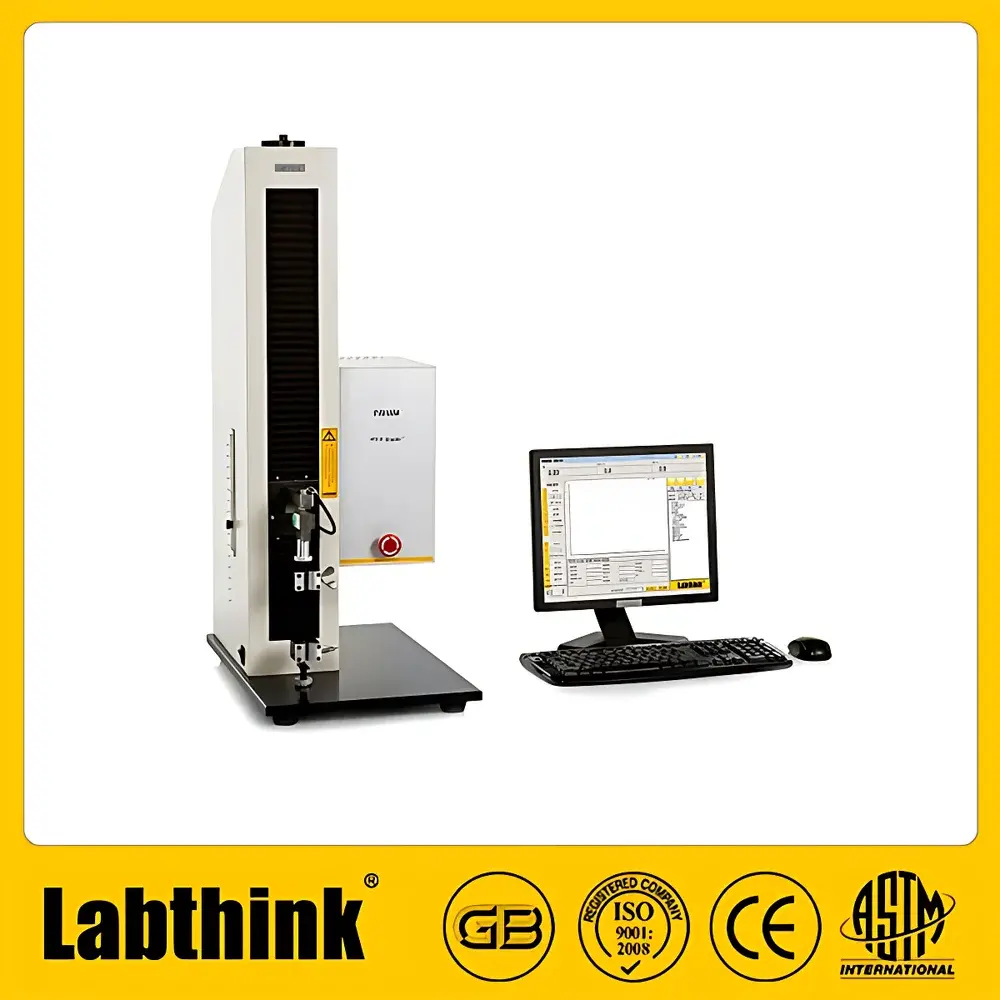
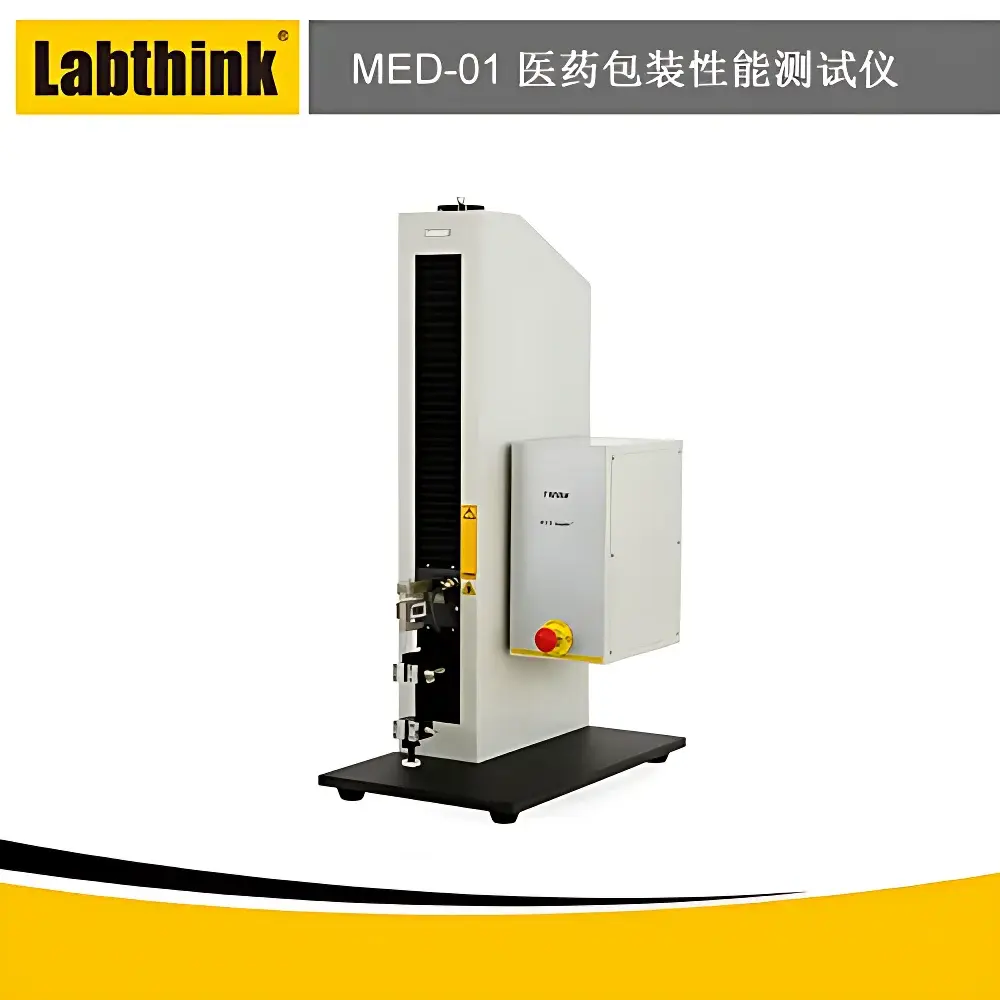
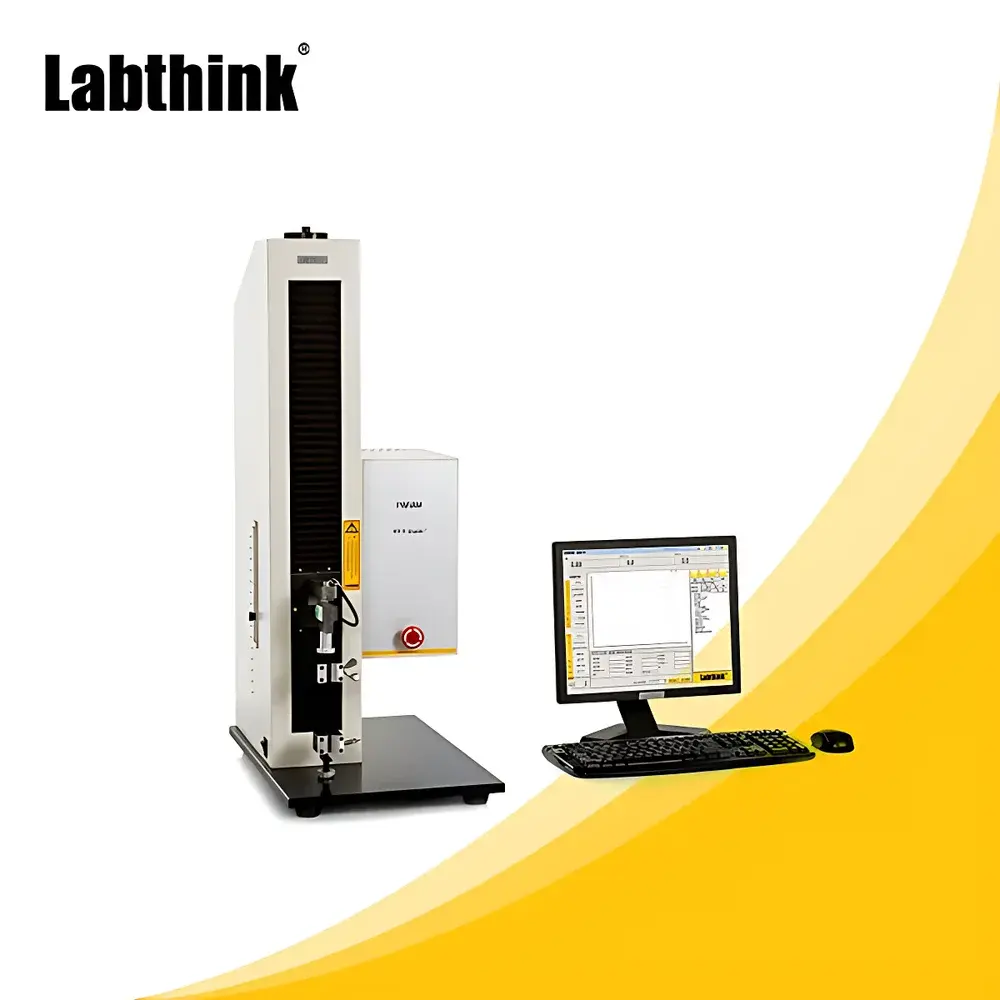
Labthink MED-01 Ampoule Break-Force Tester
| Brand | Labthink |
|---|---|
| Model | MED-01 |
| Force Range | 250 N (standard) |
| optional | 50 N, 100 N, 500 N |
| customizable | 750 N, 1000 N |
| Accuracy | Better than Class 0.5 per ISO 376 |
| Test Speed (Approach/Return) | 10, 50, 100, 150, 200, 300 mm/min (standard) |
| Sample Width | 30 mm (standard fixture), 50 mm (optional) |
| Sample Holder | Manual clamping |
| Maximum Travel | 600 mm |
| Dimensions (L×W×H) | 851 × 500 × 940 mm |
| Power Supply | 220 VAC 50 Hz / 120 VAC 60 Hz |
| Net Weight | 68 kg |
| Compliance | GB 2637–2014, YBB 00332002–2015 |
Overview
The Labthink MED-01 Ampoule Break-Force Tester is a precision mechanical testing instrument engineered for quantitative evaluation of the break-force required to separate the neck from the body of pharmaceutical glass ampoules. It operates on a controlled uniaxial bending principle: the ampoule is positioned horizontally between two parallel, rigid support anvils aligned perpendicular to its central axis; a vertically applied compressive load is incrementally increased at a defined crosshead speed until fracture occurs at the scored neck region. The peak force recorded—expressed in newtons (N)—represents the ampoule’s break-force, a critical mechanical parameter directly linked to user safety, dose accuracy, and compliance with regulatory packaging performance requirements. Designed specifically for quality control laboratories in pharmaceutical manufacturing, contract development and manufacturing organizations (CDMOs), and regulatory testing facilities, the MED-01 delivers repeatable, traceable, and auditable mechanical data essential for validation protocols under Good Manufacturing Practice (GMP) and ISO 13485 frameworks.
Key Features
- Modular force transducer architecture supporting standard 250 N capacity, with factory-calibrated options ranging from 50 N to 1000 N to accommodate diverse ampoule formats (e.g., 1 mL, 2 mL, 5 mL, 10 mL, and 20 mL types).
- Class 0.5 force measurement accuracy per ISO 376, verified via accredited calibration certificates traceable to national metrology institutes (e.g., NIM, NIST).
- Six-step programmable test speed selection (10–300 mm/min) for both approach and return phases, enabling method alignment with pharmacopoeial guidance and internal SOPs.
- Manually operated, ergonomic sample holder with fixed 30 mm width anvil spacing (50 mm option available) ensures consistent positioning of cylindrical ampoules without axial rotation or slippage.
- Rigid cast-iron frame and linear-motion guide system minimize deflection and vibration, contributing to high reproducibility across repeated measurements (RSD < 1.2% for intra-batch n = 10).
- Dual-voltage power supply (220 VAC 50 Hz / 120 VAC 60 Hz) facilitates global deployment without external transformers.
Sample Compatibility & Compliance
The MED-01 is validated for use with all standard Type I, II, and III borosilicate glass ampoules conforming to Ph. Eur. 3.2.1 and USP . It supports vials with nominal capacities from 1 mL to 20 mL, including those featuring color-coded scoring rings or laser-scored break-lines. The instrument satisfies mandatory mechanical testing requirements specified in GB 2637–2014 (“Glass Ampoules for Pharmaceutical Use”) and YBB 00332002–2015 (“Controlled-Release and Immediate-Release Dosage Forms – Glass Ampoules”), which define upper and lower break-force limits based on ampoule volume and wall thickness. While not a standalone GLP-compliant system, the MED-01 serves as a foundational component in GLP/GMP-aligned test workflows when paired with documented calibration records, equipment logs, and operator training verification.
Software & Data Management
The MED-01 operates in stand-alone mode with an integrated digital display showing real-time load (N), displacement (mm), and test status. Force–displacement curves are not stored internally; however, analog output (±10 V) and RS232 serial interface enable seamless integration with third-party data acquisition systems (e.g., LabVIEW, MATLAB, or LIMS platforms). Users may export timestamped force-at-fracture values in CSV format for statistical process control (SPC) analysis, trend reporting, and audit-ready documentation. For full 21 CFR Part 11 compliance—including electronic signatures, audit trails, and user access controls—integration with Labthink’s optional TS2100 TestSuite software is recommended.
Applications
- Verification of ampoule break-force consistency during incoming raw material inspection of primary packaging components.
- Stability study support: monitoring changes in break-force after accelerated aging (e.g., 40 °C/75% RH for 6 months) to assess glass embrittlement or score degradation.
- Process validation of ampoule manufacturing lines, particularly post-annealing and scoring station adjustments.
- Comparative evaluation of alternative glass suppliers or scoring methodologies (mechanical vs. laser).
- Root cause analysis of field complaints related to difficult opening or unintended breakage during clinical administration.
- Supporting submissions to regulatory agencies (e.g., NMPA, EMA, FDA) requiring mechanical performance data for Type II Drug Master Files (DMFs).
FAQ
What standards does the MED-01 comply with?
The instrument meets the mechanical test configuration and performance criteria outlined in GB 2637–2014 and YBB 00332002–2015. It is also compatible with test setups referenced in Ph. Eur. 3.2.1 Annex and USP general chapter requirements.
Is calibration certification included with delivery?
Yes—each unit ships with a factory calibration certificate traceable to China National Institute of Metrology (NIM), covering the installed force range at three points (20%, 60%, and 100% of full scale).
Can the MED-01 test plastic or polymer-based ampoules?
No—the device is optimized for rigid, brittle glass substrates exhibiting linear-elastic-to-brittle fracture behavior. Polymeric containers require different test geometries and load profiles, and are outside the scope of this instrument’s design intent.
What maintenance is required?
Routine maintenance includes monthly visual inspection of anvils for wear or deformation, biannual lubrication of lead screws, and annual recalibration by an accredited service provider.
Is technical support available in English for international users?
Yes—Labthink provides multilingual documentation (English, Spanish, German, Japanese), remote troubleshooting, and on-site service coordination through authorized regional partners.





