
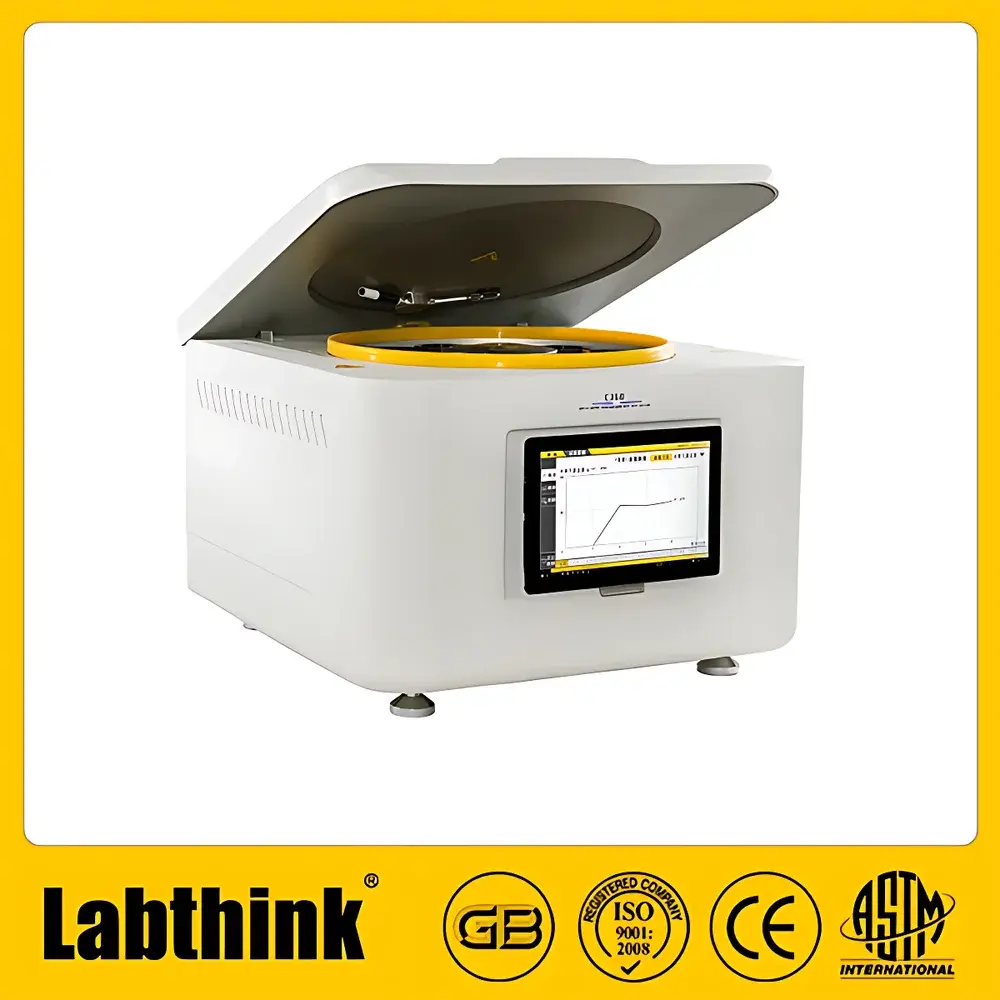
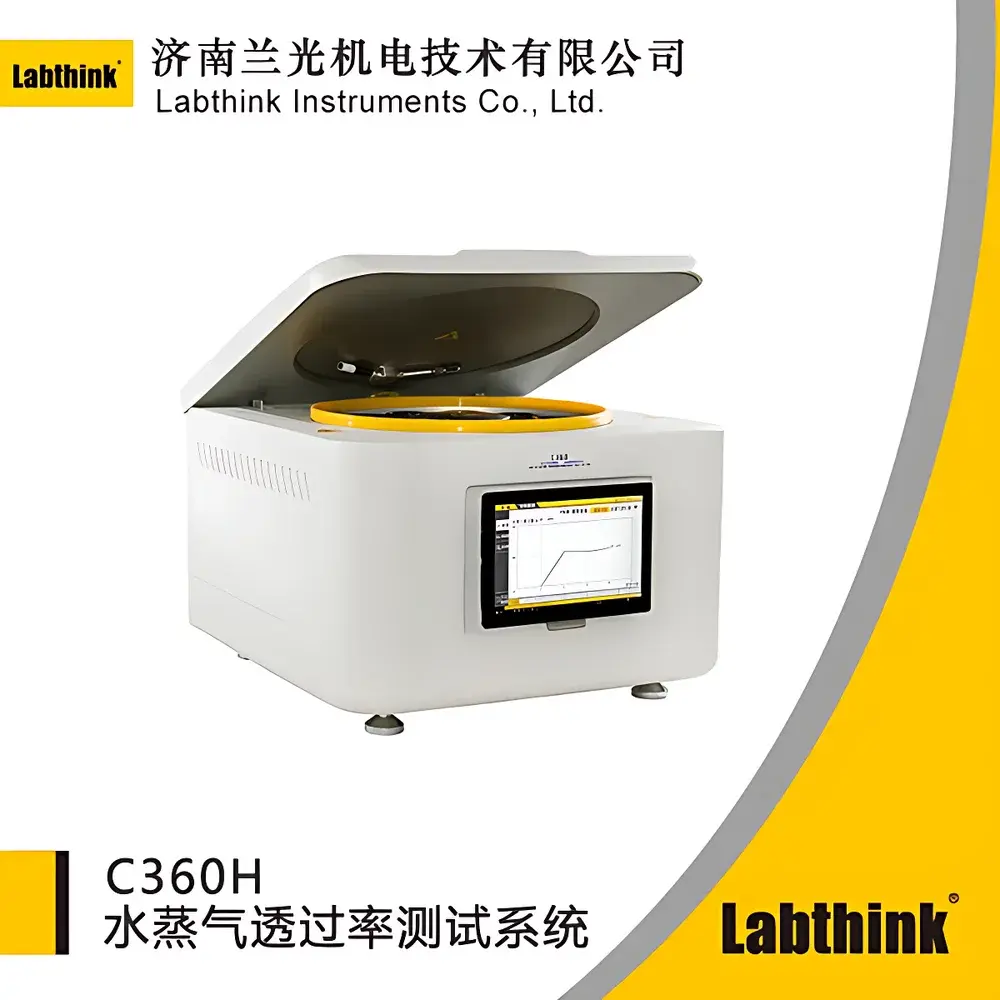
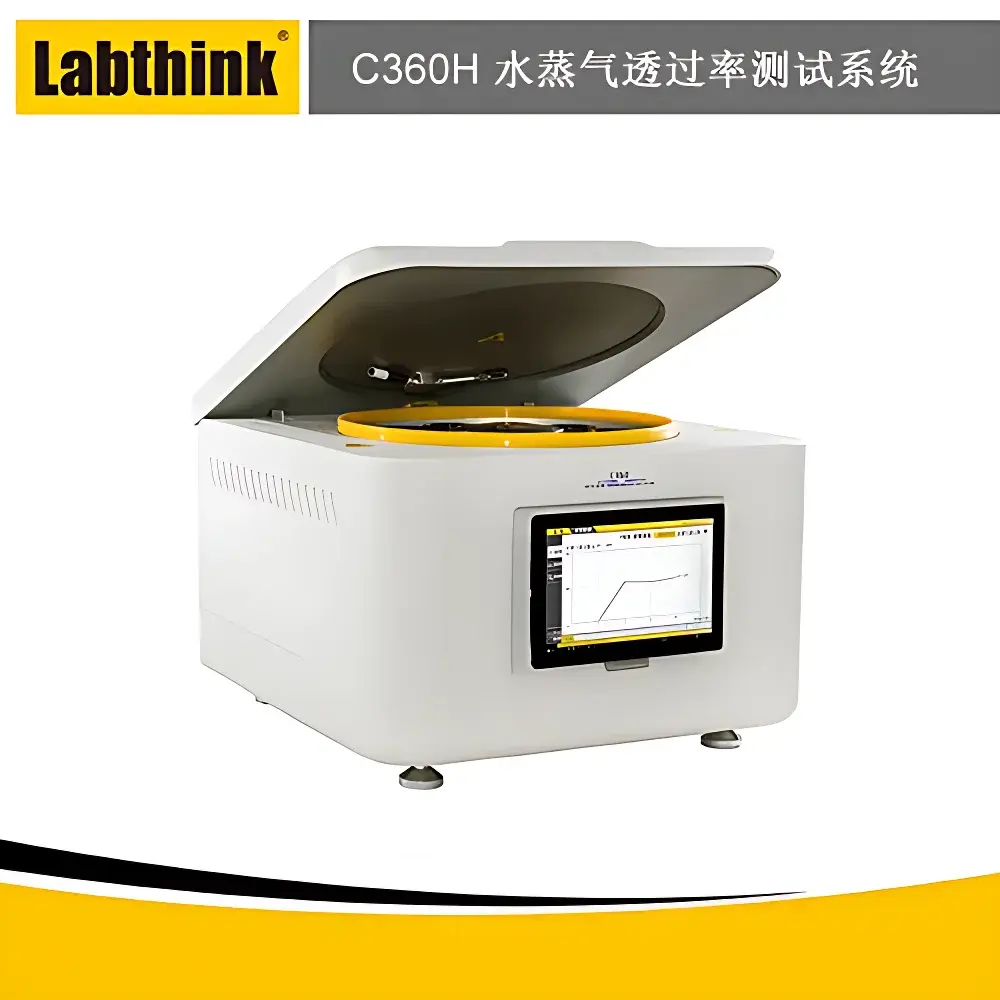
Labthink C360H Gravimetric Water Vapor Transmission Rate Tester (YBB00092003-2015 Compliant)
| Brand | Labthink |
|---|---|
| Origin | Shandong, China |
| Manufacturer Type | Direct Manufacturer |
| Country of Origin | China |
| Model | C360H |
| Testing Methods | Gravimetric Gain & Loss Modes |
| Maximum WVTR (Loss Mode) | 10,000/n g/(m²·day) (n = 1–12) |
| Maximum WVTR (Gain Mode) | 1,200 g/(m²·day) per station |
| Test Stations | 12 |
| Temperature Range | 20–55 °C ±0.2 °C |
| Humidity Range | 10–90 %RH ±1 %RH |
| Sample Diameter | Φ74 mm |
| Sample Thickness | ≤3 mm |
| Test Area | 33 cm² |
| Carrier Gas | Compressed Air (≥0.6 MPa) |
| Desiccant System | Core-free Long-life Dryer (20,000 h service life) |
| Humidification | Fog-free Integrated Humidifier |
| Data Management | DataShield™ Audit-Trail-Enabled Software |
| Regulatory Options | Optional 21 CFR Part 11 Compliance Package |
| GMP Computer System Validation Support | Optional |
Overview
The Labthink C360H Gravimetric Water Vapor Transmission Rate (WVTR) Tester is an ASTM E96-23 and GB/T 1037-compliant instrumentation platform engineered for precise, reproducible measurement of water vapor permeation through packaging materials used in pharmaceutical, medical device, food, and personal care applications. It implements the gravimetric principle—either weight gain (moisture ingress into desiccated test cups) or weight loss (evaporation from water-filled cups)—to quantify mass change over time under rigorously controlled thermal and hygrometric conditions. Designed specifically to meet the stringent requirements of Chinese Pharmacopoeia YBB00092003-2015 for pharmaceutical packaging material qualification, the C360H delivers traceable, standards-aligned data essential for regulatory submissions, stability protocol development, and barrier performance benchmarking. Its dual-mode capability enables accurate characterization across the full spectrum of barrier properties—from ultra-high-barrier aluminum-laminates (WVTR 100 g/m²·day)—without hardware reconfiguration.
Key Features
- 12 independent, parallel test stations with real-time individual mass monitoring via high-resolution electromagnetic force compensation balances (resolution ≤0.1 mg), ensuring statistical robustness and throughput efficiency.
- Patented 3D spatial temperature uniformity control system maintains ±0.2 °C stability across the entire test chamber volume (20–55 °C range), eliminating thermal gradients that compromise diffusion kinetics.
- Fog-free active humidity generation and core-free desiccant modules provide continuous, maintenance-free RH control (10–90 %RH ±1 %RH) for durations exceeding 30 days—critical for low-permeability material validation.
- Automated airflow profiling adjusts laminar sweep velocity in real time to match sample surface resistance, optimizing boundary layer management per ASTM E96 Annex A4.
- Integrated 12-inch Windows 10 industrial touchscreen interface with preloaded method templates, automatic calibration logging, and embedded diagnostics reduces operator dependency and training overhead.
- Modular DataShield™ software architecture supports ALCOA+ data integrity principles, including electronic signatures, audit trails, role-based access control, and encrypted local/cloud backup.
Sample Compatibility & Compliance
The C360H accommodates rigid and flexible substrates up to 3 mm thickness and 74 mm diameter—including blister foils, cold-forming aluminum, PVC/PVDC laminates, polymer films (PET, PP, PE), coated papers, Tyvek®, and multilayer pouch structures. All mechanical clamping, sealing, and environmental conditioning subsystems conform to ISO/IEC 17025 metrological traceability requirements. The system is pre-validated against pharmacopeial monographs YBB00092003-2015 and USP , and supports full IQ/OQ/PQ documentation packages aligned with EU Annex 11 and FDA guidance on computerized system validation. Optional CFR 21 Part 11 compliance includes electronic signature workflows, immutable audit logs, and system-level permission hierarchies meeting GLP/GMP data governance mandates.
Software & Data Management
DataShield™ v4.2 operates as a standalone or network-deployed application supporting CSV, XML, PDF, and LIMS-compatible ASTM E1384 export formats. It enforces automated calculation of WVTR (g/m²·day), transmission rate coefficient (g·mm/m²·day·kPa), and permeability index per ISO 2528:2019. All raw mass/time datasets are timestamped, digitally signed, and stored with hash-verified integrity. The software integrates with enterprise SQL databases and supports RESTful API calls for automated report ingestion into QMS platforms such as TrackWise or Veeva Vault. Built-in uncertainty propagation modeling calculates combined standard uncertainty (k=2) for each reported WVTR value based on balance repeatability, temperature/humidity sensor drift, and area measurement tolerances.
Applications
- Pharmaceutical primary packaging qualification per ICH Q5C and Q1A(R2) stability guidelines.
- Comparative barrier screening of novel polymer blends and nanocomposite coatings during formulation development.
- Accelerated aging correlation studies linking WVTR to product moisture content drift in real-time stability chambers.
- Root cause analysis of blister pack delamination or tablet caking incidents via retrospective WVTR trend analysis.
- Contract laboratory testing services requiring ISO/IEC 17025-accredited reporting for global regulatory filings (EMA, PMDA, Health Canada).
- Medical device packaging validation per ISO 11607-1:2019 clause 7.2.2 for sterile barrier systems.
FAQ
What standards does the C360H directly support?
ASTM E96 (Procedure A/B), GB/T 1037, GB/T 16928, ISO 2528, TAPPI T464, DIN 53122-1, and YBB00092003-2015.
Can the system validate ultra-high-barrier materials (WVTR < 0.005 g/m²·day)?
Yes—via extended-duration gain-mode testing (up to 30 days) with integrated drift-compensation algorithms and environmental noise suppression filters.
Is remote monitoring and multi-user access supported?
Yes—through optional DataShield™ Enterprise Server deployment with TLS 1.3 encryption, SSO integration, and concurrent license management.
How is calibration traceability maintained?
All sensors undergo annual third-party calibration accredited to ISO/IEC 17025; balance verification uses NIST-traceable stainless steel weights certified to Class E2 tolerance.
Does the system support audit-ready electronic records for FDA inspections?
With the optional 21 CFR Part 11 package, it provides complete electronic record lifecycle management—including creation, modification, retention, and retrieval—with full audit trail visibility and e-signature enforcement.






